Home >> Topics >> Chemical Thermodynamics
Unattempted Questions
Questions Available: 18
Year: 2021
Topic: Chemical Thermodynamics
1.
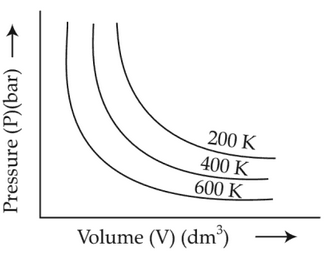
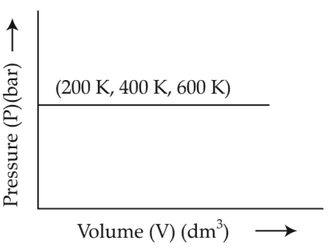
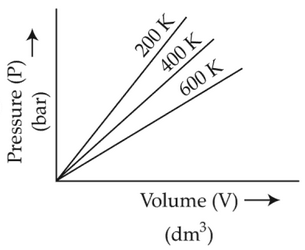
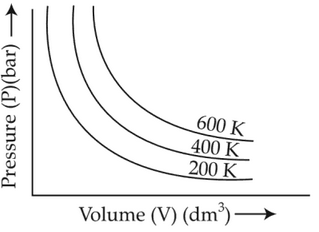
Choose the correct option for graphical representation of Boyle's law, which shows a graph of pressure vs. volume of a gas at different temperatures:
(1).
(2).
(3).
(4).

Year: 2025
Topic: Chemical Thermodynamics
2.
The standard heat of formation, in kcal/mol of \(Ba^{2+}\) is: [Given : standard heat of formation of \(\text{So}^{2-}_4\) ion (aq) = - 216 kcal/mol, standard heat of crystallisation of \(\text{BaSO}_4(s)\) = - 4.5 kcal/mol, standard heat of formation of \(\text{ BaSO}_4(s)\) = - 349 kcal/mol]
(1).
+ 220.5
(2).
- 128.5
(3).
- 133.0
(4).
+ 133.0

Year: 2025
Topic: Chemical Thermodynamics
3.
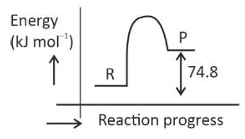
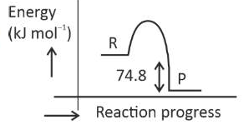
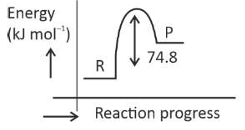
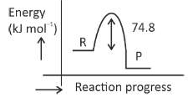
\(\text{C(s) + 2H}_2 \left( g \right) \rightarrow CH_4(g)\);\(\Delta H = -74.8 kJ mol^{-l}\) Which of the following diagrams gives an accurate representation of the above reaction? [R → reactants; P → products]
(1).
(2).
(3).
(4).

Year: 2024
Topic: Chemical Thermodynamics
4.
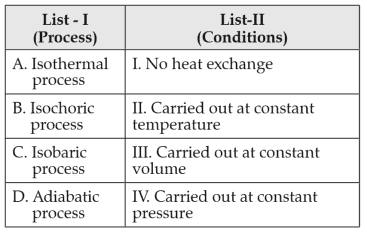
Match List-I with List-II

Choose the correct answer from the options given below:
(1).
A-I, B=II, C-III, D-IV
(2).
A-II, B-III, C-IV. D-I
(3).
A-IV, B-III, C-II, D-I
(4).
A-IV, B-II, C-III, D-I

Year: 2024
Topic: Chemical Thermodynamics
5.
In which of the following processes entropy form increases ?
(1).
A liquid evaporates to vapour
(2).
Temperature of a crystalline solid lowered from 130 K to 0 K
(3).
\(2\text{NaHCO}_3\left(g\right)\,\rightarrow\,\text{Na}_2\text{CO}_3\left(s\right)\) +\(\text{CO}_2\left(g\right)\,+\,\text{H}_2\text{O}\left(g\right)\)
(4).
\( \text{Cl}_2(g) \rightarrow 2\text{Cl}(g) \)

Year: 2024
Topic: Chemical Thermodynamics
6.
The work done during reversible isothermal expansion of one mole of hydrogen gas at \(25^\circ \text{C}\) from pressure of \(20\) atmosphere to \(10\) atmosphere is:
(Given \(\text{R}\,=\,2.0\,cal K^{-1}mol^{-1}\))
(1).
413.14 calories
(2).
100 calories
(3).
0 calorie
(4).
-413.14 calories

Year: 2023
Topic: Chemical Thermodynamics
7.
Given below are two statements : one is labelled as Assertion A and the other is labelled as Reason R:
Assertion A : In equation \(\delta_r\, G\, =\, -nFE_{\text{cell}}\), value of \(\delta_r\, G\) depends on n.
Reason R: \(E_{\text{cell}}\) is an intensive property and \(\delta_r\, G\) is an extensive property.
In the light of the above statements, choose the correct answer from the options given below:
(1).
Both A and R are true but R is NOT the correct explanation of A.
(2).
A is true but R is false.
(3).
A is false but R is true.
(4).
Both A and R are true and R is the correct explanation of A.

Year: 2023
Topic: Chemical Thermodynamics
8.
Which amongst the following options is the correct relation between change in enthalpy and change in internal energy?
(1).
\(\Delta H\,=\,\Delta U\, +\, \Delta n_g\, RT
(2).
\(\Delta H\,-\,\Delta U\, =\,-\, \Delta n\, RT
(3).
\(\Delta H\,+\,\Delta U\, =\, \Delta n\, RT
(4).
\(\Delta H\,=\,\Delta U\, -\, \Delta n_g\, RT

Year: 2022
Topic: Chemical Thermodynamics
9.
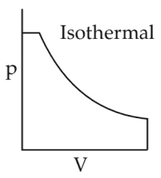
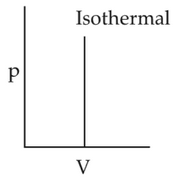
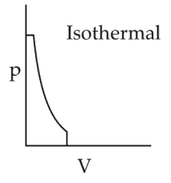
Which of the following p-V curve representsmaximum work done?
(1).
(2).
(3).
(4).

Year: 2021
Topic: Chemical Thermodynamics
10.
Which one among the following is the correct option for right relationship between CP and CV for one mole of ideal gas ?
(1).
CP + CV= R
(2).
CP-CV=R
(3).
CP= RCV
(4).
CV = RCP

Year: 2021
Topic: Chemical Thermodynamics
11.
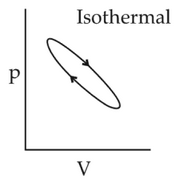
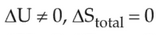
For irreversible expansion of an ideal gas under isothermal condition, the correct option is
(1).
(2).
(3).
(4).

Year: 2020
Topic: Chemical Thermodynamics
12.
For the reaction, 2Cl(g)→ C2(g), the correct option is:
(1).
\(\Delta_r\, H \,>\, 0 \text{ and } \Delta_r \,S\, <\, 0\)
(2).
\(\Delta_r\, H\, <\, 0 \text{ and } \Delta_r\, S \,>\, 0\)
(3).
\(\Delta_r\, H\, <\, 0 \text{ and } \Delta_r\, S\, <\, 0\)
(4).
\(\Delta_r\, H\, >\, 0 \text{ and } \Delta_r\, S\, >\, 0\)

Year: 2020
Topic: Chemical Thermodynamics
13.
The correct option for free expansion of an ideal gas under adiabatic condition is:
(1).
\(q\, =\, 0,\, \Delta T\, <\,0\, \text{ and}\, w\,>\, 0\)
(2).
\(q\, <\, 0,\, \Delta T\, =\,0\, \text{ and}\, w\,=\, 0\)
(3).
\(q\, >\, 0,\, \Delta T\, >\,0\, \text{ and}\, w\,>\, 0\)
(4).
\(q\, =\, 0,\, \Delta T\, =\,0\, \text{ and}\, w\,=\, 0\)

Year: 2019
Topic: Chemical Thermodynamics
14.
Under isothermal condition, a gas at 300 K expands from 0.1 L to 0.25 L against a constant external pressure of 2 bar. The work done by the gas is
(1).
5 kJ
(2).
25 J
(3).
30 J
(4).
-30 J

Year: 2019
Topic: Chemical Thermodynamics
15.
In which case change in entropy is negative ?
(1).
Expansion of a gas at constant temperature
(2).
Sublimation of solid to gas
(3).
2H(g) \(\rightarrow\) H2(g) (c)
(4).
Evaporation of water

Year: 2017
Topic: Chemical Thermodynamics
16.
A gas is allowed to expand in a well insulated container against a constant external pressure of 2.5 atm from an initial volume of 2.50 L to a final volume of 4.50 L. The change in internal energy \(\Delta \text{U}\) of the gas in joules will be
(1).
+505 J
(2).
1136.25 J
(3).
–500 J
(4).
–505 J

Year: 2016
Topic: Chemical Thermodynamics
17.
The correct thermodynamic conditions for the spontaneous reaction at all temperatures is
(1).
AH > 0 and AS < 0
(2).
AH < 0 and AS > 0
(3).
AH < 0 and AS < 0
(4).
AH < 0 and AS = 0

Year: 2016
Topic: Chemical Thermodynamics
18.
Consider the following liquid - vapour equilibrium
Liquid \(\rightleftharpoons\) Vapour
Which of the following relations is correct ?
(1).
\(\displaystyle \frac{\text{dlnP}}{\text{dT}}\) = \(\displaystyle \frac{- \Delta text{H}_v}{\text{RT}}\)
(2).
\(\displaystyle \frac{\text{dlnP}}{\text{dT}^2}\) = \(\displaystyle \frac{- \Delta text{H}_v}{\text{T}^2}\)
(3).
\(\displaystyle \frac{\text{dlnP}}{\text{dT}}\) = \(\displaystyle \frac{- \Delta text{H}_v}{\text{RT}^2}\)
(4).
\(\displaystyle \frac{\text{dlnG}}{\text{dT}^2}\) = \(\displaystyle \frac{- \Delta text{H}_v}{\text{RT}^2}\)