Home >> Topics >> Haloalkanes and Haloarenes
Unattempted Questions
Questions Available: 12
Year: 2020
Topic: Haloalkanes and Haloarenes
1.
Which of the following alkane cannot be made in good yield by Wurtz reaction?
(1).
2,3-Dimethylbutane
(2).
n-Heptane
(3).
n-Butane
(4).
n-Hexane

Year: 2025
Topic: Haloalkanes and Haloarenes
2.
Given below are two statements: one is labelled as Assertion (A) and the other is labelled as Reason (R).
Assertion (A) :

Reason (R) : lodine is a better leaving group because of its large size.
In the light of the above statements, choose the correct answer from the options given below :
(1).
A is false but R is true
(2).
Both A and R are true and R is the correct explanation of A
(3).
Both A and R are true but R is not the correct explanation of A
(4).
A is true but R is false

Year: 2024
Topic: Haloalkanes and Haloarenes
3.
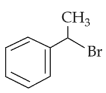
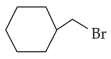
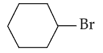
The compound that will undergo \(\text{S}_\text{N}1\) reaction with the fastest rate is:
(1).
(2).
(3).
(4).

Year: 2023
Topic: Haloalkanes and Haloarenes
4.
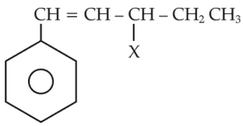
The given compound

is an example of
(1).
aryl halide
(2).
allylic halide
(3).
vinylic halide
(4).
benzylic halide

Year: 2022
Topic: Haloalkanes and Haloarenes
5.
The incorrect statement regarding chirality is
(1).
SN1reaction yields 1:1 mixture of bothenantiomers
(2).
The product obtained by SN1 reaction ofhaloalkane having chirality at the reactive siteshows inversion of configuration
(3).
Enantiomers are superimposable mirror images on each other
(4).
A racemic mixture shows zero optical rotation

Year: 2021
Topic: Haloalkanes and Haloarenes
6.
The correct sequence of bond enthalpy of 'C-X' bond is
(1).
CH3-F< CH3-Cl< CH3-Br < CH3-I
(2).
CH3-F> CH3-Cl> CH3-Br> CH3-I
(3).
CH3-F< CH3-Cl> CH3-Br > CH3-I
(4).
CH3-CI> CH3-F>CH3-Br > CH3-I

Year: 2020
Topic: Haloalkanes and Haloarenes
7.
Elimination reaction of 2-Bromo-pentane to form pent-2-ene is:
(a) \(\beta\) - Elimination reaction
(b) Follows Zaitsev rule
(c) Dehydrohalogenation reaction
(d) Dehydration reaction
Choose the correct option from the following:
(1).
(a), (c), (d)
(2).
(b), (c), (d)
(3).
(a), (b), (d)
(4).
(a), (b), (c)

Year: 2020
Topic: Haloalkanes and Haloarenes
8.
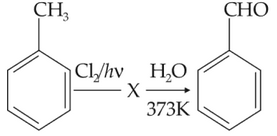
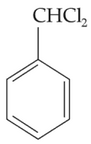
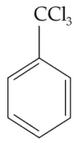
ldentify compound X in the following sequence of reacions:
(1).
(2).
(3).
(4).

Year: 2018
Topic: Haloalkanes and Haloarenes
9.
The compound C7H8 undergoes the following reactions:

The product 'C' is
(1).
p-bromotoluene.
(2).
3-bromo-2,4,6-trichlorotoluene.
(3).
o-bromotoluene.
(4).
m-bromotoluene.

Year: 2018
Topic: Haloalkanes and Haloarenes
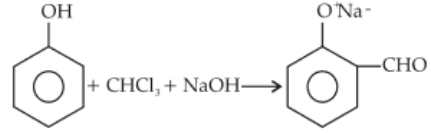
10.
In the reaction, the electrophile involved is
(1).
Dichlorocarbene (\(\text{:CCl}_2\))
(2).
Dichloromethyl anion (\(\text{C}^+\text{HCl}_2\))
(3).
Formyl cation (\(\text{C}^+\text{HO}\)
(4).
Dichloromethyl cation (\(\text{C}^+\text{HCl}_2\))

Year: 2016
Topic: Haloalkanes and Haloarenes
11.
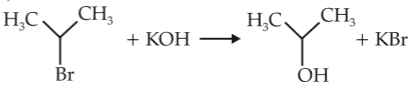
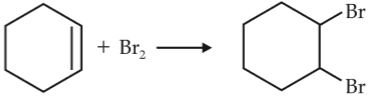
For the following reactions,
(i) CH3CH2CH2Br + KOH \(\rightarrow\) CH3CH = CH2 + KBr + H2O
(ii)
(iii)
Which of the following statement is correct ?
(1).
(i) is elimination reaction, (ii) is substitution and (iii) is addition reaction
(2).
(i) is elimination, (ii) and (iii) are substitution reactions
(3).
(i) is substitution, (ii) and (iii) are addition reactions
(4).
(i) and (ii) are elimination reactions and (iii) is addition reaction

Year: 2016
Topic: Haloalkanes and Haloarenes
12.
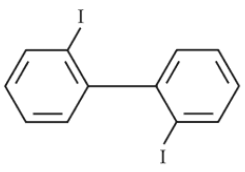
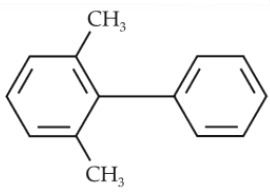
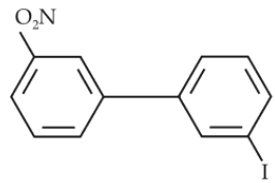
Which of the following biphenyls is optically active ?
(1).
(2).
(3).
(4).