Home >> Topics >> Chemical Kinetics
Unattempted Questions
Questions Available: 20
Year: 2025
Topic: Chemical Kinetics
1.
If the half-life (\(t_{1/2}\)) for a first order reaction is 1 minute, then the time required for 99.9% completion of the reaction is closest to :
(1).
10 minutes
(2).
2 minutes
(3).
4 minutes
(4).
5 minutes

Year: 2025
Topic: Chemical Kinetics
2.
If the rate constant of a reaction is 0.03 s-1, how much time does it take for 7.2 mol L-1 concentration of the reactant to get reduced to 0.9 mol L-1 ?
(Given: log 2 = 0391)
(1).
21.0 s
(2).
69.3 s
(3).
23.1 s
(4).
210 s

Year: 2024
Topic: Chemical Kinetics
3.
The rate of a reaction quadruples where temperature cahnges from \(27^\circ \text{C}\) to \(57^\circ \text{C}\) calculate the energy of activation.
Given \(\text{R}\,=\,8.314\,\text{J}\,\text{K}^{-1}\,\text{mol}^{-1}\), \(\text{log}4\,=\,0.6021\)
(1).
\(3.80\, \text{kJ/mol}\)
(2).
\(3804\, \text{kJ/mol}\)
(3).
\(38.04\, \text{kJ/mol}\)
(4).
\(380.4\,\text{ kJ/mol}\)

Year: 2024
Topic: Chemical Kinetics
4.
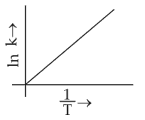
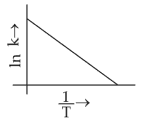
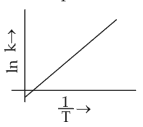
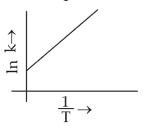
Which plot of \(ln\,k\) vs \(\displaystyle \frac{1}{T}\) is consistent with Arrhenius equation?
(1).
(2).
(3).
(4).

Year: 2024
Topic: Chemical Kinetics
5.
Activation energy of any chemical reactions can be calculated if one knows the value of
(1).
Orientation of reactant molecules during collision
(2).
Rate constant at two different temperatures
(3).
Rate constant at standard temepartures
(4).
Probability of collision

Year: 2023
Topic: Chemical Kinetics
6.
For a certain reaction, the rate = k [A]2 [B], when the initial concentration of A is tripled keeping concentration of B constant, the initial rate would
(1).
increase by a factor of six
(2).
increase by a factor of nine
(3).
increase by a factor of three
(4).
decrease by a factor of nine

Year: 2023
Topic: Chemical Kinetics
7.
Given below are two statements: one is labelled as Assertion A and the other is labelled as Reason R :
Assertion A : A reaction can have zero activation energy.
Reason R: The minimum extra amount ofenergy absorbed by reactant molecules so that their enengy becomes equal to threshold value, is called activation energy.
In the light of the above statements, choose the correct answer from the options given below:
(1).
Both A and R are true but R is NOT the correct explanation of A.
(2).
A is true but R is false.
(3).
A is false but R is true.
(4).
Both A and R are true and R is the correct explanation of A.

Year: 2022
Topic: Chemical Kinetics
8.
The given graph is a representation of kinetics ofa reaction.

The y and x axes for zero and first order reactions,respectively are
(1).
zero order (y = concentration and x = time),first order (y = t and x = concentration)
(2).
zero order (y = concentration and x = time),first order (y = rate constant and x =concentration)
(3).
zero order (y = rate and x = concentration),first order (y = t and x = concentration)
(4).
zero order (y = rate and x = concentration),first order (y = rate and x = t)

Year: 2022
Topic: Chemical Kinetics
9.
For a first order reaction A → Products, initialconcentration of A is 0.1 M, which becomes0.001 M after 5 minutes. Rate constant for thereaction in min-1 is
(1).
1.3818
(2).
0.9212
(3).
0.4606
(4).
0.2303

Year: 2021
Topic: Chemical Kinetics
10.
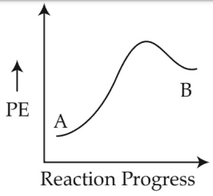
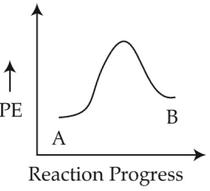
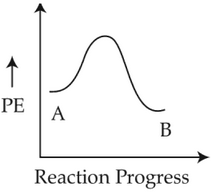
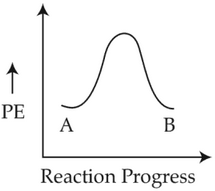
For a reaction A → B, enthalpy of reaction is -4.2 kJ mol-1 and enthalpy of activation is 9.6 kJ mol-1. The correct potential energy profle for the reaction is shown in option.
(1).
(2).
(3).
(4).

Year: 2021
Topic: Chemical Kinetics
11.
The slope of Arrhenius Plot \(\left(\,ln\,k\,v/s\,\frac{1}{T}\right)\) of first order reaction is -5 x 10³ K. The value of Ea of the reaction is. Choose the correct option.
[Given R=8.314 JK-1mol-1]
(1).
41.5 kJ mol-1
(2).
83.0 kJ mol-1
(3).
166 kJ mol-1
(4).
-83 kJ mol-1

Year: 2020
Topic: Chemical Kinetics
12.
The rate constant for a first order reaction is 4.606 x 10⁻³s-1, The time required to reduce 2.0g of the reactant to 0.2 g is:
(1).
200 s
(2).
500 s
(3).
1000 s
(4).
100 s

Year: 2019
Topic: Chemical Kinetics
13.
If the rate constant for a first order reaction is k, the time (t) required for the completion of 99% of the reaction is given by
(1).
t = 6.909/k
(2).
t = 4.606/k
(3).
t = 2.303/k
(4).
t = 0.693/k

Year: 2018
Topic: Chemical Kinetics
14.
When initial concentration of the reactant is doubled, the half-life period of a zero order reaction
(1).
remains unchanged
(2).
is tripled
(3).
is doubled
(4).
is halved

Year: 2018
Topic: Chemical Kinetics
15.
The correct difference between first and second order reactions is that
(1).
the rate of a first-order reaction does depend on reactant concentrations; the rate of a second-order reaction does not depend on reactant concentrations.
(2).
a first-order reaction can be catalyzed; a second-order reaction cannot be catalyzed.
(3).
the half-life of a first-order reaction does not depend on [A]0 ; the half-life of a second-order reaction does depend on [A]0 .
(4).
the rate of a first-order reaction does not depend on reactant concentrations; the rate of a second-order reaction does depend on reactant concentrations.

Year: 2017
Topic: Chemical Kinetics
16.
Mechanism of a hypothetical reaction X2 + Y2 \(\rightarrow\) 2XY is given below:
(i) X2 \(\rightarrow\) X + X (fast)
(ii) X + Y2 \(\rightleftharpoons\) XY + Y (slow)
(iii) X + Y \(\rightarrow\) XY (fast)
The overall order of the reaction will be
(1).
1.5
(2).
1
(3).
2
(4).
0

Year: 2017
Topic: Chemical Kinetics
17.
A first order reaction has a specific reaction rate of 10-2 s-1. How much time will it take for 20 g of the reactant to reduce to 5 g ?
(1).
693.0 second
(2).
238.6 second
(3).
138.6 second
(4).
346.5 second

Year: 2016
Topic: Chemical Kinetics
18.
Consider the nitration of benzene using mixed conc . H2SO4 and HNO3 . If a large amount of KHSO4 is added to the mixture , the rate of nitration will be
(1).
slower
(2).
unchanged
(3).
doubled
(4).
faster

Year: 2016
Topic: Chemical Kinetics
19.
The rate of a first - order reaction is 0.04 mol L-1S-1 at 10 sec and 0.03 mol L-1S-1 at 20 sec after initiation of the reaction . The half - life period of the reaction is
(1).
34.1 s
(2).
44.1 s
(3).
54.1 s
(4).
24.1 s

Year: 2016
Topic: Chemical Kinetics
20.
The addition of a catalyst during a chemical reaction alters which of the following quantities ?
(1).
Internal energy
(2).
Enthalpy
(3).
Activation energy
(4).
Entropy