
Home >> My Performance >> My Topic Test Performance >> My Question Performance
My Question Performance Summary in Full Tests !
Questions Available: 17
Questions Attempted: 10
Number of Attempts: 15
Correct Attempts: 8
Total Time Spent: 00:30
Avg Time Per Question: 00:02
My Question Performance Summary in Full Tests
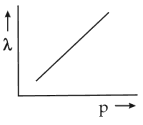
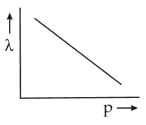
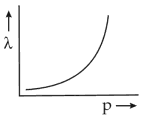
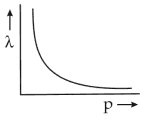
The graph which shows the variation of the de Broglie wavelength (λ) of a particle and its associated momentum (p) is
(1).
(2).
(3).
(4).
(1).
(2).
(3).
(4).
Number of Attempts: 2
Correct Attempts: 1
Time Taken: 00:04
Average Time: 00:02
Which of the following options represent the variation of photoelectric current with property of light shown on x-axis?
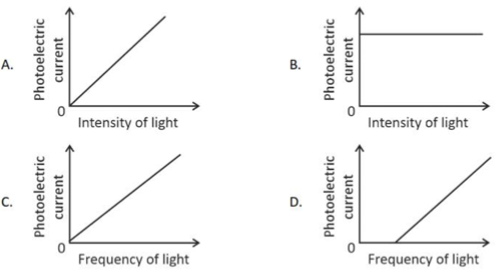
(1). B and D
(2). A only
(3). A and C
(4). A and D
(1). B and D
(2). A only
(3). A and C
(4). A and D
Number of Attempts: 2
Correct Attempts: 1
Time Taken: 00:04
Average Time: 00:02
A photon and an electron (mass m) have the same energy E. The ratio (\(\displaystyle \frac{\lambda_\text{photon}}{ \lambda_\text{electron}}\) ) of their de Broglie wavelengths is: (c is the speed of light)
(1). \(\displaystyle \frac{1}{\text{C}}\sqrt{\frac{\text{E}}{2\text{m}}}\)
(2). \(\displaystyle \sqrt{\frac{\text{E}}{2\text{m}}}\)
(3). \(\displaystyle \text{C}\sqrt{2\text{mE}}\)
(4). \(\displaystyle \text{C}\sqrt{\frac{2\text{m}}{\text{E}}}\)
(1). \(\displaystyle \frac{1}{\text{C}}\sqrt{\frac{\text{E}}{2\text{m}}}\)
(2). \(\displaystyle \sqrt{\frac{\text{E}}{2\text{m}}}\)
(3). \(\displaystyle \text{C}\sqrt{2\text{mE}}\)
(4). \(\displaystyle \text{C}\sqrt{\frac{2\text{m}}{\text{E}}}\)
Number of Attempts: 2
Correct Attempts: 1
Time Taken: 00:04
Average Time: 00:02
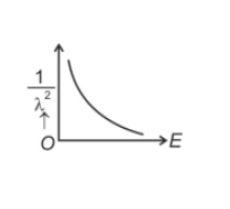
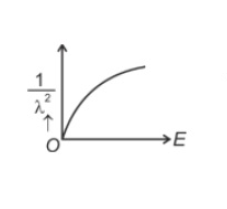
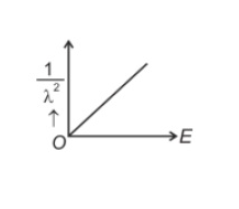
The graph which shows the variation of \((1/λ^2)\) and its kineticenergy, E is (where λ is de Broglie wavelength of a free particle):
(1).
(2).
(3).
(4).
(1).
(2).
(3).
(4).
Number of Attempts: 2
Correct Attempts: 1
Time Taken: 00:04
Average Time: 00:02
If c is the velocity of light in free space, the correct statements about photon among the following are:
A. The energy of a photon is E = hv.
B. The velocity of a photon is c.
C. The momentum of a photon, p = hv/c.
D. In a photon-electron collision, both total energy and total momentum are conserved.
E. Photon possesses positive charge.
Choose the correct answer from the options given below:
(1). A and B only
(2). A, B, C and D only
(3). A, C and D only
(4). A, B, D and E only
A. The energy of a photon is E = hv.
B. The velocity of a photon is c.
C. The momentum of a photon, p = hv/c.
D. In a photon-electron collision, both total energy and total momentum are conserved.
E. Photon possesses positive charge.
Choose the correct answer from the options given below:
(1). A and B only
(2). A, B, C and D only
(3). A, C and D only
(4). A, B, D and E only
Number of Attempts: 2
Correct Attempts: 1
Time Taken: 00:04
Average Time: 00:02
The work functions of Caesium (Cs), Potassium (K) and Sodium (Na)are 2.14eV, 2.30eV and 2.75eV respectively. If incident electromagneticradiation has an incident energy of 2.20eV, which of thesephotosensitive surfaces may emit photoelectrons?
(1). Both Na and K
(2). K only
(3). Na only
(4). Cs only
(1). Both Na and K
(2). K only
(3). Na only
(4). Cs only
Number of Attempts: 2
Correct Attempts: 1
Time Taken: 00:04
Average Time: 00:02
When two monochromatic lights of frequency, v and \(\displaystyle \frac{v}{2}\) are incident on a photoelectric metal, their stopping potential becomes \(\displaystyle \frac{V_s}{2}\) and \(\displaystyle V_s\) respectively. The threshold frequency for this metal is
(1). 2 v
(2). 3 v
(3). \(\displaystyle \frac{2}{3}v\)
(4). \(\displaystyle \frac{3}{2}v\)
(1). 2 v
(2). 3 v
(3). \(\displaystyle \frac{2}{3}v\)
(4). \(\displaystyle \frac{3}{2}v\)
Number of Attempts: 2
Correct Attempts: 1
Time Taken: 00:04
Average Time: 00:02
The number of photons per second on an average emitted by the source of monochromatic light of wavelength 600 nm, when it delivers the power of \(3.3 × 10^{−3}\) watt will be \((h = 6.6 × 10^{−34}J s)\)
(1). \(10^{18}\)
(2). \(10^{17}\)
(3). \(10^{16}\)
(4). \(10^{15}\)
(1). \(10^{18}\)
(2). \(10^{17}\)
(3). \(10^{16}\)
(4). \(10^{15}\)
Number of Attempts: 2
Correct Attempts: 1
Time Taken: 00:04
Average Time: 00:02
An electron is accelerated from rest through a potential difference of V
volt. If the de Broglie wavelength of the electron is \(1.227 × 10^2nm\) the
potential difference is:
(1). \(10^2V\)
(2). \(10^3V\)
(3). \(10^4V\)
(4). \(10V\)
(1). \(10^2V\)
(2). \(10^3V\)
(3). \(10^4V\)
(4). \(10V\)
Number of Attempts: 2
Correct Attempts: 1
Time Taken: 00:04
Average Time: 00:02
Light of frequency 1.5 times the threshold frequency is incident on a
photosensitive material. What will be the photoelectric current if the
frequency is halved and intensity is doubled?
(1). four times
(2). one-fourth
(3). zero
(4). doubled
(1). four times
(2). one-fourth
(3). zero
(4). doubled
Number of Attempts: 2
Correct Attempts: 1
Time Taken: 00:04
Average Time: 00:02
An electron is accelerated through a potential difference of 10,000 V.Its de Broglie wavelength is, (nearly) \(\left(m_e= 9 × 10^−31kg\right)\)
(1). \(12.2\,nm\)
(2). \(12.2 \times 10^{−13}\,m\)
(3). \(12.2 \times 10^{−12}\,m\)
(4). \(12.2 \times 10^{−14}\,m\)
(1). \(12.2\,nm\)
(2). \(12.2 \times 10^{−13}\,m\)
(3). \(12.2 \times 10^{−12}\,m\)
(4). \(12.2 \times 10^{−14}\,m\)
Number of Attempts: 2
Correct Attempts: 1
Time Taken: 00:04
Average Time: 00:02
An electron of mass m with an initial velocity \(\vec{v}\,=v_0\hat{i} \left( v_0\,>\,0 \right)\) enters an electric field \(\vec{E}\,=\,-\vec{E}_0 \hat{i} \left ( E_0 \,=\, constant\, >\, 0 \right )\) at t = 0. If \(λ_0\) is its de-Broglie wavelength initially, then its de-Broglie wavelength at time t is
(1). \(\displaystyle \frac{λ_0}{\left(1+\frac{eE_0}{mv_0}t\right)}\)
(2). \(\displaystyle λ_0 \left(1+\frac{eE_0}{mv_0}t \right)\)
(3). \(λ_0\,t\)
(4). \(λ_0\)
(1). \(\displaystyle \frac{λ_0}{\left(1+\frac{eE_0}{mv_0}t\right)}\)
(2). \(\displaystyle λ_0 \left(1+\frac{eE_0}{mv_0}t \right)\)
(3). \(λ_0\,t\)
(4). \(λ_0\)
Number of Attempts: 2
Correct Attempts: 1
Time Taken: 00:04
Average Time: 00:02
When the light of frequency \(2v_0\)
(where \(v_0\)
is threshold frequency), is
incident on a metal plate, the maximum velocity of electrons emitted is
\(v_1\)
. When the frequency of the incident radiation is increased to \(5v_0\)
, the
maximum velocity of electrons emitted from the same plate is \(v_2\)
. The
ratio of \(v_1\)
to \(v_2\)
is
(1). 1 : 2
(2). 1 : 4
(3). 4 : 1
(4). 2 : 1
(1). 1 : 2
(2). 1 : 4
(3). 4 : 1
(4). 2 : 1
Number of Attempts: 2
Correct Attempts: 1
Time Taken: 00:04
Average Time: 00:02
The de-Broglie wavelength of a neutron in thermal equilibrium with heavy water at a temperature T (kelvin) and mass m, is
(1). \(\displaystyle \frac{h}{\sqrt{3mkT}}\)
(2). \(\displaystyle \frac{2h}{\sqrt{3mkT}}\)
(3). \(\displaystyle \frac{2h}{\sqrt{mkT}}\)
(4). \(\displaystyle \frac{h}{\sqrt{mkT}}\)
(1). \(\displaystyle \frac{h}{\sqrt{3mkT}}\)
(2). \(\displaystyle \frac{2h}{\sqrt{3mkT}}\)
(3). \(\displaystyle \frac{2h}{\sqrt{mkT}}\)
(4). \(\displaystyle \frac{h}{\sqrt{mkT}}\)
Number of Attempts: 2
Correct Attempts: 1
Time Taken: 00:04
Average Time: 00:02
The photoelectric threshold wavelength of silver is \(3250 \times 10^{−10}\,m\). The velocity of the electron ejected from a silver surface by ultraviolet light of wavelength \(2536 \times 10^{−10}\,m\) is
[Given: \(h \,=\, 4.14 \times 10^{−15}\, \text{eVs}\) and \(c \,=\, 3 \times 10^8\,ms^{−1}\)]
(1). \(\approx 0.6 \times 10^6\,ms^{−1}\)
(2). \(\approx 61 \times 10^3\,ms^{−1}\)
(3). \(\approx 0.3 \times 10^6\,ms^{−1}\)
(4). \(\approx 6 \times 10^5\,ms^{−1}\)
[Given: \(h \,=\, 4.14 \times 10^{−15}\, \text{eVs}\) and \(c \,=\, 3 \times 10^8\,ms^{−1}\)]
(1). \(\approx 0.6 \times 10^6\,ms^{−1}\)
(2). \(\approx 61 \times 10^3\,ms^{−1}\)
(3). \(\approx 0.3 \times 10^6\,ms^{−1}\)
(4). \(\approx 6 \times 10^5\,ms^{−1}\)
Number of Attempts: 2
Correct Attempts: 1
Time Taken: 00:04
Average Time: 00:02
An electron of mass m and a photon have same energy E. The ratio ofde-Broglie wavelengths associated with them is(c being velocity of light)
(1). \(\displaystyle c\left(2mE\right)^{1/2}\)
(2). \(\displaystyle \frac{1}{c}\left(\frac{2m}{E}\right)^{1/2}\)
(3). \(\displaystyle \frac{1}{c}\left(\frac{E}{2m}\right)^{1/2}\)
(4). \(\displaystyle \left(\frac{E}{2m}\right)^{1/2}\)
(1). \(\displaystyle c\left(2mE\right)^{1/2}\)
(2). \(\displaystyle \frac{1}{c}\left(\frac{2m}{E}\right)^{1/2}\)
(3). \(\displaystyle \frac{1}{c}\left(\frac{E}{2m}\right)^{1/2}\)
(4). \(\displaystyle \left(\frac{E}{2m}\right)^{1/2}\)
Number of Attempts: 2
Correct Attempts: 1
Time Taken: 00:04
Average Time: 00:02
When a metallic surface is illuminated with radiation of wavelength \(\lambda\), the stopping potential is \(\text{V}\). If the same surface is illuminated with radiation of wavelength \(2\lambda\), the stopping potential is \(\displaystyle \frac{V}{4}\).The threshold wavelength for the metallic surface is
(1). \(\displaystyle \frac{5}{2}\, \lambda\)
(2). \(3\, \lambda\)
(3). \(4\, \lambda\)
(4). \(5\, \lambda\)
(1). \(\displaystyle \frac{5}{2}\, \lambda\)
(2). \(3\, \lambda\)
(3). \(4\, \lambda\)
(4). \(5\, \lambda\)
Number of Attempts: 2
Correct Attempts: 1
Time Taken: 00:04
Average Time: 00:02