
Home >> My Performance >> My Topic Test Performance >> My Question Performance
My Question Performance Summary in Full Tests !
Questions Available: 68
Questions Attempted: 10
Number of Attempts: 15
Correct Attempts: 8
Total Time Spent: 00:30
Avg Time Per Question: 00:02
My Question Performance Summary in Full Tests
Transposons can be used during which one of the
following?
(1). Polymerase chain reaction
(2). Gene silencing
(3). Autoradiography
(4). Gene sequencing
(1). Polymerase chain reaction
(2). Gene silencing
(3). Autoradiography
(4). Gene sequencing
Number of Attempts: 2
Correct Attempts: 1
Time Taken: 00:04
Average Time: 00:02
DNA polymorphism forms the basis of:
(1). Genetic mapping
(2). DNA finger printing
(3). Both genetic mapping and DNA fingerprinting
(4). Translation
(1). Genetic mapping
(2). DNA finger printing
(3). Both genetic mapping and DNA fingerprinting
(4). Translation
Number of Attempts: 2
Correct Attempts: 1
Time Taken: 00:04
Average Time: 00:02
Complete the flow chart on central dogma.

(1). (a)-Replication; (b)-Transcription; (c)-Transduction; (d)-Protein
(2). (a)-Translation; (b)-Replication; (c)-Transcription; (d)-Transduction
(3). (a)-Replication; (b)-Transcription; (c)-Translation; (d).Protein
(4). (a)-Transduction; (b)-Translation; (c)-Replication; (d)-Protein
(1). (a)-Replication; (b)-Transcription; (c)-Transduction; (d)-Protein
(2). (a)-Translation; (b)-Replication; (c)-Transcription; (d)-Transduction
(3). (a)-Replication; (b)-Transcription; (c)-Translation; (d).Protein
(4). (a)-Transduction; (b)-Translation; (c)-Replication; (d)-Protein
Number of Attempts: 2
Correct Attempts: 1
Time Taken: 00:04
Average Time: 00:02
If Adenine makes 30% of the DNA molecule, what will be the percentage of Thymine, Guanine and Cytosine in it?
(1). T: 20; G: 30; C: 20
(2). T: 20; G: 20: C: 30
(3). T:30; G: 20; C: 20
(4). T: 20: G: 25; C: 25
(1). T: 20; G: 30; C: 20
(2). T: 20; G: 20: C: 30
(3). T:30; G: 20; C: 20
(4). T: 20: G: 25; C: 25
Number of Attempts: 2
Correct Attempts: 1
Time Taken: 00:04
Average Time: 00:02
If the distance between two consecutive base pairs
is 0.34 nm and the total number of base pairs of a
DNA double helix in a typical mammalian cell is
6.6 x 10⁹ bp, then the length of the DNA is
approximately:
(1). 2.5 meters
(2). 2.2 meters
(3). 2.7 meters
(4). 2.0 meters
(1). 2.5 meters
(2). 2.2 meters
(3). 2.7 meters
(4). 2.0 meters
Number of Attempts: 2
Correct Attempts: 1
Time Taken: 00:04
Average Time: 00:02
Name the enzyme that facilitates opening of DNA
helix during transcription.
(1). DNA helicase
(2). DNA polymerase
(3). RNA polymerase
(4). DNA ligase
(1). DNA helicase
(2). DNA polymerase
(3). RNA polymerase
(4). DNA ligase
Number of Attempts: 2
Correct Attempts: 1
Time Taken: 00:04
Average Time: 00:02
A gene locus has two alleles A, a. If the frequency of dominant allele A is 0.4, then what will be the frequency of homozygous dominant, heterozygous and homozygous recessive individuals in the population ?
(1). 0.16 (AA); 0.24 (Aa); 0.36 (aa)
(2). 0.16 (AA); 0.48 (Aa); 0.36 (aa)
(3). 0.16 (AA); 0.36 (Aa); 0.48 (aa)
(4). 0.36 (AA); 0.48 (Aa); 0.16 (aa)
(1). 0.16 (AA); 0.24 (Aa); 0.36 (aa)
(2). 0.16 (AA); 0.48 (Aa); 0.36 (aa)
(3). 0.16 (AA); 0.36 (Aa); 0.48 (aa)
(4). 0.36 (AA); 0.48 (Aa); 0.16 (aa)
Number of Attempts: 2
Correct Attempts: 1
Time Taken: 00:04
Average Time: 00:02
Under which of the following conditions will there be no change in the reading frame of following mRNA ? 5' AACAGCGGUGCUAUU 3'
(1). Deletion of G from 5th position
(2). Insertion of A and G at 4th and 5th positions respectively
(3). Deletion of GGU from 7th, 8th and 9th positions
(4). Insertion of G at 5th position
(1). Deletion of G from 5th position
(2). Insertion of A and G at 4th and 5th positions respectively
(3). Deletion of GGU from 7th, 8th and 9th positions
(4). Insertion of G at 5th position
Number of Attempts: 2
Correct Attempts: 1
Time Taken: 00:04
Average Time: 00:02
Select the correct match
(1). Francois Jacob and Jacques Monod - lac operon
(2). Matthew Meselson and F. Stahl - Pisum sativum
(3). Alfred Hershey and Martha Chase - TMV
(4). Alec Jeffreys - Streptococcus pneumoniae
(1). Francois Jacob and Jacques Monod - lac operon
(2). Matthew Meselson and F. Stahl - Pisum sativum
(3). Alfred Hershey and Martha Chase - TMV
(4). Alec Jeffreys - Streptococcus pneumoniae
Number of Attempts: 2
Correct Attempts: 1
Time Taken: 00:04
Average Time: 00:02
All of the following are part of an operon except
(1). a promoter.
(2). an enhancer.
(3). structural genes.
(4). an operator.
(1). a promoter.
(2). an enhancer.
(3). structural genes.
(4). an operator.
Number of Attempts: 2
Correct Attempts: 1
Time Taken: 00:04
Average Time: 00:02
The final proof for DNA as the genetic material came from the experiments of
(1). Hargobind Khorana
(2). Griffith
(3). Hershey and Chase
(4). Avery, Mcleod and McCarty
(1). Hargobind Khorana
(2). Griffith
(3). Hershey and Chase
(4). Avery, Mcleod and McCarty
Number of Attempts: 2
Correct Attempts: 1
Time Taken: 00:04
Average Time: 00:02
During DNA replication, Okazaki fragments are used to elongate
(1). the lagging strand away from the replication fork.
(2). the leading strand towards the replication fork.
(3). the lagging strand towards the replication fork.
(4). the leading strand away from the replication fork.
(1). the lagging strand away from the replication fork.
(2). the leading strand towards the replication fork.
(3). the lagging strand towards the replication fork.
(4). the leading strand away from the replication fork.
Number of Attempts: 2
Correct Attempts: 1
Time Taken: 00:04
Average Time: 00:02
A disease caused by an autosomal primary non- disjunction is
(1). sickle cell anemia.
(2). down's syndrome.
(3). klinefelter's syndrome.
(4). turner's syndrome.
(1). sickle cell anemia.
(2). down's syndrome.
(3). klinefelter's syndrome.
(4). turner's syndrome.
Number of Attempts: 2
Correct Attempts: 1
Time Taken: 00:04
Average Time: 00:02
Name the class of enzyme that usually catalyze
the following reaction :
S - G + S# → S + S# - G
Where, G → a group other than hydrogen
S → a substrate
S# → another substrate
(1). Ligase
(2). Hydrolase
(3). Lyase
(4). Transferase
S - G + S# → S + S# - G
Where, G → a group other than hydrogen
S → a substrate
S# → another substrate
(1). Ligase
(2). Hydrolase
(3). Lyase
(4). Transferase
Number of Attempts: 2
Correct Attempts: 1
Time Taken: 00:04
Average Time: 00:02
Given below are two statements
Statement I : In the RNA world, RNA is considered the first genetic material evolved to carry out essential life processes. RNA acts as a genetic material and also as a catalyst for some important biochemical reactions in living systems. Being reactive, RNA is unstable.
Statement II: DNA evolved from RNA and is a more stable genetic material. Its double helical strands being complementary, resist changes by evolving repairing mechanism.
In the light of the above statements, choose the most appropriate answer from the options given below :
(1). Statement I is incorrect but statement II is correct
(2). Both statement I and statement II are correct
(3). Both statemént I and statement II are incorrect
(4). Statement I is correct but statement II is incorrect
Statement I : In the RNA world, RNA is considered the first genetic material evolved to carry out essential life processes. RNA acts as a genetic material and also as a catalyst for some important biochemical reactions in living systems. Being reactive, RNA is unstable.
Statement II: DNA evolved from RNA and is a more stable genetic material. Its double helical strands being complementary, resist changes by evolving repairing mechanism.
In the light of the above statements, choose the most appropriate answer from the options given below :
(1). Statement I is incorrect but statement II is correct
(2). Both statement I and statement II are correct
(3). Both statemént I and statement II are incorrect
(4). Statement I is correct but statement II is incorrect
Number of Attempts: 2
Correct Attempts: 1
Time Taken: 00:04
Average Time: 00:02
Given below are two statements
Statement I : Transfer RNAs and ribosomal RNA do not interact with mRNA.
Statement II : RNA interference (RNAi) takes place in all eukaryotic organisms as a method of cellular defence,
In the light of the above statements, choose the most appropriate answer from the options given bclow:
(1). Statement I is incorrect but Statement II is correct
(2). Both Statement I and Statement II are correct
(3). Both Statement I and Statement II are incorrect
(4). Statement I is correct but Statement II is incorrect
Statement I : Transfer RNAs and ribosomal RNA do not interact with mRNA.
Statement II : RNA interference (RNAi) takes place in all eukaryotic organisms as a method of cellular defence,
In the light of the above statements, choose the most appropriate answer from the options given bclow:
(1). Statement I is incorrect but Statement II is correct
(2). Both Statement I and Statement II are correct
(3). Both Statement I and Statement II are incorrect
(4). Statement I is correct but Statement II is incorrect
Number of Attempts: 2
Correct Attempts: 1
Time Taken: 00:04
Average Time: 00:02
Which of the following are the post-transcriptional events in an eukaryotic cell?
A. Transport of pre-mRNA to cytoplasm prior to splicing.
B. Removal of introns and joining of exons.
C. Addition of methyl group at 5 end of hnRNA.
D. Addition of adenine residues at 3 end of hnRNA.
E. Base pairing of two complementary RNAs.
Choose the correct answer from the options given below :
(1). C, D, E only
(2). A, B, C only
(3). B, C, D only
(4). B, C, E only
A. Transport of pre-mRNA to cytoplasm prior to splicing.
B. Removal of introns and joining of exons.
C. Addition of methyl group at 5 end of hnRNA.
D. Addition of adenine residues at 3 end of hnRNA.
E. Base pairing of two complementary RNAs.
Choose the correct answer from the options given below :
(1). C, D, E only
(2). A, B, C only
(3). B, C, D only
(4). B, C, E only
Number of Attempts: 2
Correct Attempts: 1
Time Taken: 00:04
Average Time: 00:02
Match List - I with List - II
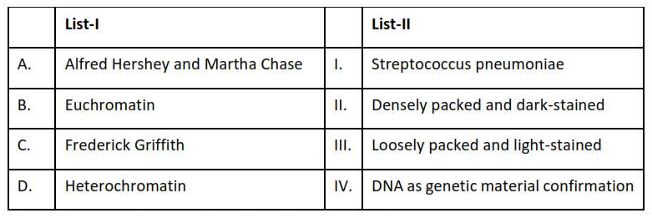
Choose the correet answer from the optionsgiven below :
(1). A-III, B-II, C-IV, D-I
(2). A-II, B-IV, C-I, D-III
(3). A-IV, B-II, C-I, D-III
(4). A-IV, B-III, C-I, D-II
Choose the correet answer from the optionsgiven below :
(1). A-III, B-II, C-IV, D-I
(2). A-II, B-IV, C-I, D-III
(3). A-IV, B-II, C-I, D-III
(4). A-IV, B-III, C-I, D-II
Number of Attempts: 2
Correct Attempts: 1
Time Taken: 00:04
Average Time: 00:02
Which chromosome in the human genome has
the highest number of genes?
(1). Chromosome 10
(2). Chromosome X
(3). ChromosomeY
(4). Chromosome I
(1). Chromosome 10
(2). Chromosome X
(3). ChromosomeY
(4). Chromosome I
Number of Attempts: 2
Correct Attempts: 1
Time Taken: 00:04
Average Time: 00:02
Who proposed that the genetic code for amino acids should be made up of three nucleotides?
(1). Franklin Stahl,
(2). George Gamow
(3). Francis Crick
(4). Jacque Monod
(1). Franklin Stahl,
(2). George Gamow
(3). Francis Crick
(4). Jacque Monod
Number of Attempts: 2
Correct Attempts: 1
Time Taken: 00:04
Average Time: 00:02
Histones are enriched with -
(1). Phenylalanine & Arginine
(2). Lysine & Arginine
(3). Leucine & Lysine
(4). Phenylalanine & Leucin
(1). Phenylalanine & Arginine
(2). Lysine & Arginine
(3). Leucine & Lysine
(4). Phenylalanine & Leucin
Number of Attempts: 2
Correct Attempts: 1
Time Taken: 00:04
Average Time: 00:02
Which factor is important for termination of transcription?
(1). \(\gamma\) (gamma)
(2). \(\alpha\) (alpha)
(3). \(\sigma\) (sigma)
(4). \(\rho\) (rho)
(1). \(\gamma\) (gamma)
(2). \(\alpha\) (alpha)
(3). \(\sigma\) (sigma)
(4). \(\rho\) (rho)
Number of Attempts: 2
Correct Attempts: 1
Time Taken: 00:04
Average Time: 00:02
A transcription unit in DNA is defined primarily by the three regions in DNA and these are with respect to upstream and downstream end;
(1). Inducer, Repressor, Structural gene
(2). Promotor, Structural gene, Terminator
(3). Repressor, Operator gene, Structural gene
(4). Structural gene, Transposons, Operator gene
(1). Inducer, Repressor, Structural gene
(2). Promotor, Structural gene, Terminator
(3). Repressor, Operator gene, Structural gene
(4). Structural gene, Transposons, Operator gene
Number of Attempts: 2
Correct Attempts: 1
Time Taken: 00:04
Average Time: 00:02
The lactose present in the growth medium of bacteria is transported to the cell by the action of
(1). Permease
(2). Polymerase
(3). Beta-galactosidase
(4). Acetylase
(1). Permease
(2). Polymerase
(3). Beta-galactosidase
(4). Acetylase
Number of Attempts: 2
Correct Attempts: 1
Time Taken: 00:04
Average Time: 00:02
Which of the following statement is correct regarding the process of replication in E.coli?
(1). The DNA dependent DNA polymerase catalyses polymerization in 5’ \(\rightarrow\) 3’ as well as 3’ \(\rightarrow\) 5’ direction.
(2). The DNA dependent DNA polymerase catalyses polymerization in 5’ \(\rightarrow\) 3’ direction.
(3). The DNA dependent DNA polymerase catalyses polymerization in one direction that is 3’ \(\rightarrow\) 5’.
(4). The DNA dependent RNA polymerase catalyses polymerization in one direction, that is 5’ \(\rightarrow\) 3’.
(1). The DNA dependent DNA polymerase catalyses polymerization in 5’ \(\rightarrow\) 3’ as well as 3’ \(\rightarrow\) 5’ direction.
(2). The DNA dependent DNA polymerase catalyses polymerization in 5’ \(\rightarrow\) 3’ direction.
(3). The DNA dependent DNA polymerase catalyses polymerization in one direction that is 3’ \(\rightarrow\) 5’.
(4). The DNA dependent RNA polymerase catalyses polymerization in one direction, that is 5’ \(\rightarrow\) 3’.
Number of Attempts: 2
Correct Attempts: 1
Time Taken: 00:04
Average Time: 00:02
Match List I with List II:
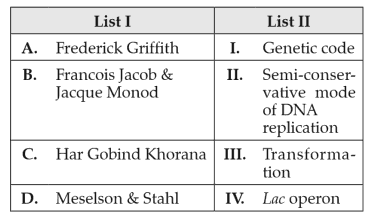 Choose the correct answer from the options given below:
(1). A-II, B-III, C-IV, D-I
(2). A-IV, B-I, C-II, D-III
(3). A-III, B-II, C-I, D-IV
(4). A-III, B-IV, C-I, D-II
Choose the correct answer from the options given below:(1). A-II, B-III, C-IV, D-I
(2). A-IV, B-I, C-II, D-III
(3). A-III, B-II, C-I, D-IV
(4). A-III, B-IV, C-I, D-II
Number of Attempts: 2
Correct Attempts: 1
Time Taken: 00:04
Average Time: 00:02
Which one is the correct product of DNA dependent RNA polymerase to the given template?
3'TACATGGCAAATATCCATTCA5 '
(1). 5'AUGUACCGUUUAUAGGGAAGU3 '
(2). 5'ATGTACCGTTTATAGGTAAGT3 '
(3). 5 ' AUGUACCGUUUAUAGGUAAGU3 '
(4). 5'AUGUAAAGUUUAUAGGUAAGU3 '
3'TACATGGCAAATATCCATTCA5 '
(1). 5'AUGUACCGUUUAUAGGGAAGU3 '
(2). 5'ATGTACCGTTTATAGGTAAGT3 '
(3). 5 ' AUGUACCGUUUAUAGGUAAGU3 '
(4). 5'AUGUAAAGUUUAUAGGUAAGU3 '
Number of Attempts: 2
Correct Attempts: 1
Time Taken: 00:04
Average Time: 00:02
Match List I with List II: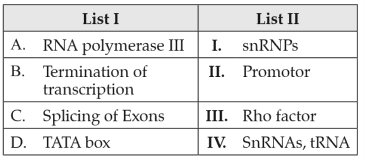
Choose the correct answer from the options given below:
(1). A-III, B-IV, C-I, D-II
(2). A-IV, B-III, C-I, D-II
(3). A-II, B-IV, C-I, D-III
(4). A-III, B-II, C-IV, D-I
Choose the correct answer from the options given below:
(1). A-III, B-IV, C-I, D-II
(2). A-IV, B-III, C-I, D-II
(3). A-II, B-IV, C-I, D-III
(4). A-III, B-II, C-IV, D-I
Number of Attempts: 2
Correct Attempts: 1
Time Taken: 00:04
Average Time: 00:02
Unequivocal proof that DNA is the genetic
material was first proposed by
(1). Alfred Hershey and Martha Chase
(2). Avery, Macleoid and MeCarthy
(3). Wilkins and Franklin
(4). Frederick Gritith
(1). Alfred Hershey and Martha Chase
(2). Avery, Macleoid and MeCarthy
(3). Wilkins and Franklin
(4). Frederick Gritith
Number of Attempts: 2
Correct Attempts: 1
Time Taken: 00:04
Average Time: 00:02
What is the role of RNA polymerase III in the
process of transcription in Eukaryotes ?
(1). Transcription of tRNA, 5 srRNA and snRNA
(2). Transcription of precursor of mRNA
(3). Transcription of only snRNAs
(4). Transcription of rRNAs (28S, 18S and 5.8S)
(1). Transcription of tRNA, 5 srRNA and snRNA
(2). Transcription of precursor of mRNA
(3). Transcription of only snRNAs
(4). Transcription of rRNAs (28S, 18S and 5.8S)
Number of Attempts: 2
Correct Attempts: 1
Time Taken: 00:04
Average Time: 00:02
Expressed Sequence Tags (ESTs) refers to:
(1). All genes that are expressed as proteins.
(2). All genes whether expressed or unexpressed.
(3). Certain important expressed genes.
(4). All genes that are expressed as RNA.
(1). All genes that are expressed as proteins.
(2). All genes whether expressed or unexpressed.
(3). Certain important expressed genes.
(4). All genes that are expressed as RNA.
Number of Attempts: 2
Correct Attempts: 1
Time Taken: 00:04
Average Time: 00:02
Match List I with List II.
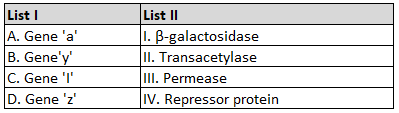
Choose the correct answer from the options given below :
(1). A-II, B-III, C-IV, D-I
(2). A-III, B-IV, C-I, D-II
(3). A-III, B-I, C-IV,D-II
(4). A-II, B-I, C-IV, D-III
Choose the correct answer from the options given below :
(1). A-II, B-III, C-IV, D-I
(2). A-III, B-IV, C-I, D-II
(3). A-III, B-I, C-IV,D-II
(4). A-II, B-I, C-IV, D-III
Number of Attempts: 2
Correct Attempts: 1
Time Taken: 00:04
Average Time: 00:02
Given below are two statements :
Statemnent I : RNA mutates at a faster rate.
Statement II : Viruses having RNA genome and shorter life span mutate and evolve faster.
In the light of the above statements, choose the correct answer from the options given below:
(1). Both Statement I and Statement II are false.
(2). Statement I is true but Statement II is false.
(3). Statement I false but Statement II is true.
(4). Both Statement I and Statement II are true.
Statemnent I : RNA mutates at a faster rate.
Statement II : Viruses having RNA genome and shorter life span mutate and evolve faster.
In the light of the above statements, choose the correct answer from the options given below:
(1). Both Statement I and Statement II are false.
(2). Statement I is true but Statement II is false.
(3). Statement I false but Statement II is true.
(4). Both Statement I and Statement II are true.
Number of Attempts: 2
Correct Attempts: 1
Time Taken: 00:04
Average Time: 00:02
Which one of the following is the sequence on
corresponding coding strand, if the sequence on
mRNA formed is as follows:
5' AUCGAUCGAUCGAUCGAUCG AUCG AUCG 3'?
(1). 3' UAGCUAGCUAGCUAGCUA GCUAGCỦAGC 5'
(2). 5' ATCGATCGATCGATCGATCG ATCGATCG 3'
(3). 3' ATCGATCGATCGATCGATCG ATCGATCG 5'
(4). 5' UAGCUAGCUAGCUAGCUAGC UAGC UAGC 3'
5' AUCGAUCGAUCGAUCGAUCG AUCG AUCG 3'?
(1). 3' UAGCUAGCUAGCUAGCUA GCUAGCỦAGC 5'
(2). 5' ATCGATCGATCGATCGATCG ATCGATCG 3'
(3). 3' ATCGATCGATCGATCGATCG ATCGATCG 5'
(4). 5' UAGCUAGCUAGCUAGCUAGC UAGC UAGC 3'
Number of Attempts: 2
Correct Attempts: 1
Time Taken: 00:04
Average Time: 00:02
If a geneticist uses the blind approach for sequencing the whole genome of an organism, followed by assignment of functions to different segment, the methodology adopted by him is called as:
(1). Sequence annotation
(2). Gene mapping
(3). Expressed sequence tags
(4). Bioinformatics
(1). Sequence annotation
(2). Gene mapping
(3). Expressed sequence tags
(4). Bioinformatics
Number of Attempts: 2
Correct Attempts: 1
Time Taken: 00:04
Average Time: 00:02
In an E. coli strain the i gene gets mutated and its product can not bind the inducer molecule. If the
growth medium is provided with lactose, what will
be the outcome?
(1). Only z gene will get transcribed
(2). z, y, a genes will be transcribed
(3). Z, y, a genes will not be translated
(4). RNA polymerase will bind the promoter region
(1). Only z gene will get transcribed
(2). z, y, a genes will be transcribed
(3). Z, y, a genes will not be translated
(4). RNA polymerase will bind the promoter region
Number of Attempts: 2
Correct Attempts: 1
Time Taken: 00:04
Average Time: 00:02
If the length of a DNA molecule is 1.1 metres, what will be the approximate number of base pairs?
(1). 3.3 × 10⁹ bp
(2). 6.6 x 10⁹ bp
(3). 3.3 x 10⁶ bp
(4). 6.6 x 10⁶ bp
(1). 3.3 × 10⁹ bp
(2). 6.6 x 10⁹ bp
(3). 3.3 x 10⁶ bp
(4). 6.6 x 10⁶ bp
Number of Attempts: 2
Correct Attempts: 1
Time Taken: 00:04
Average Time: 00:02
Ten E. coli cells with 15N- dsDNA are incubated in a medium containing 14N nucleotides. After 60 minutes, how many E. coli cells will have DNA totally free from 15N?
(1). 20 cells
(2). 40 cells
(3). 60 cells
(4). 80 cells
(1). 20 cells
(2). 40 cells
(3). 60 cells
(4). 80 cells
Number of Attempts: 2
Correct Attempts: 1
Time Taken: 00:04
Average Time: 00:02
The process of translation of mRNA to proteins
begins as soon as:
(1). The small subunit of ribosome encounters mRNA
(2). The larger subunit of ribosome encounters mRNA
(3). Both the subunits join together to bind with mRNA
(4). The tRNA is activated and the larger subunit of ribosome encounters mRNA
(1). The small subunit of ribosome encounters mRNA
(2). The larger subunit of ribosome encounters mRNA
(3). Both the subunits join together to bind with mRNA
(4). The tRNA is activated and the larger subunit of ribosome encounters mRNA
Number of Attempts: 2
Correct Attempts: 1
Time Taken: 00:04
Average Time: 00:02
Read the following statements and choose the set of correct statements:
(a) Euchromatin is loosely packed chromatin.
(b) Heterochromatin is transcriptionally active.
(c) Histone octamer is wrapped by negatively charged DNA in nucleosome.
(d) Histones are rich in lysine and arginine.
(e) Atypical nucleosome contains 400 bp of DNA helix.
Choose the correct answer from the options given below:
(1). (b), (d), (e) Only
(2). (a), (c), (d) Only
(3). (b), (e) Only
(4). (a), (c), (e) Only
(a) Euchromatin is loosely packed chromatin.
(b) Heterochromatin is transcriptionally active.
(c) Histone octamer is wrapped by negatively charged DNA in nucleosome.
(d) Histones are rich in lysine and arginine.
(e) Atypical nucleosome contains 400 bp of DNA helix.
Choose the correct answer from the options given below:
(1). (b), (d), (e) Only
(2). (a), (c), (d) Only
(3). (b), (e) Only
(4). (a), (c), (e) Only
Number of Attempts: 2
Correct Attempts: 1
Time Taken: 00:04
Average Time: 00:02
Which one of the following statements about
Histones is wrong?
(1). Histones are organized to form a unit of 8 molecules.
(2). The pH of histones is slightly acidic.
(3). Histones are rich in amino acids - Lysine and Arginine.
(4). Histones carry positive charge in the side chain.
(1). Histones are organized to form a unit of 8 molecules.
(2). The pH of histones is slightly acidic.
(3). Histones are rich in amino acids - Lysine and Arginine.
(4). Histones carry positive charge in the side chain.
Number of Attempts: 2
Correct Attempts: 1
Time Taken: 00:04
Average Time: 00:02
Statement I: The codon 'AUG' codes for methionine
and phenylalanine.
Statement II: 'AAA' and 'AAG both codons code for the amino acid lysine.
In the light of the above statements, choose the correct answer from the options given below.
(1). Both Statement I and Statement II are true
(2). Both Statement I and Statement II are false
(3). Statement I is correct but Statement II is false
(4). Statement I is incorrect but Statement II is true
Statement II: 'AAA' and 'AAG both codons code for the amino acid lysine.
In the light of the above statements, choose the correct answer from the options given below.
(1). Both Statement I and Statement II are true
(2). Both Statement I and Statement II are false
(3). Statement I is correct but Statement II is false
(4). Statement I is incorrect but Statement II is true
Number of Attempts: 2
Correct Attempts: 1
Time Taken: 00:04
Average Time: 00:02
Identify the correct statement.
(1). In capping, methyl guanosine triphosphate is added to the 3` end of hnRNA.
(2). RNA polymerase binds with Rho factor to terminate the process of transcription in bacteria.
(3). The coding strand in a transcription unit is copied to an mRNA.
(4). Split gene arrangement is characteristic of prokaryotes.
(1). In capping, methyl guanosine triphosphate is added to the 3` end of hnRNA.
(2). RNA polymerase binds with Rho factor to terminate the process of transcription in bacteria.
(3). The coding strand in a transcription unit is copied to an mRNA.
(4). Split gene arrangement is characteristic of prokaryotes.
Number of Attempts: 2
Correct Attempts: 1
Time Taken: 00:04
Average Time: 00:02
What is the role of RNA polymerase III in the process of transcription in eukaryotes?
(1). Transcribes rRNAs (28 S,18 S and 5.8 S)
(2). Transcribes tRNA, 5srRNA and snRNA
(3). Transcribes precursor of mRNA
(4). Transcribes only snRNAs
(1). Transcribes rRNAs (28 S,18 S and 5.8 S)
(2). Transcribes tRNA, 5srRNA and snRNA
(3). Transcribes precursor of mRNA
(4). Transcribes only snRNAs
Number of Attempts: 2
Correct Attempts: 1
Time Taken: 00:04
Average Time: 00:02
Which of the following RNAs is not required for
the synthesis of protein?
(1). mRNA
(2). tRNA
(3). rRNA
(4). siRNA
(1). mRNA
(2). tRNA
(3). rRNA
(4). siRNA
Number of Attempts: 2
Correct Attempts: 1
Time Taken: 00:04
Average Time: 00:02
Which is the "Only enzyme" that has "Capability"
to catalyse Initiation, Elongation and Termination
in the process of transcription in prokaryotes?
(1). DNA dependent DNA polymerase
(2). DNA dependent RNA polymerase
(3). DNA Ligase
(4). DNAse
(1). DNA dependent DNA polymerase
(2). DNA dependent RNA polymerase
(3). DNA Ligase
(4). DNAse
Number of Attempts: 2
Correct Attempts: 1
Time Taken: 00:04
Average Time: 00:02
The first phase of translation is:
(1). Recognition of DNA molecule
(2). Aminoacylation of tRNA
(3). Recognition of an anti-codon
(4). Binding of mRNA to ribosome
(1). Recognition of DNA molecule
(2). Aminoacylation of tRNA
(3). Recognition of an anti-codon
(4). Binding of mRNA to ribosome
Number of Attempts: 2
Correct Attempts: 1
Time Taken: 00:04
Average Time: 00:02
Which of the following statements is not correct?
(1). The proinsulin has an extra peptide called C- peptide.
(2). The functional insulin has A and B chains linked together by hydrogen bonds.
(3). Genetically engineered insulin is produced in E-Coli.
(4). In man insulin is synthesised as a proinsulin.
(1). The proinsulin has an extra peptide called C- peptide.
(2). The functional insulin has A and B chains linked together by hydrogen bonds.
(3). Genetically engineered insulin is produced in E-Coli.
(4). In man insulin is synthesised as a proinsulin.
Number of Attempts: 2
Correct Attempts: 1
Time Taken: 00:04
Average Time: 00:02
The sequence that controls the copy number of
the linked DNA in the vector, is termed:
(1). Ori site
(2). Palindromic sequence
(3). Recognition site
(4). Selectable marker
(1). Ori site
(2). Palindromic sequence
(3). Recognition site
(4). Selectable marker
Number of Attempts: 2
Correct Attempts: 1
Time Taken: 00:04
Average Time: 00:02
Select the correct match.
(1). Phenylketonuria - Autosomal dominant trait
(2). Sickle cell anaemia - Autosomal recessive trait, chromosome-11
(3). Thalassemia - X-linked
(4). Haemophilia - Y-linked
(1). Phenylketonuria - Autosomal dominant trait
(2). Sickle cell anaemia - Autosomal recessive trait, chromosome-11
(3). Thalassemia - X-linked
(4). Haemophilia - Y-linked
Number of Attempts: 2
Correct Attempts: 1
Time Taken: 00:04
Average Time: 00:02
Which of the following statements is correct ?
(1). Adenine pairs with thymine through one H-bond.
(2). Adenine pairs with thymine through three H-bonds.
(3). Adenine does not pair with thymine.
(4). Adenine pairs with thymine through two H-bonds.
(1). Adenine pairs with thymine through one H-bond.
(2). Adenine pairs with thymine through three H-bonds.
(3). Adenine does not pair with thymine.
(4). Adenine pairs with thymine through two H-bonds.
Number of Attempts: 2
Correct Attempts: 1
Time Taken: 00:04
Average Time: 00:02
Choose the correct pair from the following:
Break the DNA into
(1). Polymerases fragments Separate the two strands of
(2). Nucleases DNA
(3). Exonucleases Make cuts at specific positions within DNA - Join the two DNA molecules
(4). Ligases
(1). Polymerases fragments Separate the two strands of
(2). Nucleases DNA
(3). Exonucleases Make cuts at specific positions within DNA - Join the two DNA molecules
(4). Ligases
Number of Attempts: 2
Correct Attempts: 1
Time Taken: 00:04
Average Time: 00:02
Select the incorrect statement :
(1). In male grasshoppers, 50% of sperms have no sex-chromosome.
(2). In domesticated fowls, sex of progeny depends on the type of sperm rather than egg.
(3). Human males have one of their sex-chromosome much shorter than the other.
(4). Male fruit fly is heterogametic.
(1). In male grasshoppers, 50% of sperms have no sex-chromosome.
(2). In domesticated fowls, sex of progeny depends on the type of sperm rather than egg.
(3). Human males have one of their sex-chromosome much shorter than the other.
(4). Male fruit fly is heterogametic.
Number of Attempts: 2
Correct Attempts: 1
Time Taken: 00:04
Average Time: 00:02
Expressed Sequence Tags (ESTs) refers to
(1). polypeptide expression.
(2). DNA polymorphism.
(3). Novel DNA sequences.
(4). genes expressed as RNA
(1). polypeptide expression.
(2). DNA polymorphism.
(3). Novel DNA sequences.
(4). genes expressed as RNA
Number of Attempts: 2
Correct Attempts: 1
Time Taken: 00:04
Average Time: 00:02
Match the following genes of the Lac operon with their respective products
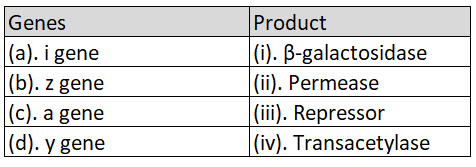
Select the correct option from the following
(1). (a) - (iii), (b) - (i), (c) - (ii), (d) - (iv)
(2). (a) - (iii), (b) - (i), (c) - (iv), (d) - (ii)
(3). (a) - (iii), (b) - (iv), (c) - (i), (d) - (ii)
(4). (a) - (i), (b) - (iii), (c) - (ii), (d) - (iv)
Select the correct option from the following
(1). (a) - (iii), (b) - (i), (c) - (ii), (d) - (iv)
(2). (a) - (iii), (b) - (i), (c) - (iv), (d) - (ii)
(3). (a) - (iii), (b) - (iv), (c) - (i), (d) - (ii)
(4). (a) - (i), (b) - (iii), (c) - (ii), (d) - (iv)
Number of Attempts: 2
Correct Attempts: 1
Time Taken: 00:04
Average Time: 00:02
Which of the following features of genetic code does allow bacteria to produce human insulin by recombinant DNA technology ?
(1). Genetic code is redundant
(2). Genetic code is nearly universal
(3). Genetic code is specific
(4). Genetic code is not ambiguous
(1). Genetic code is redundant
(2). Genetic code is nearly universal
(3). Genetic code is specific
(4). Genetic code is not ambiguous
Number of Attempts: 2
Correct Attempts: 1
Time Taken: 00:04
Average Time: 00:02
Purines found in the DNA and RNA are
(1). adenine and guanine.
(2). guanine and cytosine.
(3). cytosine and thymine.
(4). adenine and thymine.
(1). adenine and guanine.
(2). guanine and cytosine.
(3). cytosine and thymine.
(4). adenine and thymine.
Number of Attempts: 2
Correct Attempts: 1
Time Taken: 00:04
Average Time: 00:02
The experimental proof for semi-conservative replication of DNA was first shown in a
(1). virus.
(2). plant.
(3). bacterium.
(4). fungus.
(1). virus.
(2). plant.
(3). bacterium.
(4). fungus.
Number of Attempts: 2
Correct Attempts: 1
Time Taken: 00:04
Average Time: 00:02
Select the correct match:
(1). G. Mendel – Transformation
(2). T.H. Morgan – Transduction
(3). F2 × Recessive parent – Dihybrid cross
(4). Ribozyme - Nucleic acid
(1). G. Mendel – Transformation
(2). T.H. Morgan – Transduction
(3). F2 × Recessive parent – Dihybrid cross
(4). Ribozyme - Nucleic acid
Number of Attempts: 2
Correct Attempts: 1
Time Taken: 00:04
Average Time: 00:02
AGGTATCGCAT is a sequence from the coding strand of a gene. What will be the corresponding sequence of the transcribed mRNA?
(1). UCCAUAGCGUA
(2). ACCUAUGCGAU
(3). UGGTUTCGCAT
(4). AGGUAUCGCAU
(1). UCCAUAGCGUA
(2). ACCUAUGCGAU
(3). UGGTUTCGCAT
(4). AGGUAUCGCAU
Number of Attempts: 2
Correct Attempts: 1
Time Taken: 00:04
Average Time: 00:02
Spliceosomes are not found in cells of
(1). bacteria.
(2). plants.
(3). fungi.
(4). animals.
(1). bacteria.
(2). plants.
(3). fungi.
(4). animals.
Number of Attempts: 2
Correct Attempts: 1
Time Taken: 00:04
Average Time: 00:02
The association of histone H1 with a nucleosome indicates
(1). the DNA double helix is exposed.
(2). transcription is occurring.
(3). DNA replication is occurring.
(4). the DNA is condensed into a chromatin fibre.
(1). the DNA double helix is exposed.
(2). transcription is occurring.
(3). DNA replication is occurring.
(4). the DNA is condensed into a chromatin fibre.
Number of Attempts: 2
Correct Attempts: 1
Time Taken: 00:04
Average Time: 00:02
Which of the following RNA's is the most abundant in animal cell ?
(1). mi-RNA
(2). r-RNA
(3). t-RNA
(4). m-RNA
(1). mi-RNA
(2). r-RNA
(3). t-RNA
(4). m-RNA
Number of Attempts: 2
Correct Attempts: 1
Time Taken: 00:04
Average Time: 00:02
If there are 999 bases in an RNA that codes for a protein with 333 amino acids, and the base at position 901 is deleted such that the length of the RNA becomes 998 bases, how many codons will be altered ?
(1). 333
(2). 1
(3). 11
(4). 33
(1). 333
(2). 1
(3). 11
(4). 33
Number of Attempts: 2
Correct Attempts: 1
Time Taken: 00:04
Average Time: 00:02
Thalassemia and sickle cell anaemia are caused due to a problem in globin molecule synthesis. Select the correct statement.
(1). Sickle cell anemia is due to a quantitative problem of globin molecules. Options
(2). Both are due to a qualitative defect in globin chain synthesis.
(3). Both are due to a quantitative defect in globin chain synthesis.
(4). Thalassemia is due to less synthesis of globin molecules.
(1). Sickle cell anemia is due to a quantitative problem of globin molecules. Options
(2). Both are due to a qualitative defect in globin chain synthesis.
(3). Both are due to a quantitative defect in globin chain synthesis.
(4). Thalassemia is due to less synthesis of globin molecules.
Number of Attempts: 2
Correct Attempts: 1
Time Taken: 00:04
Average Time: 00:02
Which of the following is required as inducer(s) for the expression of lac operon ?
(1). galactose
(2). lactose
(3). lactose and galactose
(4). glucose
(1). galactose
(2). lactose
(3). lactose and galactose
(4). glucose
Number of Attempts: 2
Correct Attempts: 1
Time Taken: 00:04
Average Time: 00:02
A complex of ribosomes attached to a single strand of RNA is known as
(1). polymer
(2). polypeptide
(3). okazaki fragment
(4). polysome
(1). polymer
(2). polypeptide
(3). okazaki fragment
(4). polysome
Number of Attempts: 2
Correct Attempts: 1
Time Taken: 00:04
Average Time: 00:02
Which one of the following is the start codon ?
(1). UGA
(2). UAA
(3). UAG
(4). AUG
(1). UGA
(2). UAA
(3). UAG
(4). AUG
Number of Attempts: 2
Correct Attempts: 1
Time Taken: 00:04
Average Time: 00:02