
Home >> My Performance >> My Topic Test Performance >> My Question Performance
My Question Performance Summary in Full Tests !
Questions Available: 17
Questions Attempted: 10
Number of Attempts: 15
Correct Attempts: 8
Total Time Spent: 00:30
Avg Time Per Question: 00:02
My Question Performance Summary in Full Tests
Consider the following statements regarding function of adrenal medullary hormones :
A. It causes pupilary constriction
B. It is a hyperglycemic hormone
C. It causes piloerection
D. It increases strength of heart contraction
Choose the correct answer from the options given below :
(1). D Only
(2). C and D Only
(3). B, Cland D Only
(4). A, C and D Only
A. It causes pupilary constriction
B. It is a hyperglycemic hormone
C. It causes piloerection
D. It increases strength of heart contraction
Choose the correct answer from the options given below :
(1). D Only
(2). C and D Only
(3). B, Cland D Only
(4). A, C and D Only
Number of Attempts: 2
Correct Attempts: 1
Time Taken: 00:04
Average Time: 00:02
Match List - I with List - II.
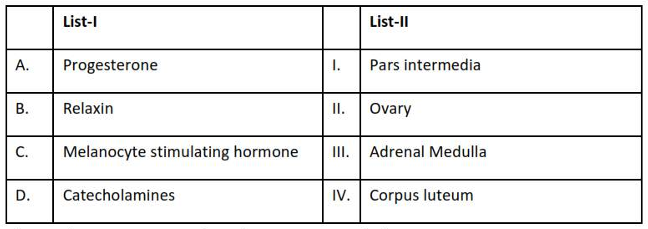
Choose the correct answer from the options given below :
(1). A-III, B-II, C-IV, D-I
(2). A-IV, B-II, C-I, D-III
(3). A-IV, B-II, C-III, D-I
(4). A-II, B-IV, C-I, D-III
Choose the correct answer from the options given below :
(1). A-III, B-II, C-IV, D-I
(2). A-IV, B-II, C-I, D-III
(3). A-IV, B-II, C-III, D-I
(4). A-II, B-IV, C-I, D-III
Number of Attempts: 2
Correct Attempts: 1
Time Taken: 00:04
Average Time: 00:02
Which of the following hormones released from the pituitary is actually synthesized in the hypothalamus ?
(1). Adenocorticotrophic hormone (ACTH)
(2). Luteinizing hormone (LH)
(3). Anti-diuretic hormone (ADH)
(4). Follicle-stimulating hormone (FSH)
(1). Adenocorticotrophic hormone (ACTH)
(2). Luteinizing hormone (LH)
(3). Anti-diuretic hormone (ADH)
(4). Follicle-stimulating hormone (FSH)
Number of Attempts: 2
Correct Attempts: 1
Time Taken: 00:04
Average Time: 00:02
Match List - I with List - II.
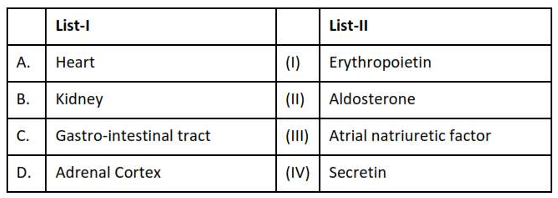
Choose the correct answer from the options given below :
(1). A-III, B-I, C-IV, D-II
(2). A-IL, B-I, C-III D-IV
(3). A-IV, B-III, C-II, D-I
(4). A-I, B-III, C-IV, D-II
Choose the correct answer from the options given below :
(1). A-III, B-I, C-IV, D-II
(2). A-IL, B-I, C-III D-IV
(3). A-IV, B-III, C-II, D-I
(4). A-I, B-III, C-IV, D-II
Number of Attempts: 2
Correct Attempts: 1
Time Taken: 00:04
Average Time: 00:02
Which of the following is not a steroid hormone?
(1). Progesterone
(2). Glucagon
(3). Cortisol
(4). Testosterone
(1). Progesterone
(2). Glucagon
(3). Cortisol
(4). Testosterone
Number of Attempts: 2
Correct Attempts: 1
Time Taken: 00:04
Average Time: 00:02
Match List I with List II
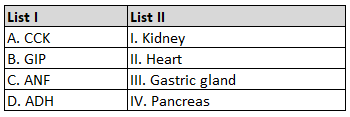
Choose the correct answer from the options given below
(1). A-III, B-II, C-IV, D-I
(2). A-II, B-IV, C-I, D-III
(3). A-IV, B-II, C-III, D-I
(4). A-IV, B-III, C-II, D-I
Choose the correct answer from the options given below
(1). A-III, B-II, C-IV, D-I
(2). A-II, B-IV, C-I, D-III
(3). A-IV, B-II, C-III, D-I
(4). A-IV, B-III, C-II, D-I
Number of Attempts: 2
Correct Attempts: 1
Time Taken: 00:04
Average Time: 00:02
Which of the following statements are correct?
A. An excessive loss of body fluid from the body switches off osmoreceptors.
B. ADH facilitates water reabsorption to prevent diuresis.
C. ANF causes vasodilation.
D. ADH causes increase in blood pressure.
E. ADH is responsible for decrease in GFR.
Choose the correct answer from the options given below:
(1). B, C and D only
(2). A, B and E only
(3). C, D and E only
(4). A and B only
A. An excessive loss of body fluid from the body switches off osmoreceptors.
B. ADH facilitates water reabsorption to prevent diuresis.
C. ANF causes vasodilation.
D. ADH causes increase in blood pressure.
E. ADH is responsible for decrease in GFR.
Choose the correct answer from the options given below:
(1). B, C and D only
(2). A, B and E only
(3). C, D and E only
(4). A and B only
Number of Attempts: 2
Correct Attempts: 1
Time Taken: 00:04
Average Time: 00:02
Which of the following are NOT under the control
of thyroid hormone?
A. Maintenance of water and electrolyte balance.
B. Regulation of basal metabolic rate.
C. Normal rhythm of sleep-wake cycle.
D. Development of immune system.
E. Support the process of R.B.Cs formation.
Choose the correct answer from the options given below:
(1). B and C only
(2). C and D only
(3). D and E only
(4). A and D only
A. Maintenance of water and electrolyte balance.
B. Regulation of basal metabolic rate.
C. Normal rhythm of sleep-wake cycle.
D. Development of immune system.
E. Support the process of R.B.Cs formation.
Choose the correct answer from the options given below:
(1). B and C only
(2). C and D only
(3). D and E only
(4). A and D only
Number of Attempts: 2
Correct Attempts: 1
Time Taken: 00:04
Average Time: 00:02
Which of the following are not the effects of
Parathyroid hormone?
(a) Stinulates the process of bone resorption,.
(b) Decreases Ca2+ level in blood,.
(c) Reabsorption of Ca by renal tubules,.
(d) Decreases the absorption of Ca² from digested food.
(e) Increases metabolism of carbohydrates.
Choose the most appropriate answer from the options given below:
(1). (a) and (c) only
(2). (b), (d) and (e) only
(3). (a) and (e) only
(4). (b) and (c) only
(a) Stinulates the process of bone resorption,.
(b) Decreases Ca2+ level in blood,.
(c) Reabsorption of Ca by renal tubules,.
(d) Decreases the absorption of Ca² from digested food.
(e) Increases metabolism of carbohydrates.
Choose the most appropriate answer from the options given below:
(1). (a) and (c) only
(2). (b), (d) and (e) only
(3). (a) and (e) only
(4). (b) and (c) only
Number of Attempts: 2
Correct Attempts: 1
Time Taken: 00:04
Average Time: 00:02
Erythropoietin hormone which stimulates R.B.C.
formation is produced by:
(1). Alpha cells of pancreas
(2). The cells of rostral adenohypophysis
(3). The cells of bone marrow
(4). Juxtaglomerular cells of the kidney
(1). Alpha cells of pancreas
(2). The cells of rostral adenohypophysis
(3). The cells of bone marrow
(4). Juxtaglomerular cells of the kidney
Number of Attempts: 2
Correct Attempts: 1
Time Taken: 00:04
Average Time: 00:02
Select the correct statement.
(1). Glucagon is associated with hypoglycemia.
(2). Insulin acts on pancreatic cells and adipocytes.
(3). Insulin is associated with hyperglycemia.
(4). Glucocorticoids stimulate gluconeogenesis.
(1). Glucagon is associated with hypoglycemia.
(2). Insulin acts on pancreatic cells and adipocytes.
(3). Insulin is associated with hyperglycemia.
(4). Glucocorticoids stimulate gluconeogenesis.
Number of Attempts: 2
Correct Attempts: 1
Time Taken: 00:04
Average Time: 00:02
Match the following hormones with the respective disease :

(1). (a) - (ii), (b) - (iv), (c) - (iii), (d) - (i)
(2). (a) - (v), (b) - (iv), (c) - (i), (d) - (iii)
(3). (a) - (ii), (b) - (iv), (c) - (i), (d) - (iii)
(4). (a) - (v), (b) - (i), (c) - (ii), (d) - (iii)
(1). (a) - (ii), (b) - (iv), (c) - (iii), (d) - (i)
(2). (a) - (v), (b) - (iv), (c) - (i), (d) - (iii)
(3). (a) - (ii), (b) - (iv), (c) - (i), (d) - (iii)
(4). (a) - (v), (b) - (i), (c) - (ii), (d) - (iii)
Number of Attempts: 2
Correct Attempts: 1
Time Taken: 00:04
Average Time: 00:02
How does steroid hormone influence the cellular activities ?
(1). Binding to DNA and forming a genehormone complex
(2). Activating cyclic AMP located on the cell membrane
(3). Using aquaporin channels as second messenger
(4). Changing the permeability of the cell membrane
(1). Binding to DNA and forming a genehormone complex
(2). Activating cyclic AMP located on the cell membrane
(3). Using aquaporin channels as second messenger
(4). Changing the permeability of the cell membrane
Number of Attempts: 2
Correct Attempts: 1
Time Taken: 00:04
Average Time: 00:02
Which of the following is an amino acid derived hormone?
(1). Estriol
(2). Estradiol
(3). Ecdysone
(4). Epinephrine
(1). Estriol
(2). Estradiol
(3). Ecdysone
(4). Epinephrine
Number of Attempts: 2
Correct Attempts: 1
Time Taken: 00:04
Average Time: 00:02
Which of the following hormones can play a significant role in osteoporosis?
(1). Parathyroid hormone and Prolactin
(2). Estrogen and Parathyroid hormone
(3). Progesterone and Aldosterone
(4). Aldosterone and Prolactin
(1). Parathyroid hormone and Prolactin
(2). Estrogen and Parathyroid hormone
(3). Progesterone and Aldosterone
(4). Aldosterone and Prolactin
Number of Attempts: 2
Correct Attempts: 1
Time Taken: 00:04
Average Time: 00:02
Hypersecretion of Growth Hormone in adults does not cause further increase in height, because
(1). muscle fibres do not grow in size after birth.
(2). growth hormone becomes inactive in adults.
(3). epiphyseal plates close after adole scence.
(4). bones loose their sensitivity to Growth Hormone in adults.
(1). muscle fibres do not grow in size after birth.
(2). growth hormone becomes inactive in adults.
(3). epiphyseal plates close after adole scence.
(4). bones loose their sensitivity to Growth Hormone in adults.
Number of Attempts: 2
Correct Attempts: 1
Time Taken: 00:04
Average Time: 00:02
The amino acid, tryptophan is the precursor for the synthesis of
(1). thyroxine and tri - iodothyronine
(2). estrogen and progesterone
(3). cortisol and cortisone
(4). melatonin and serotonin
(1). thyroxine and tri - iodothyronine
(2). estrogen and progesterone
(3). cortisol and cortisone
(4). melatonin and serotonin
Number of Attempts: 2
Correct Attempts: 1
Time Taken: 00:04
Average Time: 00:02