
Home >> My Performance >> My Topic Test Performance >> My Question Performance
My Question Performance Summary in Full Tests !
Questions Available: 18
Questions Attempted: 10
Number of Attempts: 15
Correct Attempts: 8
Total Time Spent: 00:30
Avg Time Per Question: 00:02
My Question Performance Summary in Full Tests
Cardiac activities of the heart are regulated by :
A. Nodal tissue
B. A special neural centre in the medulla oblongata
C. Adrenal medullary hormones
D. Adrenal cortical hormones
Choose the correct answer from the options given below :
(1). A, B and D Only
(2). A, B and C Only
(3). A, B, C and D
(4). A, C and D Only
A. Nodal tissue
B. A special neural centre in the medulla oblongata
C. Adrenal medullary hormones
D. Adrenal cortical hormones
Choose the correct answer from the options given below :
(1). A, B and D Only
(2). A, B and C Only
(3). A, B, C and D
(4). A, C and D Only
Number of Attempts: 2
Correct Attempts: 1
Time Taken: 00:04
Average Time: 00:02
Following are the stages of pathway for conduction of an action potential through the heart:
A. AV bundle
B. Purkinje fibres
C. AV node
D. Bundle branches
E. SA node
Choose the correct sequence of pathway from the options given below:
(1). B-D-E-C-A
(2). E-A-D-B-C
(3). E-C-A-D-B
(4). A-E-C-B-D
A. AV bundle
B. Purkinje fibres
C. AV node
D. Bundle branches
E. SA node
Choose the correct sequence of pathway from the options given below:
(1). B-D-E-C-A
(2). E-A-D-B-C
(3). E-C-A-D-B
(4). A-E-C-B-D
Number of Attempts: 2
Correct Attempts: 1
Time Taken: 00:04
Average Time: 00:02
Match List I with List II: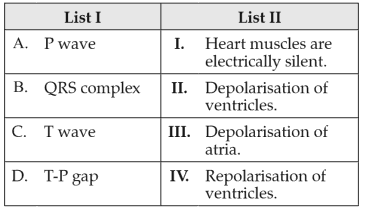
Choose the correct answer from the options given below:
(1). A-II, B-III, C-I, D-IV
(2). A-IV, B-II, C-I, D-III
(3). A-I, B-III, C-IV, D-II
(4). A-III, B-II, C-IV, D-I
Choose the correct answer from the options given below:
(1). A-II, B-III, C-I, D-IV
(2). A-IV, B-II, C-I, D-III
(3). A-I, B-III, C-IV, D-II
(4). A-III, B-II, C-IV, D-I
Number of Attempts: 2
Correct Attempts: 1
Time Taken: 00:04
Average Time: 00:02
Match List I with List II.
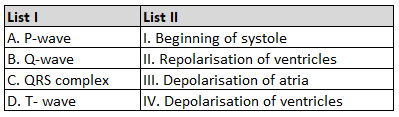
Choose the correct answer from the options given below:
(1). A-IV, B-III, C-II, D-I
(2). A-II, B-IV, C-I, D-III
(3). A-I, B-II, C-III, D-IV
(4). A-III, B-I, C-IV, D-II
Choose the correct answer from the options given below:
(1). A-IV, B-III, C-II, D-I
(2). A-II, B-IV, C-I, D-III
(3). A-I, B-II, C-III, D-IV
(4). A-III, B-I, C-IV, D-II
Number of Attempts: 2
Correct Attempts: 1
Time Taken: 00:04
Average Time: 00:02
Which of the following statements are correct?
A. Basophils are most abundant cells of the total WBCs
B. Basophils secrete histamine, serotonin and heparin
C. Basophils are involved in inflammatory response
D. Basophils have kidney shaped nucleus
E. Basophils are agranulocytes
Choose the correct answer from the options given below:
(1). C and E only
(2). B and C only
(3). A and B only
(4). D and E only
A. Basophils are most abundant cells of the total WBCs
B. Basophils secrete histamine, serotonin and heparin
C. Basophils are involved in inflammatory response
D. Basophils have kidney shaped nucleus
E. Basophils are agranulocytes
Choose the correct answer from the options given below:
(1). C and E only
(2). B and C only
(3). A and B only
(4). D and E only
Number of Attempts: 2
Correct Attempts: 1
Time Taken: 00:04
Average Time: 00:02
Given below are two statements:
Statement I : The coagulum is formed of a network of threads called thrombins.
Statemnent II : Spleen is the graveyard of erythrocytes.
In the light of the above statements, choose the most appropriate answer from the options given below:
(1). Both Statement I and Statement II are correct
(2). Both Statement I and Statement II are incorrect
(3). Statement I is correct but Statement II is incorrect
(4). Statement I is incorrect but Statement II is correct
Statement I : The coagulum is formed of a network of threads called thrombins.
Statemnent II : Spleen is the graveyard of erythrocytes.
In the light of the above statements, choose the most appropriate answer from the options given below:
(1). Both Statement I and Statement II are correct
(2). Both Statement I and Statement II are incorrect
(3). Statement I is correct but Statement II is incorrect
(4). Statement I is incorrect but Statement II is correct
Number of Attempts: 2
Correct Attempts: 1
Time Taken: 00:04
Average Time: 00:02
Which one of the following statements is correct ?
(1). The atrioventricular node (AVN) generates an action potential to stimulate atrial contraction
(2). The tricuspid and the bicuspid valves open due to the pressure exerted by the simultaneous contraction of the atria
(3). Blood moves freely from atrium to the ventricle during joint diastole
(4). Increased ventricular pressure causes closing of the semilunar valves
(1). The atrioventricular node (AVN) generates an action potential to stimulate atrial contraction
(2). The tricuspid and the bicuspid valves open due to the pressure exerted by the simultaneous contraction of the atria
(3). Blood moves freely from atrium to the ventricle during joint diastole
(4). Increased ventricular pressure causes closing of the semilunar valves
Number of Attempts: 2
Correct Attempts: 1
Time Taken: 00:04
Average Time: 00:02
Which enzyme is responsible for the conversion of
inactive fibrinogens to fibrins?
(1). Thrombin
(2). Renin
(3). Epinephrine
(4). Thrombokinase
(1). Thrombin
(2). Renin
(3). Epinephrine
(4). Thrombokinase
Number of Attempts: 2
Correct Attempts: 1
Time Taken: 00:04
Average Time: 00:02
Persons with 'AB' blood group are called as "Universal recipients", This is due to:
(1). Absence of antigens A and B on the surface of RBCs
(2). Absence of antigens A and B in plasma
(3). Presence of antibodies, anti-A and anti-B, on RBCs
(4). Absence of antibodies, anti-A and anti-B, in plasma
(1). Absence of antigens A and B on the surface of RBCs
(2). Absence of antigens A and B in plasma
(3). Presence of antibodies, anti-A and anti-B, on RBCs
(4). Absence of antibodies, anti-A and anti-B, in plasma
Number of Attempts: 2
Correct Attempts: 1
Time Taken: 00:04
Average Time: 00:02
The QRS complex in a standard ECG represents:
(1). Depolarisation of auricles
(2). Depolarisation of ventrices
(3). Repolarisation of ventricles
(4). Repolarisation of auricles
(1). Depolarisation of auricles
(2). Depolarisation of ventrices
(3). Repolarisation of ventricles
(4). Repolarisation of auricles
Number of Attempts: 2
Correct Attempts: 1
Time Taken: 00:04
Average Time: 00:02
Match the following columns and select the correctoption.

(1). (a) - (iii), (b) - (ii), (c) - (i), (d) - (iv)
(2). (a) - (iii), (b) - (i), (c) - (iv), (d) - (ii)
(3). (a) - (ii), (b) - (i), (c) - (iv), (d) - (iii)
(4). (a) - (iv), (b) - (iii), (c) - (i), (d) - (ii)
(1). (a) - (iii), (b) - (ii), (c) - (i), (d) - (iv)
(2). (a) - (iii), (b) - (i), (c) - (iv), (d) - (ii)
(3). (a) - (ii), (b) - (i), (c) - (iv), (d) - (iii)
(4). (a) - (iv), (b) - (iii), (c) - (i), (d) - (ii)
Number of Attempts: 2
Correct Attempts: 1
Time Taken: 00:04
Average Time: 00:02
Match the following columns and select the correctoption.

(1). (a) - (iv), (b) - (i), (c) - (ii), (d) - (iii)
(2). (a) - (i), (b) - (ii), (c) - (iv), (d) - (iii)
(3). (a) - (ii), (b) - (i), (c) - (iii), (d) - (iv)
(4). (a) - (iii), (b) - (iv), (c) - (ii), (d) - (i)
(1). (a) - (iv), (b) - (i), (c) - (ii), (d) - (iii)
(2). (a) - (i), (b) - (ii), (c) - (iv), (d) - (iii)
(3). (a) - (ii), (b) - (i), (c) - (iii), (d) - (iv)
(4). (a) - (iii), (b) - (iv), (c) - (ii), (d) - (i)
Number of Attempts: 2
Correct Attempts: 1
Time Taken: 00:04
Average Time: 00:02
Match the column I with Column 2

(1). (a) - (iv), (b) - (i), (c) - (ii), (d) - (v)
(2). (a) - (ii), (b) - (i), (c) - (v), (d) - (iii)
(3). (a) - (ii), (b) - (iii), (c) - (v), (d) - (iv)
(4). (a) - (iv), (b) - (i), (c) - (ii), (d) - (iii)
(1). (a) - (iv), (b) - (i), (c) - (ii), (d) - (v)
(2). (a) - (ii), (b) - (i), (c) - (v), (d) - (iii)
(3). (a) - (ii), (b) - (iii), (c) - (v), (d) - (iv)
(4). (a) - (iv), (b) - (i), (c) - (ii), (d) - (iii)
Number of Attempts: 2
Correct Attempts: 1
Time Taken: 00:04
Average Time: 00:02
What would be the heart rate of a person if the cardiac output is 5 L , blood volume in the ventricles at the end of diastole is 100 mL and at the end of ventricular systole is 50 ml ?
(1). 75 beats per minute
(2). 100 beats per minute
(3). 125 beats per minute
(4). 50 beats per minute
(1). 75 beats per minute
(2). 100 beats per minute
(3). 125 beats per minute
(4). 50 beats per minute
Number of Attempts: 2
Correct Attempts: 1
Time Taken: 00:04
Average Time: 00:02
Match the items given in Column I with those in Column II and select the correct option given below:
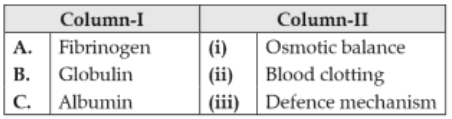
(1). (a) - (ii), (b) - (iii), (c) - (i)
(2). (a) - (i), (b) - (iii), (c) - (ii)
(3). (a) - (i), (b) - (ii), (c) - (iii)
(4). (a) - (iii), (b) - (ii), (c) - (i)
(1). (a) - (ii), (b) - (iii), (c) - (i)
(2). (a) - (i), (b) - (iii), (c) - (ii)
(3). (a) - (i), (b) - (ii), (c) - (iii)
(4). (a) - (iii), (b) - (ii), (c) - (i)
Number of Attempts: 2
Correct Attempts: 1
Time Taken: 00:04
Average Time: 00:02
Match the items given in Column I with those in Column II and select the correct option given below :
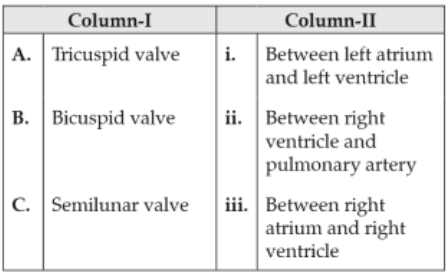
(1). (a) - (ii), (b) - (i), (c) - (iii)
(2). (a) - (i), (b) - (ii), (c) - (iii)
(3). (a) - (i), (b) - (iii), (c) - (ii)
(4). (a) - (iii), (b) - (i), (c) - (ii)
(1). (a) - (ii), (b) - (i), (c) - (iii)
(2). (a) - (i), (b) - (ii), (c) - (iii)
(3). (a) - (i), (b) - (iii), (c) - (ii)
(4). (a) - (iii), (b) - (i), (c) - (ii)
Number of Attempts: 2
Correct Attempts: 1
Time Taken: 00:04
Average Time: 00:02
Adult human RBC's are enucleate. Which of the following statement(s) is/are most appropriate explanation for this feature ?
(i) They do not need to reproduce
(ii) They are somatic cells
(iii) They do not metabolise
(iv) All their internal space is available for oxygen
(1). (ii) and (iii)
(2). Only (iv)
(3). Only (i)
(4). (i), (iii) and (iv)
(i) They do not need to reproduce
(ii) They are somatic cells
(iii) They do not metabolise
(iv) All their internal space is available for oxygen
(1). (ii) and (iii)
(2). Only (iv)
(3). Only (i)
(4). (i), (iii) and (iv)
Number of Attempts: 2
Correct Attempts: 1
Time Taken: 00:04
Average Time: 00:02
Blood pressure in the pulmonary artery is
(1). more than that in the carotid
(2). more than that in the pulmonary vein
(3). less than that in the venae cavae
(4). same as that in the aorta
(1). more than that in the carotid
(2). more than that in the pulmonary vein
(3). less than that in the venae cavae
(4). same as that in the aorta
Number of Attempts: 2
Correct Attempts: 1
Time Taken: 00:04
Average Time: 00:02