
Home >> My Performance >> My Topic Test Performance >> My Question Performance
My Question Performance Summary in Full Tests !
Questions Available: 30
Questions Attempted: 10
Number of Attempts: 15
Correct Attempts: 8
Total Time Spent: 00:30
Avg Time Per Question: 00:02
My Question Performance Summary in Full Tests
Regarding catalytic cycle of an enzyme action, select the correct sequential steps :
A. Substrate enzyme complex formation.
B. Free enzyme ready to bind with another substrate.
C. Release of products.
D. Chemical bonds of the substrate broken.
E. Substrate binding to active site.
Choose the correct answer from the options given below :
(1). B, A, C, D, E
(2). E, D, C, B, A
(3). E, A, D, C, B
(4). A, E, B, D, C
A. Substrate enzyme complex formation.
B. Free enzyme ready to bind with another substrate.
C. Release of products.
D. Chemical bonds of the substrate broken.
E. Substrate binding to active site.
Choose the correct answer from the options given below :
(1). B, A, C, D, E
(2). E, D, C, B, A
(3). E, A, D, C, B
(4). A, E, B, D, C
Number of Attempts: 2
Correct Attempts: 1
Time Taken: 00:04
Average Time: 00:02
Read the following statements on lipids and find
out correct set of statements:
(a) Lecithin found in the plasma membrane is a glycolipid.
(b) Saturated fatty acids possess one or more c =c bonds.
(c) Gingely oil has lower melting point, hence remains as oil in winter.
(d) Lipids are generally insoluble in water but soluble in some organic solvents.
(e) When fatty acid is esterified with glycerol, monoglycerides are formed.
Choose the correct answer from the options given below:
(1). (a), (b) and (c) only
(2). (a), (d) and (e) only
(3). ('c), (d) and (e) only
(4). (a), (b) and (d) only
(a) Lecithin found in the plasma membrane is a glycolipid.
(b) Saturated fatty acids possess one or more c =c bonds.
(c) Gingely oil has lower melting point, hence remains as oil in winter.
(d) Lipids are generally insoluble in water but soluble in some organic solvents.
(e) When fatty acid is esterified with glycerol, monoglycerides are formed.
Choose the correct answer from the options given below:
(1). (a), (b) and (c) only
(2). (a), (d) and (e) only
(3). ('c), (d) and (e) only
(4). (a), (b) and (d) only
Number of Attempts: 2
Correct Attempts: 1
Time Taken: 00:04
Average Time: 00:02
Match the following:
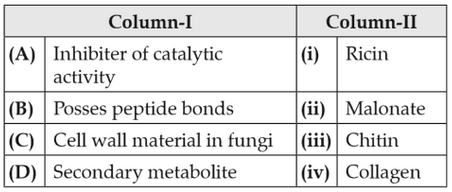
Choose the correct option from the following:
(1). (a) - (iii), (b) - (i), (c) - (iv), (d) - (ii)
(2). (a) - (iii), (b) - (iv), (c) - (i), (d) - (ii)
(3). (a) - (ii), (b) - (iii), (c) - (i), (d) - (iv)
(4). (a) - (ii), (b) - (iv), (c) - (iii), (d) - (i)
Choose the correct option from the following:
(1). (a) - (iii), (b) - (i), (c) - (iv), (d) - (ii)
(2). (a) - (iii), (b) - (iv), (c) - (i), (d) - (ii)
(3). (a) - (ii), (b) - (iii), (c) - (i), (d) - (iv)
(4). (a) - (ii), (b) - (iv), (c) - (iii), (d) - (i)
Number of Attempts: 2
Correct Attempts: 1
Time Taken: 00:04
Average Time: 00:02
Which of following organisms cannot fix nitrogen?
A. Azotobacter
B. Oscillatoria
C. Anabaena
D. Volvox
E. Nostoc
Choose the correct answer from the options given below:
(1). E only
(2). A only
(3). D only
(4). Bonly
A. Azotobacter
B. Oscillatoria
C. Anabaena
D. Volvox
E. Nostoc
Choose the correct answer from the options given below:
(1). E only
(2). A only
(3). D only
(4). Bonly
Number of Attempts: 2
Correct Attempts: 1
Time Taken: 00:04
Average Time: 00:02
Match List I with List II.
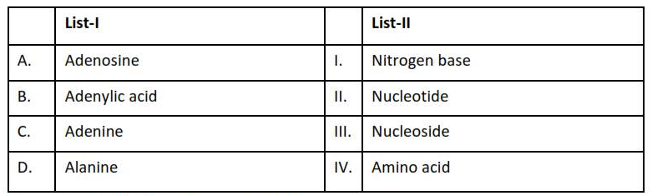
Choose the option with all correct matches.
(1). A-II, B-III, C-I, D-IV
(2). A-III, B-IV, C-II, D-I
(3). A-III, B-II, C-IV, D-I
(4). A-III, B-II, C-I, D-IV
Choose the option with all correct matches.
(1). A-II, B-III, C-I, D-IV
(2). A-III, B-IV, C-II, D-I
(3). A-III, B-II, C-IV, D-I
(4). A-III, B-II, C-I, D-IV
Number of Attempts: 2
Correct Attempts: 1
Time Taken: 00:04
Average Time: 00:02
The protein portion of an enzyme is called :
(1). Prosthetic group
(2). Cofactor
(3). Coenzyme
(4). Apoenzyme
(1). Prosthetic group
(2). Cofactor
(3). Coenzyme
(4). Apoenzyme
Number of Attempts: 2
Correct Attempts: 1
Time Taken: 00:04
Average Time: 00:02
Which one of the following enzymes contains
'Haem' as the prosthetic group?
(1). Catalase
(2). RuBisCo
(3). Carbonic anhydrase
(4). Succinate dehydrogenase
(1). Catalase
(2). RuBisCo
(3). Carbonic anhydrase
(4). Succinate dehydrogenase
Number of Attempts: 2
Correct Attempts: 1
Time Taken: 00:04
Average Time: 00:02
Inhibition of Succinic dehydrogenase enzyme by malonate is a classical example of:
(1). Competitive inhibition
(2). Enzyme activation
(3). Cofactor inhibition
(4). Feedback inhibition
(1). Competitive inhibition
(2). Enzyme activation
(3). Cofactor inhibition
(4). Feedback inhibition
Number of Attempts: 2
Correct Attempts: 1
Time Taken: 00:04
Average Time: 00:02
Lectin, a small molecular weight organic compound found in living tissues, is an example of:
(1). Glycerides
(2). Carbohydrates
(3). Amino acids
(4). Phospolipids
(1). Glycerides
(2). Carbohydrates
(3). Amino acids
(4). Phospolipids
Number of Attempts: 2
Correct Attempts: 1
Time Taken: 00:04
Average Time: 00:02
The cofactor of the enzyme carboxypeptidase is:
(1). Flavin
(2). Haem
(3). Zinc
(4). Niacin
(1). Flavin
(2). Haem
(3). Zinc
(4). Niacin
Number of Attempts: 2
Correct Attempts: 1
Time Taken: 00:04
Average Time: 00:02
Match List I with List II:
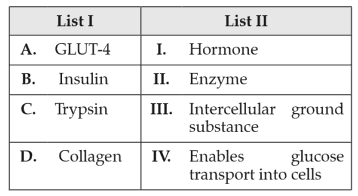
Choose the correct answer from the options given below:
(1). A-II, B-III, C-IV, D-I
(2). A-III, B-IV, C-I, D-II
(3). A-IV, B-I, C-II, D-III
(4). A-I, B-II, C-III, D-IV
Choose the correct answer from the options given below:
(1). A-II, B-III, C-IV, D-I
(2). A-III, B-IV, C-I, D-II
(3). A-IV, B-I, C-II, D-III
(4). A-I, B-II, C-III, D-IV
Number of Attempts: 2
Correct Attempts: 1
Time Taken: 00:04
Average Time: 00:02
Match List I with List II: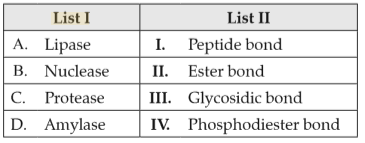
Choose the correct answer from the options given below:
(1). A-II, B-IV, C-I, D-III
(2). A-IV, B-I, C-III, D-II
(3). A-IV, B-II, C-III, D-I
(4). A-III, B-II, C-I, D-IV
Choose the correct answer from the options given below:
(1). A-II, B-IV, C-I, D-III
(2). A-IV, B-I, C-III, D-II
(3). A-IV, B-II, C-III, D-I
(4). A-III, B-II, C-I, D-IV
Number of Attempts: 2
Correct Attempts: 1
Time Taken: 00:04
Average Time: 00:02
Given below are two statements :
Statement I : A protein is imagined as a line, the left end represented by first amino acid (C-terminal) and the right end represented by last amino acid (N-terminal).
Statement II : Adult human haemoglobin, consists of 4 subunits (two subunits of \(\alpha\) type and two subunits of \(\beta\) type.)
In the light of the above statements, choose the correct answer from the options given below:
(1). Both statement I and Statement II are false.
(2). Statement I is true but Statement II is false.
(3). Statement I is false but Statement II is true.
(4). Both statement I and Statement II are true.
Statement I : A protein is imagined as a line, the left end represented by first amino acid (C-terminal) and the right end represented by last amino acid (N-terminal).
Statement II : Adult human haemoglobin, consists of 4 subunits (two subunits of \(\alpha\) type and two subunits of \(\beta\) type.)
In the light of the above statements, choose the correct answer from the options given below:
(1). Both statement I and Statement II are false.
(2). Statement I is true but Statement II is false.
(3). Statement I is false but Statement II is true.
(4). Both statement I and Statement II are true.
Number of Attempts: 2
Correct Attempts: 1
Time Taken: 00:04
Average Time: 00:02
Given below are two statements :
Statement I : Low temperature preserves the enzyme in a temporarily inactive state whereas high temperature destroys enzymatic activity because proteins are denatured by heat.
Statement II : When the inhibitor closely resembles the substrate in its molecular structure and inhibits the activity of the enzyme, it is known as competitive inhibitor.
In the light of the above statements, choose the correct answer from the options given below :
(1). Both Statement I and Statement II are false.
(2). Statement I is true but Statement II is false.
(3). Statement I is false but Statement II is true.
(4). Both Statement I and Statement II are true.
Statement I : Low temperature preserves the enzyme in a temporarily inactive state whereas high temperature destroys enzymatic activity because proteins are denatured by heat.
Statement II : When the inhibitor closely resembles the substrate in its molecular structure and inhibits the activity of the enzyme, it is known as competitive inhibitor.
In the light of the above statements, choose the correct answer from the options given below :
(1). Both Statement I and Statement II are false.
(2). Statement I is true but Statement II is false.
(3). Statement I is false but Statement II is true.
(4). Both Statement I and Statement II are true.
Number of Attempts: 2
Correct Attempts: 1
Time Taken: 00:04
Average Time: 00:02
A dehydration reaction links two glucose molecules to produce maltose. If the formula for glucose is C6H12O6 then what is the formula for maltose?
(1). C12H20O10
(2). C12H24O12
(3). C12H22O11
(4). C12H24O11
(1). C12H20O10
(2). C12H24O12
(3). C12H22O11
(4). C12H24O11
Number of Attempts: 2
Correct Attempts: 1
Time Taken: 00:04
Average Time: 00:02
Match list I with list II.
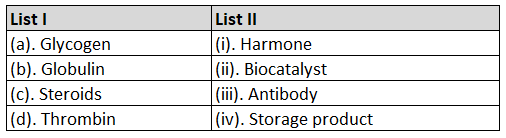
Choose the correct answerfrom the options given below :
(1). (a)- (ii); (b) - (iü); (c) -(iv); (d)- (i)a
(2). (a)- (iv); (b) - (ii); (c) -(i); (d)- (ii)oinb
(3). (a)- (ii); (b) - (iv); (c) - (ii); (d) (i)
(4). (a)- (iv); (b) - (iü); (c) - (i); (d) - (ii)
Choose the correct answerfrom the options given below :
(1). (a)- (ii); (b) - (iü); (c) -(iv); (d)- (i)a
(2). (a)- (iv); (b) - (ii); (c) -(i); (d)- (ii)oinb
(3). (a)- (ii); (b) - (iv); (c) - (ii); (d) (i)
(4). (a)- (iv); (b) - (iü); (c) - (i); (d) - (ii)
Number of Attempts: 2
Correct Attempts: 1
Time Taken: 00:04
Average Time: 00:02
Following are the statements with reference to
"lipids'.
(a) Lipids having only single bonds are called unsaturated fatty acids.
(b) Lecithin is a phospholipid.
(c) Trihydroxy propane is glycerol.
(d) Palmitic acid has 20 carbon atoms including carboxyl carbon.
(e) Arachidonic acid has 16 carbon atoms.
Choose the correct answer from the options given below.
(1). (a) and (b) only
(2). (c) and (d) only
(3). (b) and (c) only
(4). (b) and (e) only
(a) Lipids having only single bonds are called unsaturated fatty acids.
(b) Lecithin is a phospholipid.
(c) Trihydroxy propane is glycerol.
(d) Palmitic acid has 20 carbon atoms including carboxyl carbon.
(e) Arachidonic acid has 16 carbon atoms.
Choose the correct answer from the options given below.
(1). (a) and (b) only
(2). (c) and (d) only
(3). (b) and (c) only
(4). (b) and (e) only
Number of Attempts: 2
Correct Attempts: 1
Time Taken: 00:04
Average Time: 00:02
Match List -I with List - II.
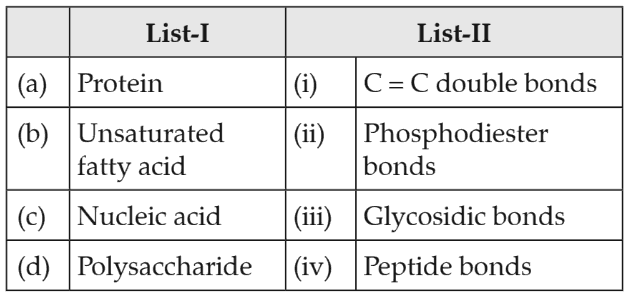
Choose the correct answer from the options given below.
(1). (a) - (iv), (b) - (i), (c) - (ii), (d) - (iii)
(2). (a) - (i), (b) - (iv), (c) - (iii), (d) - (ii)
(3). (a) - (ii), (b) - (i), (c) -(iv), (d) - (iii)
(4). (a) - (iv), (b) - (iii), (c) -(i), (d) - (ii)
Choose the correct answer from the options given below.
(1). (a) - (iv), (b) - (i), (c) - (ii), (d) - (iii)
(2). (a) - (i), (b) - (iv), (c) - (iii), (d) - (ii)
(3). (a) - (ii), (b) - (i), (c) -(iv), (d) - (iii)
(4). (a) - (iv), (b) - (iii), (c) -(i), (d) - (ii)
Number of Attempts: 2
Correct Attempts: 1
Time Taken: 00:04
Average Time: 00:02
With regard to insulin choose correct options.
(a) C-peptide is not present in mature insulin.
(b) The insulin produced by rDNA technology has C-peptide.
(c) The pro-insulin has C-peptide.
(d) A-peptide and B-peptide of insulin are interconnected by disulphide bridges.
Choose the correct answer from the options given below.
(1). (b) and (d) only
(2). (b) and (c) only
(3). (a), (c) and (d) only
(4). (a) and (d) only
(a) C-peptide is not present in mature insulin.
(b) The insulin produced by rDNA technology has C-peptide.
(c) The pro-insulin has C-peptide.
(d) A-peptide and B-peptide of insulin are interconnected by disulphide bridges.
Choose the correct answer from the options given below.
(1). (b) and (d) only
(2). (b) and (c) only
(3). (a), (c) and (d) only
(4). (a) and (d) only
Number of Attempts: 2
Correct Attempts: 1
Time Taken: 00:04
Average Time: 00:02
ldentify the basic amino acid from the following.
(1). Glutamic Acid
(2). Lysine
(3). Valine
(4). Tyrosine
(1). Glutamic Acid
(2). Lysine
(3). Valine
(4). Tyrosine
Number of Attempts: 2
Correct Attempts: 1
Time Taken: 00:04
Average Time: 00:02
ldentify the substances having glycosidic bond and
peptide bond, respectively in their structure
(1). Glycerol, trypsin Chitin, cholesterol
(2). Cellulose, lecithin
(3). Inulin, insulin
(4). Chitin, cholesterol
(1). Glycerol, trypsin Chitin, cholesterol
(2). Cellulose, lecithin
(3). Inulin, insulin
(4). Chitin, cholesterol
Number of Attempts: 2
Correct Attempts: 1
Time Taken: 00:04
Average Time: 00:02
Which one of the following is the most abundant
protein in the animals ?
(1). Collagen
(2). Lectin
(3). Insulin
(4). Haemoglobin
(1). Collagen
(2). Lectin
(3). Insulin
(4). Haemoglobin
Number of Attempts: 2
Correct Attempts: 1
Time Taken: 00:04
Average Time: 00:02
Concanavalin A is
(1). an essential oil.
(2). a lectin.
(3). a pigment.
(4). an alkaloid.
(1). an essential oil.
(2). a lectin.
(3). a pigment.
(4). an alkaloid.
Number of Attempts: 2
Correct Attempts: 1
Time Taken: 00:04
Average Time: 00:02
Consider the following statements :
(A) Coenzyme or metal ion that is tightly bound to enzyme protein is called prosthetic group.
(B) A complete catalytic active enzyme with its bound prosthetic group is called apoenzyme.
Select the correct option.
(1). (A) is true by (B) is false
(2). Both (A) and (B) are false
(3). (A) is false but (B) is true
(4). Both (A) and (B) are true
(A) Coenzyme or metal ion that is tightly bound to enzyme protein is called prosthetic group.
(B) A complete catalytic active enzyme with its bound prosthetic group is called apoenzyme.
Select the correct option.
(1). (A) is true by (B) is false
(2). Both (A) and (B) are false
(3). (A) is false but (B) is true
(4). Both (A) and (B) are true
Number of Attempts: 2
Correct Attempts: 1
Time Taken: 00:04
Average Time: 00:02
The two functional groups characteristic of sugars are
(1). carbonyl and hydroxyl.
(2). carbonyl and phosphate.
(3). carbonyl and methyl.
(4). hydroxyl and methyl.
(1). carbonyl and hydroxyl.
(2). carbonyl and phosphate.
(3). carbonyl and methyl.
(4). hydroxyl and methyl.
Number of Attempts: 2
Correct Attempts: 1
Time Taken: 00:04
Average Time: 00:02
Viroids differ from viruses in having
(1). RNA molecules without protein coat.
(2). DNA molecules with protein coat.
(3). DNA molecules without protein coat.
(4). RNA molecules with protein coat.
(1). RNA molecules without protein coat.
(2). DNA molecules with protein coat.
(3). DNA molecules without protein coat.
(4). RNA molecules with protein coat.
Number of Attempts: 2
Correct Attempts: 1
Time Taken: 00:04
Average Time: 00:02
Which one of the following statements is correct, with reference to enzymes ?
(1). Holoenzyme = Coenzyme + Co-factor
(2). Apoenzyme = Holoenzyme + Coenzyme
(3). Holoenzyme = Apoenzyme + Coenzyme
(4). Coenzyme = Apoenzyme + Holoenzyme
(1). Holoenzyme = Coenzyme + Co-factor
(2). Apoenzyme = Holoenzyme + Coenzyme
(3). Holoenzyme = Apoenzyme + Coenzyme
(4). Coenzyme = Apoenzyme + Holoenzyme
Number of Attempts: 2
Correct Attempts: 1
Time Taken: 00:04
Average Time: 00:02
Which of the following are not polymeric ?
(1). Lipids
(2). Nucleic acids
(3). Proteins
(4). Polysaccharides
(1). Lipids
(2). Nucleic acids
(3). Proteins
(4). Polysaccharides
Number of Attempts: 2
Correct Attempts: 1
Time Taken: 00:04
Average Time: 00:02
Which one of the following statements is wrong ?
(1). Cellulose is a polysaccharide
(2). Uracil is a pyrimidine
(3). Glycine is a sulphur containing amino acid
(4). Sucrose is a disaccharide
(1). Cellulose is a polysaccharide
(2). Uracil is a pyrimidine
(3). Glycine is a sulphur containing amino acid
(4). Sucrose is a disaccharide
Number of Attempts: 2
Correct Attempts: 1
Time Taken: 00:04
Average Time: 00:02
A typical fat molecule is made up of
(1). one glycerol and three fatty acid molecules
(2). one glycerol and one fatty acid molecule
(3). three glycerol and three fatty acid molecules
(4). three glycerol molecules and one fatty acid molecule
(1). one glycerol and three fatty acid molecules
(2). one glycerol and one fatty acid molecule
(3). three glycerol and three fatty acid molecules
(4). three glycerol molecules and one fatty acid molecule
Number of Attempts: 2
Correct Attempts: 1
Time Taken: 00:04
Average Time: 00:02