
Home >> My Performance >> My Topic Test Performance >> My Question Performance
My Question Performance Summary in Full Tests !
Questions Available: 27
Questions Attempted: 10
Number of Attempts: 15
Correct Attempts: 8
Total Time Spent: 00:30
Avg Time Per Question: 00:02
My Question Performance Summary in Full Tests
Identify the part of the seed from the given figure which is destined to form root when the seed germinates
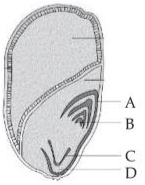
(1). C
(2). D
(3). A
(4). B
(1). C
(2). D
(3). A
(4). B
Number of Attempts: 2
Correct Attempts: 1
Time Taken: 00:04
Average Time: 00:02
The flowers are Zygomorphic in:
(a) Mustard
(b) Gulmohar
(c) Cassia
(d) Datura
(e) Chilli
Choose the correct answer from the options given below:
(1). (a), (b), (c) only
(2). (b), (c) only
(3). (d), (e) only
(4). ('c), (d), (e) only
(a) Mustard
(b) Gulmohar
(c) Cassia
(d) Datura
(e) Chilli
Choose the correct answer from the options given below:
(1). (a), (b), (c) only
(2). (b), (c) only
(3). (d), (e) only
(4). ('c), (d), (e) only
Number of Attempts: 2
Correct Attempts: 1
Time Taken: 00:04
Average Time: 00:02
Which of the following is not a stem modification ?
(1). Thorns of citrus
(2). Tendrils of cucumber
(3). Flattened structures of Opuntia
(4). Pitcher of Nepenthes
(1). Thorns of citrus
(2). Tendrils of cucumber
(3). Flattened structures of Opuntia
(4). Pitcher of Nepenthes
Number of Attempts: 2
Correct Attempts: 1
Time Taken: 00:04
Average Time: 00:02
The standard petal of a papilionaceous corolla is also called
(1). pappus
(2). vexillum
(3). corona
(4). carina
(1). pappus
(2). vexillum
(3). corona
(4). carina
Number of Attempts: 2
Correct Attempts: 1
Time Taken: 00:04
Average Time: 00:02
Given below are two statements :
Statement I: In a floral formula \(\oplus\) stands for zygomorphic nature of the flower, and G stands for inferior ovary.
Statement II : In a floral formula \(\oplus\) stands for actinomorphic nature of the flower and G stands for superior ovary.
In the light of the above statements, choose the correct answer from the options given below:
(1). Statement I is incorrect but Statement II is correct
(2). Both Statement I and Statement II are correct
(3). Both Statement I and Statement II are incorrect
(4). Statement I is correct but Statement II is incorrect
Statement I: In a floral formula \(\oplus\) stands for zygomorphic nature of the flower, and G stands for inferior ovary.
Statement II : In a floral formula \(\oplus\) stands for actinomorphic nature of the flower and G stands for superior ovary.
In the light of the above statements, choose the correct answer from the options given below:
(1). Statement I is incorrect but Statement II is correct
(2). Both Statement I and Statement II are correct
(3). Both Statement I and Statement II are incorrect
(4). Statement I is correct but Statement II is incorrect
Number of Attempts: 2
Correct Attempts: 1
Time Taken: 00:04
Average Time: 00:02
Which of the following is an example of a zygomorphic flower?
(1). Chilli
(2). Petunia
(3). Datura
(4). Pea
(1). Chilli
(2). Petunia
(3). Datura
(4). Pea
Number of Attempts: 2
Correct Attempts: 1
Time Taken: 00:04
Average Time: 00:02
Which of the following is an example of actinomorphic flower?
(1). Pisum
(2). Sesbania
(3). Datura
(4). Cassia
(1). Pisum
(2). Sesbania
(3). Datura
(4). Cassia
Number of Attempts: 2
Correct Attempts: 1
Time Taken: 00:04
Average Time: 00:02
Match List I with List II:
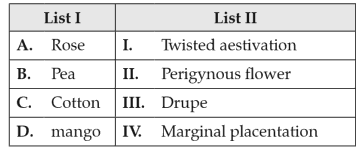
Choose the correct answer from the options given below:
(1). A-IV, B-III, C-II, D-I
(2). A-II, B-III, C-IV, D-I
(3). A-II, B-IV, C-I, D-III
(4). A-I, B-II, C-III, D-IV
Choose the correct answer from the options given below:
(1). A-IV, B-III, C-II, D-I
(2). A-II, B-III, C-IV, D-I
(3). A-II, B-IV, C-I, D-III
(4). A-I, B-II, C-III, D-IV
Number of Attempts: 2
Correct Attempts: 1
Time Taken: 00:04
Average Time: 00:02
Match List I with List II:
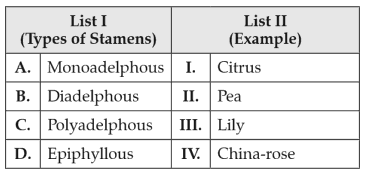 Choose the correct answer from the options given below:
(1). A-I, B-II, C-IV, D-III
(2). A-III, B-I, C-IV, D-II
(3). A-IV, B-II, C-I, D-III
(4). A-IV, B-I, C-II, D-III
Choose the correct answer from the options given below:(1). A-I, B-II, C-IV, D-III
(2). A-III, B-I, C-IV, D-II
(3). A-IV, B-II, C-I, D-III
(4). A-IV, B-I, C-II, D-III
Number of Attempts: 2
Correct Attempts: 1
Time Taken: 00:04
Average Time: 00:02
Family Fabaceae differs from Solanaceae and
Liliaceae. With respect to the stamens, pick out
the characteristics specific to family Fabaceae but
not found in Solanaceae or Liliaceae.
(1). Polyadelphous and epipetalous stamens
(2). Monoadelphous and Monothecous anthers
(3). Epiphyllous and Dithecous anthers
(4). Diadelphous and Dithecous anthers
(1). Polyadelphous and epipetalous stamens
(2). Monoadelphous and Monothecous anthers
(3). Epiphyllous and Dithecous anthers
(4). Diadelphous and Dithecous anthers
Number of Attempts: 2
Correct Attempts: 1
Time Taken: 00:04
Average Time: 00:02
Axile placentation is observed in
(1). China rose, Beans and Lupin
(2). Tomato, Dianthus and Pea
(3). China rose, Petunia and Lemon
(4). Mustard, Cucumber and Primrose
(1). China rose, Beans and Lupin
(2). Tomato, Dianthus and Pea
(3). China rose, Petunia and Lemon
(4). Mustard, Cucumber and Primrose
Number of Attempts: 2
Correct Attempts: 1
Time Taken: 00:04
Average Time: 00:02
Identify the correct set of statements:
(a) The leaflets are modified into pointed hard thorns in Citrus and Bougainvillea.
(b) Axillary buds form slender and spirally coiled tendrils in cucumber and pumpkin.
(c) Stem is flattened and fleshy on Opuntia and modified to perform the function of leaves.
(d) Rhizophora shows vertically upward growing roots that help to get oxygen for respiration.
(e) Subaerially growing stems in grasses and strawberry help in vegetative propagation.
Choose the correct answer from the options given below:
(1). (b) and (c) only
(2). (a) and (d) only
(3). (b), (c), (d) and (e) only
(4). (a), (b), (d) and (e) only
(a) The leaflets are modified into pointed hard thorns in Citrus and Bougainvillea.
(b) Axillary buds form slender and spirally coiled tendrils in cucumber and pumpkin.
(c) Stem is flattened and fleshy on Opuntia and modified to perform the function of leaves.
(d) Rhizophora shows vertically upward growing roots that help to get oxygen for respiration.
(e) Subaerially growing stems in grasses and strawberry help in vegetative propagation.
Choose the correct answer from the options given below:
(1). (b) and (c) only
(2). (a) and (d) only
(3). (b), (c), (d) and (e) only
(4). (a), (b), (d) and (e) only
Number of Attempts: 2
Correct Attempts: 1
Time Taken: 00:04
Average Time: 00:02
Which part of the fruit, labelled in the given figuremakes it a false fruit?
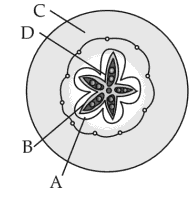
(1). A-Mesocarp
(2). B - Endocarp
(3). C-Thalamus
(4). D - Seed
(1). A-Mesocarp
(2). B - Endocarp
(3). C-Thalamus
(4). D - Seed
Number of Attempts: 2
Correct Attempts: 1
Time Taken: 00:04
Average Time: 00:02
Which one of the following plants shows vexillary aestivation and diadelphous stamens?
(1). Colchicum autumnale
(2). Pisum sativum
(3). Allium cepa
(4). Solanum nigrum
(1). Colchicum autumnale
(2). Pisum sativum
(3). Allium cepa
(4). Solanum nigrum
Number of Attempts: 2
Correct Attempts: 1
Time Taken: 00:04
Average Time: 00:02
Diadelphous stamens are found in:
(1). China rose
(2). Citrus
(3). Pea
(4). China rose and citrus
(1). China rose
(2). Citrus
(3). Pea
(4). China rose and citrus
Number of Attempts: 2
Correct Attempts: 1
Time Taken: 00:04
Average Time: 00:02
Match Column -I with Column-II.
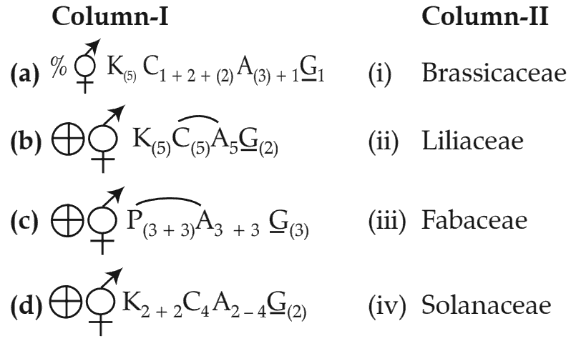
Select the correct answer from the options given below.
(1). (a) -(iii), (b) - (iv), (c) - (ii), (d) - (i)
(2). (a) - (i), (b) - (ii), (c) - (iii), (d) - (iv)
(3). (a) - (ii), (b) - (iii), (c) - (iv), (d) - (i)
(4). (a) - (iv), (b) - (ii), (c)- (i), (d) - (iii)
Select the correct answer from the options given below.
(1). (a) -(iii), (b) - (iv), (c) - (ii), (d) - (i)
(2). (a) - (i), (b) - (ii), (c) - (iii), (d) - (iv)
(3). (a) - (ii), (b) - (iii), (c) - (iv), (d) - (i)
(4). (a) - (iv), (b) - (ii), (c)- (i), (d) - (iii)
Number of Attempts: 2
Correct Attempts: 1
Time Taken: 00:04
Average Time: 00:02
Ray florets have:
(1). Superior ovary
(2). Hypogynous ovary
(3). Half inferior ovary
(4). Inferior ovary
(1). Superior ovary
(2). Hypogynous ovary
(3). Half inferior ovary
(4). Inferior ovary
Number of Attempts: 2
Correct Attempts: 1
Time Taken: 00:04
Average Time: 00:02
The roots that originate from the base of the stem
are
(1). Primary roots
(2). Prop roots
(3). Lateral roots
(4). Fibrous roots
(1). Primary roots
(2). Prop roots
(3). Lateral roots
(4). Fibrous roots
Number of Attempts: 2
Correct Attempts: 1
Time Taken: 00:04
Average Time: 00:02
The ovary is half inferior in:
(1). Mustard
(2). Sunflower
(3). Plum
(4). Brinjal
(1). Mustard
(2). Sunflower
(3). Plum
(4). Brinjal
Number of Attempts: 2
Correct Attempts: 1
Time Taken: 00:04
Average Time: 00:02
Placentation , in which ovules develop on the inner wall of the ovary or in peripheral part , is
(1). axile
(2). parietal
(3). free central
(4). basal
(1). axile
(2). parietal
(3). free central
(4). basal
Number of Attempts: 2
Correct Attempts: 1
Time Taken: 00:04
Average Time: 00:02
Sweet potato is a modified
(1). rhizome.
(2). tap root.
(3). adventitious root.
(4). stem.
(1). rhizome.
(2). tap root.
(3). adventitious root.
(4). stem.
Number of Attempts: 2
Correct Attempts: 1
Time Taken: 00:04
Average Time: 00:02
In Bougainvillea thorns are the modifications of
(1). leaf.
(2). stipules.
(3). adventitious root.
(4). stem.
(1). leaf.
(2). stipules.
(3). adventitious root.
(4). stem.
Number of Attempts: 2
Correct Attempts: 1
Time Taken: 00:04
Average Time: 00:02
Coconut fruit is a
(1). capsule.
(2). drupe.
(3). berry.
(4). nut.
(1). capsule.
(2). drupe.
(3). berry.
(4). nut.
Number of Attempts: 2
Correct Attempts: 1
Time Taken: 00:04
Average Time: 00:02
Tricarpellary, syncarpous gynoecium is found in the flowers of
(1). Solanaceae
(2). Fabaceae
(3). Poaceae
(4). Liliaceae
(1). Solanaceae
(2). Fabaceae
(3). Poaceae
(4). Liliaceae
Number of Attempts: 2
Correct Attempts: 1
Time Taken: 00:04
Average Time: 00:02
Cotyledon of maize grain is called
(1). coleorhiza
(2). coleoptile
(3). scutellum
(4). plumule
(1). coleorhiza
(2). coleoptile
(3). scutellum
(4). plumule
Number of Attempts: 2
Correct Attempts: 1
Time Taken: 00:04
Average Time: 00:02
Proximal end of the filament of stamen is attached to the
(1). connective
(2). placenta
(3). thalamus or petal
(4). anther
(1). connective
(2). placenta
(3). thalamus or petal
(4). anther
Number of Attempts: 2
Correct Attempts: 1
Time Taken: 00:04
Average Time: 00:02
Stems modified into flat green organs performing the functions of leaves are known as
(1). phyllodes
(2). phylloclades
(3). scales
(4). cladodes
(1). phyllodes
(2). phylloclades
(3). scales
(4). cladodes
Number of Attempts: 2
Correct Attempts: 1
Time Taken: 00:04
Average Time: 00:02