
Home >> My Performance >> My Topic Test Performance >> My Question Performance
My Question Performance Summary in Full Tests !
Questions Available: 25
Questions Attempted: 10
Number of Attempts: 15
Correct Attempts: 8
Total Time Spent: 00:30
Avg Time Per Question: 00:02
My Question Performance Summary in Full Tests
Given below are two statements : One is labelled
as Assertion A and the other is labelled as Reason R.
Assertion A : The first stage of gametophyte in the life cycle of moss is protonema stage.
Reason R: Protonema develops directly from spores produced in capsule.
In the light of the above statements, choose the most appropriate answer from the options given below:
(1). Both A and R are correct but R is NOT the correct explanation of A.
(2). A is correct but R is not correct.
(3). A is not correct but R is correct.
(4). Both A and R are correct and R is the correct explanation of A.
Assertion A : The first stage of gametophyte in the life cycle of moss is protonema stage.
Reason R: Protonema develops directly from spores produced in capsule.
In the light of the above statements, choose the most appropriate answer from the options given below:
(1). Both A and R are correct but R is NOT the correct explanation of A.
(2). A is correct but R is not correct.
(3). A is not correct but R is correct.
(4). Both A and R are correct and R is the correct explanation of A.
Number of Attempts: 2
Correct Attempts: 1
Time Taken: 00:04
Average Time: 00:02
Match the plant with the kind of life cycle itexhibits.
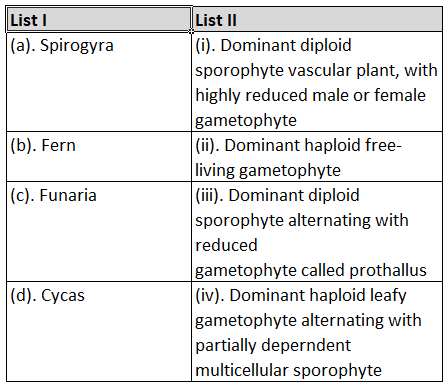
Choose the correct answer from the options given below:
(1). (a)- (iv); (b) - (i); (c) - (ii); (d) - (iii)
(2). (a)- (ii); (b) - (iii); (c) - (iv); (d) - (i)
(3). (a)- (iii); (b) - (iv); (c) -(i); (d) - (ii)
(4). (a)- (ii); (b) - (iv); (c) - (i); (d) - (iii)
Choose the correct answer from the options given below:
(1). (a)- (iv); (b) - (i); (c) - (ii); (d) - (iii)
(2). (a)- (ii); (b) - (iii); (c) - (iv); (d) - (i)
(3). (a)- (iii); (b) - (iv); (c) -(i); (d) - (ii)
(4). (a)- (ii); (b) - (iv); (c) - (i); (d) - (iii)
Number of Attempts: 2
Correct Attempts: 1
Time Taken: 00:04
Average Time: 00:02
In case of poriferans, the spongocoel is lined with flagellated cells called
(1). mesenchymal cells.
(2). ostia.
(3). oscula.
(4). choanocytes.
(1). mesenchymal cells.
(2). ostia.
(3). oscula.
(4). choanocytes.
Number of Attempts: 2
Correct Attempts: 1
Time Taken: 00:04
Average Time: 00:02
Life cycle of Ectocarpus and Fucus respectively are
(1). Haplodiplontic, Haplontic
(2). Haplontic, Diplontic
(3). Diplontic, Haplodiplontic
(4). Haplodiplontic, Diplontic
(1). Haplodiplontic, Haplontic
(2). Haplontic, Diplontic
(3). Diplontic, Haplodiplontic
(4). Haplodiplontic, Diplontic
Number of Attempts: 2
Correct Attempts: 1
Time Taken: 00:04
Average Time: 00:02
The correct sequence of events in the life cycle of bryophytes is
A. Fusion of antherozoid with egg.
B. Attachment of gametophyte to substratum.
C. Reduction division to produce haploid spores.
D. Formation of sporophyte.
E. Release of antherozoids into water.
Choose the correct answer from the options given below :
(1). D, E, A, B, C
(2). D, E, A, C, B
(3). B, E, A, C, D
(4). B, E, A, D, C
A. Fusion of antherozoid with egg.
B. Attachment of gametophyte to substratum.
C. Reduction division to produce haploid spores.
D. Formation of sporophyte.
E. Release of antherozoids into water.
Choose the correct answer from the options given below :
(1). D, E, A, B, C
(2). D, E, A, C, B
(3). B, E, A, C, D
(4). B, E, A, D, C
Number of Attempts: 2
Correct Attempts: 1
Time Taken: 00:04
Average Time: 00:02
In bryophytes, the gemmae help in which one of the following?
(1). Gaseous exchange
(2). Sexual reproduction
(3). Asexual reproduction
(4). Nutrient absorption
(1). Gaseous exchange
(2). Sexual reproduction
(3). Asexual reproduction
(4). Nutrient absorption
Number of Attempts: 2
Correct Attempts: 1
Time Taken: 00:04
Average Time: 00:02
Match List I with List II.
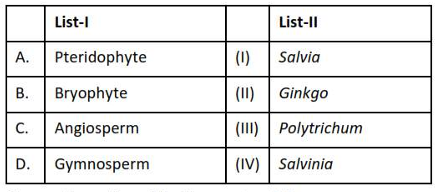
Choose the option with all correct matches.
(1). A-IV, B-III, C-II, D-I
(2). A-III, B-IV, C-II, D-I
(3). A-IV, B-III, C-I, D-II
(4). A-III, B-IV, C-I, D-II
Choose the option with all correct matches.
(1). A-IV, B-III, C-II, D-I
(2). A-III, B-IV, C-II, D-I
(3). A-IV, B-III, C-I, D-II
(4). A-III, B-IV, C-I, D-II
Number of Attempts: 2
Correct Attempts: 1
Time Taken: 00:04
Average Time: 00:02
Which one of the following is the characteristic feature of gymnosperms?
(1). Gymnosperms have flowers for reproduction.
(2). Seeds are enclosed in fruits.
(3). Seeds are naked.
(4). Seeds are absent.
(1). Gymnosperms have flowers for reproduction.
(2). Seeds are enclosed in fruits.
(3). Seeds are naked.
(4). Seeds are absent.
Number of Attempts: 2
Correct Attempts: 1
Time Taken: 00:04
Average Time: 00:02
Given below are the stages in the life cycle of pteridophytes. Arrange the following stages in the correct sequence.
A. Prothallus stage
B. Meiosis in spore mother cells
C. Fertilisation
D. Formation of archegonia and antheridia in gametophyte.
E. Transfer of antherozoids to the archegonia in presence of water.
Choose the correct answer from the options given below?
(1). E, D, C, B, A
(2). B, A, D, E, C
(3). B, A, E, C, D
(4). D, E, C,A, B
A. Prothallus stage
B. Meiosis in spore mother cells
C. Fertilisation
D. Formation of archegonia and antheridia in gametophyte.
E. Transfer of antherozoids to the archegonia in presence of water.
Choose the correct answer from the options given below?
(1). E, D, C, B, A
(2). B, A, D, E, C
(3). B, A, E, C, D
(4). D, E, C,A, B
Number of Attempts: 2
Correct Attempts: 1
Time Taken: 00:04
Average Time: 00:02
Identify the pair of heterosporous pteridophytes
among the following:
(1). Selaginella and Salvinia
(2). Psilotum and Salvinia
(3). Equisetum and Salvinia
(4). Lycopodium and Selaginella
(1). Selaginella and Salvinia
(2). Psilotum and Salvinia
(3). Equisetum and Salvinia
(4). Lycopodium and Selaginella
Number of Attempts: 2
Correct Attempts: 1
Time Taken: 00:04
Average Time: 00:02
Which of the following is incorrectly matched?
(1). Ectocarpus - Fucoxanthin
(2). Ulothrix - Mannitol
(3). Porphyra - Floridian Starch
(4). Volvox - Starch
(1). Ectocarpus - Fucoxanthin
(2). Ulothrix - Mannitol
(3). Porphyra - Floridian Starch
(4). Volvox - Starch
Number of Attempts: 2
Correct Attempts: 1
Time Taken: 00:04
Average Time: 00:02
Hydrocolloid carrageen is obtained from
(1). Chlorophyceae and Phaeophyceae
(2). Phaeophyceae and Rhodophyceae
(3). Rhodophyceae only
(4). Phaeophyceae only
(1). Chlorophyceae and Phaeophyceae
(2). Phaeophyceae and Rhodophyceae
(3). Rhodophyceae only
(4). Phaeophyceae only
Number of Attempts: 2
Correct Attempts: 1
Time Taken: 00:04
Average Time: 00:02
Gemmae are present in:
(1). Mosses
(2). Pteridophytes
(3). Some Gymnosperms
(4). Some Liverworts
(1). Mosses
(2). Pteridophytes
(3). Some Gymnosperms
(4). Some Liverworts
Number of Attempts: 2
Correct Attempts: 1
Time Taken: 00:04
Average Time: 00:02
Genera like Selaginella and Salvinia produce two
kinds of spores. Such plants are known as:
(1). Homosorus
(2). Heterosorus
(3). Homosporous
(4). Heterosporous
(1). Homosorus
(2). Heterosorus
(3). Homosporous
(4). Heterosporous
Number of Attempts: 2
Correct Attempts: 1
Time Taken: 00:04
Average Time: 00:02
Which of the following pairs is of unicellular algae?
(1). Gelidium and Gracilaria
(2). Anabaena and Volvox
(3). Chlorella and Spirulina
(4). Laminaria and Sargassum
(1). Gelidium and Gracilaria
(2). Anabaena and Volvox
(3). Chlorella and Spirulina
(4). Laminaria and Sargassum
Number of Attempts: 2
Correct Attempts: 1
Time Taken: 00:04
Average Time: 00:02
Strobili or cones are found in
(1). Pteris
(2). Marchantia
(3). Equisetum
(4). Salvinia
(1). Pteris
(2). Marchantia
(3). Equisetum
(4). Salvinia
Number of Attempts: 2
Correct Attempts: 1
Time Taken: 00:04
Average Time: 00:02
From evolutionary point of view, retention of the female gametophyte with developing young embryo on the parent sporophyte for some time, is first observed in
(1). mosses.
(2). pteridophytes.
(3). gymnosperms.
(4). liverworts.
(1). mosses.
(2). pteridophytes.
(3). gymnosperms.
(4). liverworts.
Number of Attempts: 2
Correct Attempts: 1
Time Taken: 00:04
Average Time: 00:02
Which one is wrongly matched?
(1). Unicellular organism – Chlorella
(2). Gemma cups – Marchantia
(3). Biflagellate zoospores – Brown algae
(4). Uniflagellate gametes – Polysiphonia
(1). Unicellular organism – Chlorella
(2). Gemma cups – Marchantia
(3). Biflagellate zoospores – Brown algae
(4). Uniflagellate gametes – Polysiphonia
Number of Attempts: 2
Correct Attempts: 1
Time Taken: 00:04
Average Time: 00:02
Winged pollen grains are present in
(1). Pinus.
(2). Mango.
(3). Cycas.
(4). Mustard.
(1). Pinus.
(2). Mango.
(3). Cycas.
(4). Mustard.
Number of Attempts: 2
Correct Attempts: 1
Time Taken: 00:04
Average Time: 00:02
Which of the following statements is correct?
(1). Stems are usually unbranched in both Cycas and Cedrus.
(2). Horsetails are Gymnosperms.
(3). Selaginella is heterosporous, while Salvinia is homosporous.
(4). Ovules are not enclosed by ovary wall in Gymnosperms.
(1). Stems are usually unbranched in both Cycas and Cedrus.
(2). Horsetails are Gymnosperms.
(3). Selaginella is heterosporous, while Salvinia is homosporous.
(4). Ovules are not enclosed by ovary wall in Gymnosperms.
Number of Attempts: 2
Correct Attempts: 1
Time Taken: 00:04
Average Time: 00:02
An example of colonial alga is
(1). Spirogyra.
(2). Chlorella.
(3). Volvox.
(4). Ulothrix.
(1). Spirogyra.
(2). Chlorella.
(3). Volvox.
(4). Ulothrix.
Number of Attempts: 2
Correct Attempts: 1
Time Taken: 00:04
Average Time: 00:02
Select the mismatch from the following
(1). Equisetum – Homosporous
(2). Pinus – Dioecious
(3). Cycas – Dioecious
(4). Salvinia – Heterosporous
(1). Equisetum – Homosporous
(2). Pinus – Dioecious
(3). Cycas – Dioecious
(4). Salvinia – Heterosporous
Number of Attempts: 2
Correct Attempts: 1
Time Taken: 00:04
Average Time: 00:02
Zygotic meiosis is characteristic of
(1). Chlamydomonas.
(2). Marchantia.
(3). Fucus.
(4). Funaria.
(1). Chlamydomonas.
(2). Marchantia.
(3). Fucus.
(4). Funaria.
Number of Attempts: 2
Correct Attempts: 1
Time Taken: 00:04
Average Time: 00:02
In bryophytes and pteridophytes, transport of male gametes requires
(1). insects
(2). birds
(3). water
(4). wind
(1). insects
(2). birds
(3). water
(4). wind
Number of Attempts: 2
Correct Attempts: 1
Time Taken: 00:04
Average Time: 00:02
Select the correct statement
(1). Salvinia, Ginkgo and Pinus all are gymnosperms
(2). Sequoia is one of the tallest trees
(3). The leaves of gymnosperms are not well adapted to extremes of climate
(4). Gymnosperms are both homosporous and heterosporous
(1). Salvinia, Ginkgo and Pinus all are gymnosperms
(2). Sequoia is one of the tallest trees
(3). The leaves of gymnosperms are not well adapted to extremes of climate
(4). Gymnosperms are both homosporous and heterosporous
Number of Attempts: 2
Correct Attempts: 1
Time Taken: 00:04
Average Time: 00:02