
Home >> My Performance >> My Topic Test Performance >> My Question Performance
My Question Performance Summary in Full Tests !
Questions Available: 30
Questions Attempted: 10
Number of Attempts: 15
Correct Attempts: 8
Total Time Spent: 00:30
Avg Time Per Question: 00:02
My Question Performance Summary in Full Tests
The equivalent capacitance of the system shown in the following circuitis
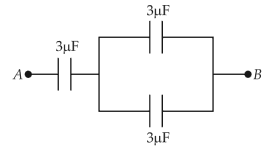
(1). 3 µF
(2). 6 µF
(3). 9 µF
(4). 2 µF
(1). 3 µF
(2). 6 µF
(3). 9 µF
(4). 2 µF
Number of Attempts: 2
Correct Attempts: 1
Time Taken: 00:04
Average Time: 00:02
The angle between the electric lines of force and the equipotential surface is
(1). \(0^\circ \)
(2). \(45^\circ \)
(3). \(90^\circ \)
(4). \(180^\circ \)
(1). \(0^\circ \)
(2). \(45^\circ \)
(3). \(90^\circ \)
(4). \(180^\circ \)
Number of Attempts: 2
Correct Attempts: 1
Time Taken: 00:04
Average Time: 00:02
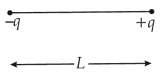
Two point charges −q and +q are placed at a distance of L, as shown in the figure. The magnitude of electric field intensity at a distance R (R ≫ L) varies as:
(1). \(\displaystyle \frac{1}{R^2}\)
(2). \(\displaystyle\frac{1}{R^3}\)
(3). \(\displaystyle\frac{1}{R^4}\)
(4). \(\displaystyle\frac{1}{R^6}\)
(1). \(\displaystyle \frac{1}{R^2}\)
(2). \(\displaystyle\frac{1}{R^3}\)
(3). \(\displaystyle\frac{1}{R^4}\)
(4). \(\displaystyle\frac{1}{R^6}\)
Number of Attempts: 2
Correct Attempts: 1
Time Taken: 00:04
Average Time: 00:02
The plates of a parallel plate capacitor are separated by d. Two slabs of different dielectric constants \(\text{K}_1\, \text{and}\, \text{K}_2\) with thickness \(\displaystyle \frac{3}{8}\text{d}\) and \(\displaystyle \frac{d}{2}\), respectively are inserted in the capacitor. Due to this, the capacitance becomes two times larger than when there is nothing between plates.
If \(\text{K}_1\,=\,1.25\, \text{K}_2\), the value of \(\text{K}_1\) is:
(1). 1.33
(2). 2.66
(3). 2.33
(4). 1.60
If \(\text{K}_1\,=\,1.25\, \text{K}_2\), the value of \(\text{K}_1\) is:
(1). 1.33
(2). 2.66
(3). 2.33
(4). 1.60
Number of Attempts: 2
Correct Attempts: 1
Time Taken: 00:04
Average Time: 00:02
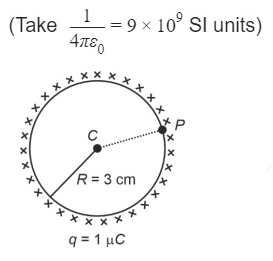
A thin spherical shell is charged by some source. The potential difference between the two points C and P (in V ) shown in the figure is: (Take \( \frac{1}{4πϵ0} = 9 × 10^9 \) SI units)
(1). 3 × 10⁵
(2). 1 × 10⁵
(3). 0.5 × 10⁵
(4). Zero
(1). 3 × 10⁵
(2). 1 × 10⁵
(3). 0.5 × 10⁵
(4). Zero
Number of Attempts: 2
Correct Attempts: 1
Time Taken: 00:04
Average Time: 00:02
Given below are two statements: one is labelled as Assertion A and the other is labelled as Reason R.
Assertion A: The potential (V) at any axial point, at 2 m distance (r) from the centre of the dipole of dipole moment vector \(\vec{P}\) of magnitude, 4 ×10⁻⁶Cm , is ± 9 × 10³V. (Take \(\frac{1}{4πϵ_0} = 9 × 10^9\) SI units).
Reason R: V = ± \(\frac{2P}{4πϵ_0r^2}\) where r is the distance of any axial point, situated at 2 m from the centre of the dipole. In the light of the above statements, choose the correct answer from the options given below:
(1). Both A and R are true and R is the correct explanation of A.
(2). Both A and R are true and R is NOT the correct explanation of A.
(3). A is true but R is false.
(4). A is false but R is true.
Assertion A: The potential (V) at any axial point, at 2 m distance (r) from the centre of the dipole of dipole moment vector \(\vec{P}\) of magnitude, 4 ×10⁻⁶Cm , is ± 9 × 10³V. (Take \(\frac{1}{4πϵ_0} = 9 × 10^9\) SI units).
Reason R: V = ± \(\frac{2P}{4πϵ_0r^2}\) where r is the distance of any axial point, situated at 2 m from the centre of the dipole. In the light of the above statements, choose the correct answer from the options given below:
(1). Both A and R are true and R is the correct explanation of A.
(2). Both A and R are true and R is NOT the correct explanation of A.
(3). A is true but R is false.
(4). A is false but R is true.
Number of Attempts: 2
Correct Attempts: 1
Time Taken: 00:04
Average Time: 00:02
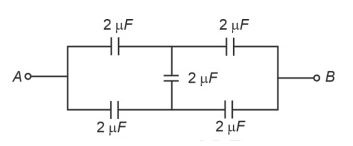
In the following circuit, the equivalent capacitance betweenterminal A and terminal B is :
(1). 2µF
(2). 1µF
(3). 0.5µF
(4). 4µF
(1). 2µF
(2). 1µF
(3). 0.5µF
(4). 4µF
Number of Attempts: 2
Correct Attempts: 1
Time Taken: 00:04
Average Time: 00:02
If the plates of a parallel plate capacitor connected to a battery are moved close to each other, then
A. the charge stored in it, increases.
B. the energy stored in it, decreases.
C. its capacitance increases.
D. the ratio of charge to its potential remains the same.
E. the product of charge and voltage increases.
Choose the most appropriate answer from the options given below:
(1). A, B and E only
(2). A, C and E only
(3). B, D and E only
(4). A, B and C only
A. the charge stored in it, increases.
B. the energy stored in it, decreases.
C. its capacitance increases.
D. the ratio of charge to its potential remains the same.
E. the product of charge and voltage increases.
Choose the most appropriate answer from the options given below:
(1). A, B and E only
(2). A, C and E only
(3). B, D and E only
(4). A, B and C only
Number of Attempts: 2
Correct Attempts: 1
Time Taken: 00:04
Average Time: 00:02
A parallel plate capacitor is charged by connecting it to a battery through a resistor. If I is the current in the circuit, then in the gap between the plates:
(1). There is no current
(2). Displacement current of magnitude equal to I flows in the same direction as I
(3). Displacement current of magnitude equal to I flows in a direction opposite to that of I
(4). Displacement current of magnitude greater than I flows but can be in any direction
(1). There is no current
(2). Displacement current of magnitude equal to I flows in the same direction as I
(3). Displacement current of magnitude equal to I flows in a direction opposite to that of I
(4). Displacement current of magnitude greater than I flows but can be in any direction
Number of Attempts: 2
Correct Attempts: 1
Time Taken: 00:04
Average Time: 00:02

(1). The magnitude of electric field on the surface is constant
(2). All the charges must necessarily be inside the surface
(3). The electric field inside the surface is necessarily uniform
(4). The number of flux lines entering the surface must be equal to the number of flux lines leaving it
Number of Attempts: 2
Correct Attempts: 1
Time Taken: 00:04
Average Time: 00:02
An electric dipole is placed at an angle of \(30^\circ\) with an electric field of intensity \(2 × 10^5NC^{−1}\). It experiences a torque equal to 4 Nm. Calculate the magnitude of charge on the dipole, if the dipole length is 2 cm.
(1). 6 mC
(2). 4 mC
(3). 2 mC
(4). 8 mC
(1). 6 mC
(2). 4 mC
(3). 2 mC
(4). 8 mC
Number of Attempts: 2
Correct Attempts: 1
Time Taken: 00:04
Average Time: 00:02
An electric dipole is placed as shown in the figure.

The electric potential in \(10^2\,V\) at point P due to dipole is (\(E_0 =\).permittivity of free space and \(\displaystyle \frac{1}{4πϵ_0}=k\) )
(1). \(\displaystyle \left(\frac{5}{8}\right)\)qK
(2). \(\displaystyle \left(\frac{8}{5}\right)\)qK
(3). \(\displaystyle \left(\frac{8}{3}\right)\)qK
(4). \(\displaystyle \left(\frac{3}{8}\right)\)qK
The electric potential in \(10^2\,V\) at point P due to dipole is (\(E_0 =\).permittivity of free space and \(\displaystyle \frac{1}{4πϵ_0}=k\) )
(1). \(\displaystyle \left(\frac{5}{8}\right)\)qK
(2). \(\displaystyle \left(\frac{8}{5}\right)\)qK
(3). \(\displaystyle \left(\frac{8}{3}\right)\)qK
(4). \(\displaystyle \left(\frac{3}{8}\right)\)qK
Number of Attempts: 2
Correct Attempts: 1
Time Taken: 00:04
Average Time: 00:02
Two hollow conducting spheres of radii R1 and R2 (R1 ≫ R2) have equal charges. The potential would be
(1). More on bigger sphere
(2). More on smaller sphere
(3). Equal on both the spheres
(4). Dependent on the material property of the sphere
(1). More on bigger sphere
(2). More on smaller sphere
(3). Equal on both the spheres
(4). Dependent on the material property of the sphere
Number of Attempts: 2
Correct Attempts: 1
Time Taken: 00:04
Average Time: 00:02
A capacitor of capacitance C = 900pF is charged fully by 100V battery B as shown in figure (a). Then it is disconnected from the battery and connected to another uncharged capacitor of capacitance C = 900pF as shown in figure (b). The electrostatic energy stored by the system (b) is 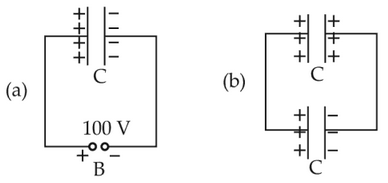
(1). 4.5 × 10⁻⁶ J
(2). 3.25 × 10⁻⁶ J
(3). 2.25 × 10⁻⁶ J
(4). 1.5 × 10⁻⁶ J
(1). 4.5 × 10⁻⁶ J
(2). 3.25 × 10⁻⁶ J
(3). 2.25 × 10⁻⁶ J
(4). 1.5 × 10⁻⁶ J
Number of Attempts: 2
Correct Attempts: 1
Time Taken: 00:04
Average Time: 00:02
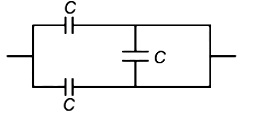
The equivalent capacitance of the combination shown in the figure is
(1). \(3\,C\)
(2). \(2\,C\)
(3). \(\displaystyle \frac{C}{2}\)
(4). \(\displaystyle \frac{3C}{2}\)
(1). \(3\,C\)
(2). \(2\,C\)
(3). \(\displaystyle \frac{C}{2}\)
(4). \(\displaystyle \frac{3C}{2}\)
Number of Attempts: 2
Correct Attempts: 1
Time Taken: 00:04
Average Time: 00:02
Two charged spherical conductors of radius R1 and R2 are connected by a wire. Then the ratio of surface charge densities of the spheres (σ1/σ2) is
(1). \(\displaystyle \frac{R_1}{R_2}\)
(2). \(\displaystyle \frac{R_2}{R_1}\)
(3). \(\displaystyle \sqrt{\frac{R_!}{R_2}}\)
(4). \(\displaystyle \frac{R_1^2}{R_2^2}\)
(1). \(\displaystyle \frac{R_1}{R_2}\)
(2). \(\displaystyle \frac{R_2}{R_1}\)
(3). \(\displaystyle \sqrt{\frac{R_!}{R_2}}\)
(4). \(\displaystyle \frac{R_1^2}{R_2^2}\)
Number of Attempts: 2
Correct Attempts: 1
Time Taken: 00:04
Average Time: 00:02
A parallel plate capacitor has a uniform electric field ' \(\vec{F}\) ' in the space between the plates. If the distance between the plates is ' d ' and the area of each plate is ' A ', the energy stored in the capacitor is ( ε0 = permittivity of free space)
(1). \(\displaystyle \frac{1}{2}ε_0E^2\)
(2). \(\displaystyle ε_0E Ad\)
(3). \(\displaystyle \frac{1}{2}ε_0E^2Ad\)
(4). \(\displaystyle \frac{E^2Ad}{ε_0}\)
(1). \(\displaystyle \frac{1}{2}ε_0E^2\)
(2). \(\displaystyle ε_0E Ad\)
(3). \(\displaystyle \frac{1}{2}ε_0E^2Ad\)
(4). \(\displaystyle \frac{E^2Ad}{ε_0}\)
Number of Attempts: 2
Correct Attempts: 1
Time Taken: 00:04
Average Time: 00:02
Twenty seven drops of same size are charged at 220 V each. They combine to form a bigger drop. Calculate the potential of the bigger drop.
(1). 660 V
(2). 1320 V
(3). 1520 V
(4). 1980 V
(1). 660 V
(2). 1320 V
(3). 1520 V
(4). 1980 V
Number of Attempts: 2
Correct Attempts: 1
Time Taken: 00:04
Average Time: 00:02
A capacitor of capacitance ' C ', is connected across an ac source of voltage V, given by \( \text{V}\, =\, V_0\, sin\, \omega t\). The displacement current between the plates of the capacitor, would then be given by
(1). \(I_d\, =\, V_0\, \epsilon \, C \, cos\, \omega t \)
(2). \(\displaystyle I_d\, =\, \frac{V_0}{\omega C}\, cos\, \omega t\)
(3). \(\displaystyle I_d \,=\, \frac{V_0}{\omega C} sin\, \omega t\)
(4). \(I_d \,=\, V_0 \,\epsilon \,C\, sin\, \omega t\)
(1). \(I_d\, =\, V_0\, \epsilon \, C \, cos\, \omega t \)
(2). \(\displaystyle I_d\, =\, \frac{V_0}{\omega C}\, cos\, \omega t\)
(3). \(\displaystyle I_d \,=\, \frac{V_0}{\omega C} sin\, \omega t\)
(4). \(I_d \,=\, V_0 \,\epsilon \,C\, sin\, \omega t\)
Number of Attempts: 2
Correct Attempts: 1
Time Taken: 00:04
Average Time: 00:02
A spherical conductor of radius 10 cm has a charge of \(3.2 × 10^{−7} C\) distributed uniformly. What is the magnitude of electric field at a point 15cm from the centre of the sphere? \(\displaystyle \frac{1}{ 4\, \pi\, \epsilon_0} = 9 × 10^9 N m^2/C^2\))
(1). \(1.28 \times 10^5\, N ∕ C \)
(2). \(1.28 \times 10^6\, N ∕ C \)
(3). \(1.28 \times 10^7\, N ∕ C \)
(4). \(1.28 \times 10^4\, N ∕ C \)
(1). \(1.28 \times 10^5\, N ∕ C \)
(2). \(1.28 \times 10^6\, N ∕ C \)
(3). \(1.28 \times 10^7\, N ∕ C \)
(4). \(1.28 \times 10^4\, N ∕ C \)
Number of Attempts: 2
Correct Attempts: 1
Time Taken: 00:04
Average Time: 00:02
In a certain region of space with volume 0.2 m3, the electric potential is found to be 5 V through out. The magnitude of electric field in this region is:
(1). 0.5 N ∕ C
(2). 1 N ∕ C
(3). 5 N ∕ C
(4). zero
(1). 0.5 N ∕ C
(2). 1 N ∕ C
(3). 5 N ∕ C
(4). zero
Number of Attempts: 2
Correct Attempts: 1
Time Taken: 00:04
Average Time: 00:02
A short electric dipole has a dipole moment of \(16 \times 10^{−9}\) Cm. The electric potential due to the dipole at a point at a distance of 0.6 m from the centre of the dipole, situated on a line making an angle of \(60^\circ\) with the dipole axis is : \(\displaystyle \left(\frac{1}{4πϵ_0} = 9 × 10^9 Nm^2/C^2\right)\)
(1). 200 V
(2). 400 V
(3). zero
(4). 50 V
(1). 200 V
(2). 400 V
(3). zero
(4). 50 V
Number of Attempts: 2
Correct Attempts: 1
Time Taken: 00:04
Average Time: 00:02
The capacitance of a parallel plate capacitor with air as medium is 6µF . With the introduction of a dielectric medium, the capacitance becomes 30µF. The permittivity of the medium is:
(\(E_0 = 8.85 × 10^{−12}\,C^2N^{−1}m^{−2}\))
(1). \( 1.77×10^{−12}\, C^2N^{−1}m^{−2}\)
(2). \(0.44×10^{−10}\, C^2N^{−1}m^{−2}\)
(3). \(5.00\, C^2 N^{−1}m^{−2}\)
(4). \(0.44×10^{−13}\, C^2N^{−1}m^{−2}\)
(\(E_0 = 8.85 × 10^{−12}\,C^2N^{−1}m^{−2}\))
(1). \( 1.77×10^{−12}\, C^2N^{−1}m^{−2}\)
(2). \(0.44×10^{−10}\, C^2N^{−1}m^{−2}\)
(3). \(5.00\, C^2 N^{−1}m^{−2}\)
(4). \(0.44×10^{−13}\, C^2N^{−1}m^{−2}\)
Number of Attempts: 2
Correct Attempts: 1
Time Taken: 00:04
Average Time: 00:02
A hollow metal sphere of radius R is uniformly charged. The electricfield due to the sphere at a distance r from the centre
(1). decreases as r increases for r < R and for r > R
(2). increases as r increases for r < R and for r > R
(3). zero as r increases for r < R, decreases as r increases for r > R
(4). zero as r increases for r < R, increases as r increases for r > R
(1). decreases as r increases for r < R and for r > R
(2). increases as r increases for r < R and for r > R
(3). zero as r increases for r < R, decreases as r increases for r > R
(4). zero as r increases for r < R, increases as r increases for r > R
Number of Attempts: 2
Correct Attempts: 1
Time Taken: 00:04
Average Time: 00:02
An electron falls from rest through a vertical distance h in a uniform and vertically upward directed electric field E. The direction of electric field is now reversed, keeping its magnitude the same. A proton is allowed to fall from rest in it through the same vertical distance h. The time of fall of the electron, in comparison to the time of fall of the proton is
(1). smaller
(2). 5 times greater
(3). 10 times greater
(4). equal
(1). smaller
(2). 5 times greater
(3). 10 times greater
(4). equal
Number of Attempts: 2
Correct Attempts: 1
Time Taken: 00:04
Average Time: 00:02
The electrostatic force between the metal plates of an isolated parallel plate capacitor C having a charge Q and area A, is
(1). Independent of the distance between the plates
(2). Linearly proportional to the distance between the plates
(3). Proportional to the square root of the distance between the plates
(4). Inversely proportional to the distance between the plates
(1). Independent of the distance between the plates
(2). Linearly proportional to the distance between the plates
(3). Proportional to the square root of the distance between the plates
(4). Inversely proportional to the distance between the plates
Number of Attempts: 2
Correct Attempts: 1
Time Taken: 00:04
Average Time: 00:02
A toy car with charge q moves on a frictionless horizontal plane surface under the influence of a uniform electric field \(\vec{E}\). Due to the force q \(\vec{E}\), its velocity increases from 0 to 6 ms−1 in one second duration. At that instant the direction of the field is reversed. The car continues to move for two more seconds under the influence of this field. The average velocity and the average speed of the toy car between 0 to 3 seconds are respectively
(1). 2 ms−1 , 4ms−1
(2). 1ms−1 , 3ms−1
(3). 1ms−1 , 3.5ms−1
(4). 1.5ms−1 , 3ms−1
(1). 2 ms−1 , 4ms−1
(2). 1ms−1 , 3ms−1
(3). 1ms−1 , 3.5ms−1
(4). 1.5ms−1 , 3ms−1
Number of Attempts: 2
Correct Attempts: 1
Time Taken: 00:04
Average Time: 00:02
A capacitor is charged by a battery. The battery is removed and another identical uncharged capacitor is connected in parallel. The total electrostatic energy of resulting system
(1). decreases by a factor of 2
(2). remains the same
(3). increases by a factor of 2
(4). increases by a factor of 4
(1). decreases by a factor of 2
(2). remains the same
(3). increases by a factor of 2
(4). increases by a factor of 4
Number of Attempts: 2
Correct Attempts: 1
Time Taken: 00:04
Average Time: 00:02
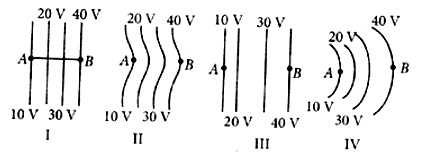
The diagrams below show regions of equipotential. A positive charge is moved from A to B in each diagram.
(1). In all the four cases the work done is the same.
(2). Minimum work is required to move q in figure (I)
(3). Maximum work is required to move q in figure (II)
(4). Maximum work is required to move q in figure (III)
(1). In all the four cases the work done is the same.
(2). Minimum work is required to move q in figure (I)
(3). Maximum work is required to move q in figure (II)
(4). Maximum work is required to move q in figure (III)
Number of Attempts: 2
Correct Attempts: 1
Time Taken: 00:04
Average Time: 00:02
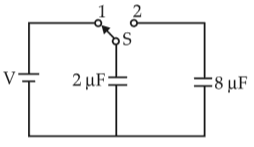
A capacitor of 2 μF is charged as shown in the diagram. When the switch S is turned to position 2, the percentage of its stored energy dissipated is
(1). 75%
(2). 80%
(3). 0%
(4). 20%
(1). 75%
(2). 80%
(3). 0%
(4). 20%
Number of Attempts: 2
Correct Attempts: 1
Time Taken: 00:04
Average Time: 00:02