
Home >> My Performance >> My Topic Test Performance >> My Question Performance
My Question Performance Summary in Full Tests !
Questions Available: 8
Questions Attempted: 10
Number of Attempts: 15
Correct Attempts: 8
Total Time Spent: 00:30
Avg Time Per Question: 00:02
My Question Performance Summary in Full Tests
Suppose the charge of a proton and an electron differ slightly. One of them is \(−e\) and the other is \(\left(e + \Delta e\right)\). If the net of electrostatic force and gravitational force between two hydrogen atoms placed at a distance d (much greater than atomic size) apart is zero, then \(\Delta e\) is of the order [Given mass of hydrogen, \(m_h =1.67 × 10^{−27} kg\)]
(1). \(10^{-20} \,C\)
(2). \(10^{-23} \,C\)
(3). \(10^{-37} \,C\)
(4). \(10^{-47} \,C\)
(1). \(10^{-20} \,C\)
(2). \(10^{-23} \,C\)
(3). \(10^{-37} \,C\)
(4). \(10^{-47} \,C\)
Number of Attempts: 2
Correct Attempts: 1
Time Taken: 00:04
Average Time: 00:02
Two identical charged conducting spheres A and B have their centres separated by a certain distance. Charge on each sphere is q and the force of repulsion between them is F. A third identical uncharged conducting sphere is brought in contact with sphere A first and then with B and finally removed from both. New force of repulsion between spehere A and B (Radii of A and B are negligible compared to the distance of separation so that for calculating force between them they can be considered as point charges) is best given as:
(1). \(\displaystyle \frac{3F}{8}\)
(2). \(\displaystyle \frac{3F}{5}\)
(3). \(\displaystyle \frac{2F}{3}\)
(4). \(\displaystyle \frac{F}{2}\)
(1). \(\displaystyle \frac{3F}{8}\)
(2). \(\displaystyle \frac{3F}{5}\)
(3). \(\displaystyle \frac{2F}{3}\)
(4). \(\displaystyle \frac{F}{2}\)
Number of Attempts: 2
Correct Attempts: 1
Time Taken: 00:04
Average Time: 00:02
An electric dipole with dipole moment \(5 \times 10^{-4}\) Cm is aligned with the direction of a uniform electric field of magnitude \(4 \times 10^5\) N/C. The dipole is then rotated through an angle of \(60^\circ\) with respect to the electric field. The change in the potential energy of the dipole is:
(1). 1.5 J
(2). 0.8 J
(3). 1.0 J
(4). 1.2 J
(1). 1.5 J
(2). 0.8 J
(3). 1.0 J
(4). 1.2 J
Number of Attempts: 2
Correct Attempts: 1
Time Taken: 00:04
Average Time: 00:02
A dipole is placed in an electric field as shown. In which direction will it move?
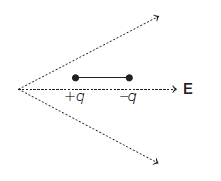
(1). Towards the left as its potential energy will increase
(2). Towards the right as its potentialenergy will decrease
(3). Towards the left as its potentialenergy will decrease
(4). Towards the right as its potentialenergy will increase
(1). Towards the left as its potential energy will increase
(2). Towards the right as its potentialenergy will decrease
(3). Towards the left as its potentialenergy will decrease
(4). Towards the right as its potentialenergy will increase
Number of Attempts: 2
Correct Attempts: 1
Time Taken: 00:04
Average Time: 00:02
Polar molecules are the molecules
(1). having zero dipole moment
(2). acquire a dipole moment only in the presence of electric field due to displacement of charges.
(3). acquire a dipole moment only when magnetic field is absent
(4). having a permanent electric dipole moment
(1). having zero dipole moment
(2). acquire a dipole moment only in the presence of electric field due to displacement of charges.
(3). acquire a dipole moment only when magnetic field is absent
(4). having a permanent electric dipole moment
Number of Attempts: 2
Correct Attempts: 1
Time Taken: 00:04
Average Time: 00:02
Two point charges A and B, having charges +Q and −Q respectively, are placed at certain distance apart and force acting between them is F. If 25% charge of A is transferred to B,then force between the charges becomes
(1). 9F/16
(2). 16F/9
(3). 4F/3
(4). F
(1). 9F/16
(2). 16F/9
(3). 4F/3
(4). F
Number of Attempts: 2
Correct Attempts: 1
Time Taken: 00:04
Average Time: 00:02
Two parallel infinite line charges with linear charge densities \(+\lambda\, C/m\) and \(−\lambda\, C/m\) are placed at a distance of 2R in free space.What is the electric field mid-way between the two line charges?
(1). \(\displaystyle \frac{2 \lambda}{\pi \epsilon _0 R}\) N/C
(2). \(\displaystyle \frac{ \lambda}{\pi \epsilon _0 R}\) N/C
(3). \(\displaystyle \frac{ \lambda}{2 \pi \epsilon _0 R}\) N/C
(4). \(\text{Zero}\)
(1). \(\displaystyle \frac{2 \lambda}{\pi \epsilon _0 R}\) N/C
(2). \(\displaystyle \frac{ \lambda}{\pi \epsilon _0 R}\) N/C
(3). \(\displaystyle \frac{ \lambda}{2 \pi \epsilon _0 R}\) N/C
(4). \(\text{Zero}\)
Number of Attempts: 2
Correct Attempts: 1
Time Taken: 00:04
Average Time: 00:02
Two identical charged spheres suspended from a common point by two mass less strings of lengths l, are initially at a distance d (d < < l) apart because of their mutual repulsion. The charges begin to leak from both the spheres at a constant rate. As a result, the spheres approach each other witha velocity \(v\). Then, \(v\) varies as a function of the distance \(x\) between the sphere, as
(1). \(\displaystyle v \propto {x}\)
(2). \(\displaystyle v \propto {x^{-\frac{1}{2}}}\)
(3). \(\displaystyle v \propto {x^{-1}}\)
(4). \(\displaystyle v \propto {x^{\frac{1}{2}}}\)
(1). \(\displaystyle v \propto {x}\)
(2). \(\displaystyle v \propto {x^{-\frac{1}{2}}}\)
(3). \(\displaystyle v \propto {x^{-1}}\)
(4). \(\displaystyle v \propto {x^{\frac{1}{2}}}\)
Number of Attempts: 2
Correct Attempts: 1
Time Taken: 00:04
Average Time: 00:02