
Home >> My Performance >> My Topic Test Performance >> My Question Performance
My Question Performance Summary in Full Tests !
Questions Available: 17
Questions Attempted: 10
Number of Attempts: 15
Correct Attempts: 8
Total Time Spent: 00:30
Avg Time Per Question: 00:02
My Question Performance Summary in Full Tests
Match List - I with List - II
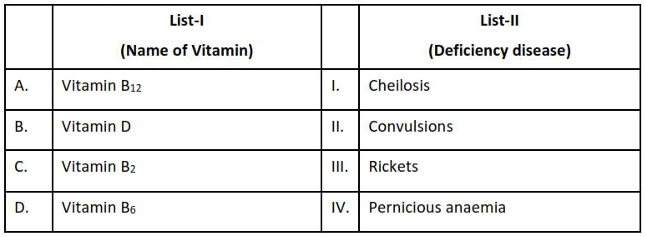
Choose the correct answer from the options given below :
(1). A-IV, B-III, C-IL, D-I
(2). A-I, B-III, C-II, D-IV
(3). A-IV, B-III, C-I, D-II
(4). A-II, B-III, C-I, D-IV
Choose the correct answer from the options given below :
(1). A-IV, B-III, C-IL, D-I
(2). A-I, B-III, C-II, D-IV
(3). A-IV, B-III, C-I, D-II
(4). A-II, B-III, C-I, D-IV
Number of Attempts: 2
Correct Attempts: 1
Time Taken: 00:04
Average Time: 00:02
Sugar 'X'
A. is found in honey.
B. is a ketó sugar.
C. exists in \(\alpha\) and \(\beta\) - anomeric forms.
D. is laevorotatory.
'X' is :
(1). Sucrose
(2). D-Glucose
(3). D-Fructose
(4). Maltose
A. is found in honey.
B. is a ketó sugar.
C. exists in \(\alpha\) and \(\beta\) - anomeric forms.
D. is laevorotatory.
'X' is :
(1). Sucrose
(2). D-Glucose
(3). D-Fructose
(4). Maltose
Number of Attempts: 2
Correct Attempts: 1
Time Taken: 00:04
Average Time: 00:02
Fehling’s solution ‘A’ is
(1). Alkaline solution of sodium potassium tartrate (Rochelle’s salt)
(2). Aqueous sodium citrate
(3). Aqueous copper sulphate
(4). Alkaline copper sulphate
(1). Alkaline solution of sodium potassium tartrate (Rochelle’s salt)
(2). Aqueous sodium citrate
(3). Aqueous copper sulphate
(4). Alkaline copper sulphate
Number of Attempts: 2
Correct Attempts: 1
Time Taken: 00:04
Average Time: 00:02
The reagents with which glucose does not react to give the corresponding tests/products are
A. Tollen's reagent
B. Schiff's reagent
C. HCN
D. NH2OH
E. NaHSO3
Choose the correct options from the given below:
(1). B and E
(2). E and D
(3). B and C
(4). A and D
A. Tollen's reagent
B. Schiff's reagent
C. HCN
D. NH2OH
E. NaHSO3
Choose the correct options from the given below:
(1). B and E
(2). E and D
(3). B and C
(4). A and D
Number of Attempts: 2
Correct Attempts: 1
Time Taken: 00:04
Average Time: 00:02
Given below are two statements:
Statemnent I : A unit formed by the attachment of a base of 1' position of sugar is known as nucleoside.
Statement II : When nucleoside is linked to phosphorous acid at 5-position of sugar moiety, we get nucleotide.
In the light of the above statements, choose the correct answer from the options given below:
(1). Both Statement I and Statement II are false.
(2). Statement I is true but Statement II is false.
(3). Statement I is false but Statement II is true.
(4). Both Statement I and Statement II are true.
Statemnent I : A unit formed by the attachment of a base of 1' position of sugar is known as nucleoside.
Statement II : When nucleoside is linked to phosphorous acid at 5-position of sugar moiety, we get nucleotide.
In the light of the above statements, choose the correct answer from the options given below:
(1). Both Statement I and Statement II are false.
(2). Statement I is true but Statement II is false.
(3). Statement I is false but Statement II is true.
(4). Both Statement I and Statement II are true.
Number of Attempts: 2
Correct Attempts: 1
Time Taken: 00:04
Average Time: 00:02
Which of the following is a basic amino acid ?
(1). Alanine
(2). Tyrosine
(3). Lysine
(4). Serine
(1). Alanine
(2). Tyrosine
(3). Lysine
(4). Serine
Number of Attempts: 2
Correct Attempts: 1
Time Taken: 00:04
Average Time: 00:02
Sucrose on hydrolysis gives:
(1). \(\alpha \text{- D-Glucose + } \beta \text{-D-Glucose}\)
(2). \(\alpha \text{- D-Glucose + } \beta \text{-D-Fructose}\)
(3). \(\alpha \text{- D-Fructose + } \beta \text{-D-Fructose}\)
(4). \(\beta \text{- D-Glucose + } \alpha \text{-D-Fructose}\)
(1). \(\alpha \text{- D-Glucose + } \beta \text{-D-Glucose}\)
(2). \(\alpha \text{- D-Glucose + } \beta \text{-D-Fructose}\)
(3). \(\alpha \text{- D-Fructose + } \beta \text{-D-Fructose}\)
(4). \(\beta \text{- D-Glucose + } \alpha \text{-D-Fructose}\)
Number of Attempts: 2
Correct Attempts: 1
Time Taken: 00:04
Average Time: 00:02
Hydrolysis of sucrose is given by the following reaction.
Sucrose + H2O \(\rightleftharpoons \) Glucose + Fructose
If the equilibrium constant (Kc) is 2 x 10¹³ at 800 K, the value of \(\Delta \text{rG}^ \ominus \) at the same temperature will be
(1). 8.314 J mol-1K-1 x 300 K x In(2 x 10¹³)
(2). 8.314 J mol-1K-1 x 300 K x In(3 x 10¹³)
(3). -8.314 J mol-1K-1 x 300 K x In(4 x 10¹³)
(4). -8.314 J mol-1K-1 x 300 K x In(2 x 10¹³)
Sucrose + H2O \(\rightleftharpoons \) Glucose + Fructose
If the equilibrium constant (Kc) is 2 x 10¹³ at 800 K, the value of \(\Delta \text{rG}^ \ominus \) at the same temperature will be
(1). 8.314 J mol-1K-1 x 300 K x In(2 x 10¹³)
(2). 8.314 J mol-1K-1 x 300 K x In(3 x 10¹³)
(3). -8.314 J mol-1K-1 x 300 K x In(4 x 10¹³)
(4). -8.314 J mol-1K-1 x 300 K x In(2 x 10¹³)
Number of Attempts: 2
Correct Attempts: 1
Time Taken: 00:04
Average Time: 00:02
The non-essential amino acid among the following is
(1). leucine
(2). alanine
(3). lysine
(4). valine
(1). leucine
(2). alanine
(3). lysine
(4). valine
Number of Attempts: 2
Correct Attempts: 1
Time Taken: 00:04
Average Time: 00:02
Enzymes that utilize ATP in phosphate transfer require an alkaline earth metal (M) as the cofactor. M is
(1). Mg
(2). Ca
(3). Sr
(4). Be
(1). Mg
(2). Ca
(3). Sr
(4). Be
Number of Attempts: 2
Correct Attempts: 1
Time Taken: 00:04
Average Time: 00:02
The difference between amylose and amylopectin is
(1). amylose is made up of glucose and galactose.
(2). amylopectin have 1 → 4 \(\alpha\) -linkage and 1 → 6 \(\beta \) - linkage.
(3). amylose have 1 → 4 \(\alpha \) - inkage and 1 → 6 \(\beta \) - linkage.
(4). amylopectin have 1 → 4 \(\alpha \) - linkage and 1 → 6 \(\alpha \) - linkage.
(1). amylose is made up of glucose and galactose.
(2). amylopectin have 1 → 4 \(\alpha\) -linkage and 1 → 6 \(\beta \) - linkage.
(3). amylose have 1 → 4 \(\alpha \) - inkage and 1 → 6 \(\beta \) - linkage.
(4). amylopectin have 1 → 4 \(\alpha \) - linkage and 1 → 6 \(\alpha \) - linkage.
Number of Attempts: 2
Correct Attempts: 1
Time Taken: 00:04
Average Time: 00:02
Which of the following compounds can form a zwitter ion ?
(1). Glycine
(2). Benzoic acid
(3). Acetanilide
(4). Aniline
(1). Glycine
(2). Benzoic acid
(3). Acetanilide
(4). Aniline
Number of Attempts: 2
Correct Attempts: 1
Time Taken: 00:04
Average Time: 00:02
Which of the following statements is not correct ?
(1). Denaturation makes the proteins more active.
(2). Insulin maintains sugar level in the blood of a human body.
(3). Ovalbumin is a simple food reserve in egg-white.
(4). Blood proteins thrombin and fibrinogen are involved in blood clotting.
(1). Denaturation makes the proteins more active.
(2). Insulin maintains sugar level in the blood of a human body.
(3). Ovalbumin is a simple food reserve in egg-white.
(4). Blood proteins thrombin and fibrinogen are involved in blood clotting.
Number of Attempts: 2
Correct Attempts: 1
Time Taken: 00:04
Average Time: 00:02
Which one of the following statements is not correct ?
(1). Coenzymes increase the catalytic activity of enzyme.
(2). Catalyst does not initiate any reaction.
(3). The value of equilibrium constant is changed in the presence of a catalyst in the reaction at equilibrium.
(4). Enzymes catalyze mainly bio-chemical reactions.
(1). Coenzymes increase the catalytic activity of enzyme.
(2). Catalyst does not initiate any reaction.
(3). The value of equilibrium constant is changed in the presence of a catalyst in the reaction at equilibrium.
(4). Enzymes catalyze mainly bio-chemical reactions.
Number of Attempts: 2
Correct Attempts: 1
Time Taken: 00:04
Average Time: 00:02
In a protein molecule various amino acids are linked together by
(1). β-glycosidic bond
(2). peptide bond
(3). dative bond
(4). a-glycosidic bond
(1). β-glycosidic bond
(2). peptide bond
(3). dative bond
(4). a-glycosidic bond
Number of Attempts: 2
Correct Attempts: 1
Time Taken: 00:04
Average Time: 00:02
The correct statement regarding RNA and DNA , respectively is
(1). The sugar component in RNA is ribose and the sugar component in DNA is 2`-deoxyribose
(2). The sugar component in RNA is arabinose and the sugar component in DNA is ribose
(3). The sugar component in RNA is 2 '-deoxyribose and the sugar component in DNA is arabinose
(4). The sugar component in RNA is arabinose and the sugar component in DNA is 2 '-deoxyribose
(1). The sugar component in RNA is ribose and the sugar component in DNA is 2`-deoxyribose
(2). The sugar component in RNA is arabinose and the sugar component in DNA is ribose
(3). The sugar component in RNA is 2 '-deoxyribose and the sugar component in DNA is arabinose
(4). The sugar component in RNA is arabinose and the sugar component in DNA is 2 '-deoxyribose
Number of Attempts: 2
Correct Attempts: 1
Time Taken: 00:04
Average Time: 00:02
Which one given below is a non - reducing sugar ?
(1). Lactose
(2). Glucose
(3). Sucrose
(4). Maltose
(1). Lactose
(2). Glucose
(3). Sucrose
(4). Maltose
Number of Attempts: 2
Correct Attempts: 1
Time Taken: 00:04
Average Time: 00:02