
Home >> My Performance >> My Topic Test Performance >> My Question Performance
My Question Performance Summary in Full Tests !
Questions Available: 15
Questions Attempted: 10
Number of Attempts: 15
Correct Attempts: 8
Total Time Spent: 00:30
Avg Time Per Question: 00:02
My Question Performance Summary in Full Tests
The area of a rectangular field (in m2 ) of length 55.3 m and breadth 25 m after rounding off the value for correct significant digits is
(1). 138 × 101
(2). 1382
(3). 1382.5
(4). 14 × 102
(1). 138 × 101
(2). 1382
(3). 1382.5
(4). 14 × 102
Number of Attempts: 2
Correct Attempts: 1
Time Taken: 00:04
Average Time: 00:02
If E and G respectively denote energy and gravitational constant, then E/G has the dimensions of
(1). [M2] [L−1] [T 0]
(2). [M ] [L−1] [T −1]
(3). [M ] [L0] [T 0]
(4). [M2] [L−2] [T −1]
(1). [M2] [L−1] [T 0]
(2). [M ] [L−1] [T −1]
(3). [M ] [L0] [T 0]
(4). [M2] [L−2] [T −1]
Number of Attempts: 2
Correct Attempts: 1
Time Taken: 00:04
Average Time: 00:02
A baloon is made of a material of surface tension S and its inflation outlet (from where gas is filled in it) has small area A. It is filled with a gas of density \(\rho\) and takes a spherical share of radius R. When the gas is allowed to flow freely out of it, its radius r changes from R to 0 (zero) in time T. If the speed v(r) of gas coming out of the balloon depends on r as \(r^a\) and \(\text{T} \propto \text{S}^\alpha \text{A}^\beta \rho^\gamma \text{R}^\delta\) then
(1). \(\text{a}=\frac{1}{2}\), \(\alpha=\frac{1}{2}\), \(\beta=\frac{1}{2}\), \( \gamma=\frac{1}{2} \text{,}\, \delta=\frac{7}{2}\)
(2). \( \text{a}=\frac{1}{2}\), \(\alpha=\frac{1}{2}\), \(\beta = -1\), \(\gamma=+1\), \(\delta=\frac{3}{2}\)
(3). \( \text{a}=\frac{1}{2}\), \(\alpha=-\frac{1}{2}\), \(\beta=-1\), \(\gamma=\frac{1}{2}\), \(\delta=\frac{5}{2}\)
(4). \(\text{a}=-\frac{1}{2}\), \(\alpha=-\frac{1}{2}\), \(\beta=-1\), \(\gamma=\frac{1}{2}\), \(\delta=\frac{7}{2}\)
(1). \(\text{a}=\frac{1}{2}\), \(\alpha=\frac{1}{2}\), \(\beta=\frac{1}{2}\), \( \gamma=\frac{1}{2} \text{,}\, \delta=\frac{7}{2}\)
(2). \( \text{a}=\frac{1}{2}\), \(\alpha=\frac{1}{2}\), \(\beta = -1\), \(\gamma=+1\), \(\delta=\frac{3}{2}\)
(3). \( \text{a}=\frac{1}{2}\), \(\alpha=-\frac{1}{2}\), \(\beta=-1\), \(\gamma=\frac{1}{2}\), \(\delta=\frac{5}{2}\)
(4). \(\text{a}=-\frac{1}{2}\), \(\alpha=-\frac{1}{2}\), \(\beta=-1\), \(\gamma=\frac{1}{2}\), \(\delta=\frac{7}{2}\)
Number of Attempts: 2
Correct Attempts: 1
Time Taken: 00:04
Average Time: 00:02
A physical quantity P is related to four observations a, b, c, and d as follows:
\(\text{P}\,=\,\text{a}^3\text{b}^2 / \text{c} \sqrt{d}\)
The percentage errors of measurement in a, b, c, and d are 1%, 3%, 2%, and 4% respectively. The percentage error in the quantity P is
(1). 15%
(2). 10%
(3). 2%
(4). 13%
\(\text{P}\,=\,\text{a}^3\text{b}^2 / \text{c} \sqrt{d}\)
The percentage errors of measurement in a, b, c, and d are 1%, 3%, 2%, and 4% respectively. The percentage error in the quantity P is
(1). 15%
(2). 10%
(3). 2%
(4). 13%
Number of Attempts: 2
Correct Attempts: 1
Time Taken: 00:04
Average Time: 00:02
The quantities which have the same dimensions as those of solid angle are:
(1). strain and angle
(2). stress and angle
(3). strain and arc
(4). angular speed and stress
(1). strain and angle
(2). stress and angle
(3). strain and arc
(4). angular speed and stress
Number of Attempts: 2
Correct Attempts: 1
Time Taken: 00:04
Average Time: 00:02
A force defined by F = αt2 + βt acts on a particle at a given time t. The factor which is dimensionless, if α and β are constants, is:
(1). \(\displaystyle \frac{\beta t}{\alpha}\)
(2). \(\displaystyle \frac{\alpha t}{\beta}\)
(3). \(\displaystyle \alpha \beta t\)
(4). \(\displaystyle \frac{\alpha \beta}{t}\)
(1). \(\displaystyle \frac{\beta t}{\alpha}\)
(2). \(\displaystyle \frac{\alpha t}{\beta}\)
(3). \(\displaystyle \alpha \beta t\)
(4). \(\displaystyle \frac{\alpha \beta}{t}\)
Number of Attempts: 2
Correct Attempts: 1
Time Taken: 00:04
Average Time: 00:02
The errors in the measurement which arise due to unpredictable fluctuations in temperature and voltage supply are
(1). Personal errors
(2). Least count errors
(3). Random errors
(4). Instrumental errors
(1). Personal errors
(2). Least count errors
(3). Random errors
(4). Instrumental errors
Number of Attempts: 2
Correct Attempts: 1
Time Taken: 00:04
Average Time: 00:02
A metal wire has mass (0.4 ± 0.002) g, radius (0.3 ± 0.001) mm and length (5 ± 0.02) cm. The maximum possible percentage error in the measurement of density will nearly be
(1). 1.30%
(2). 1.60%
(3). 1.40%
(4). 1.20%
(1). 1.30%
(2). 1.60%
(3). 1.40%
(4). 1.20%
Number of Attempts: 2
Correct Attempts: 1
Time Taken: 00:04
Average Time: 00:02
Plane angle and solid angle have
(1). Units but no dimensions
(2). Dimensions but no units
(3). No units and no dimensions
(4). Both units and dimensions
(1). Units but no dimensions
(2). Dimensions but no units
(3). No units and no dimensions
(4). Both units and dimensions
Number of Attempts: 2
Correct Attempts: 1
Time Taken: 00:04
Average Time: 00:02
If force [F], acceleration [A] and time [T] are chosen as the fundamental physical quantities. Find the dimensions of energy.
(1). [F ] [A] [T ]
(2). [F ] [A] [T 2]
(3). [F ] [A] [T −1]
(4). [F ] [A−1] [T ]
(1). [F ] [A] [T ]
(2). [F ] [A] [T 2]
(3). [F ] [A] [T −1]
(4). [F ] [A−1] [T ]
Number of Attempts: 2
Correct Attempts: 1
Time Taken: 00:04
Average Time: 00:02
Dimensions of stress are :
(1). \([M\, L^2\, T^{ −2}]\)
(2). \([M\, L^0\, T^{ −2}]\)
(3). \([M\, L^{−1}\, T^{ −2}]\)
(4). \([M\, L\, T^{ −2}]\)
(1). \([M\, L^2\, T^{ −2}]\)
(2). \([M\, L^0\, T^{ −2}]\)
(3). \([M\, L^{−1}\, T^{ −2}]\)
(4). \([M\, L\, T^{ −2}]\)
Number of Attempts: 2
Correct Attempts: 1
Time Taken: 00:04
Average Time: 00:02
Taking into account of the significant figures, what is the value of 9.99 m − 0.0099 ?
(1). 9.98 m
(2). 9.980 m
(3). 9.9 m
(4). 9.9801 m
(1). 9.98 m
(2). 9.980 m
(3). 9.9 m
(4). 9.9801 m
Number of Attempts: 2
Correct Attempts: 1
Time Taken: 00:04
Average Time: 00:02
In an experiment, the percentage of error occurred in the measurement of physical quantities A, B, C and D are 1%, 2%, 3% and 4% respectively. Then the maximum percentage of error in the measurement X, where \(\displaystyle X = \frac{A^2B^{1/2}}{C^{1/3}D^3}\) will be
(1). \(10 \% \)
(2). \(\left(\displaystyle \frac{3}{13}\right) \% \)
(3). \(16 \%\)
(4). \(-10 \%\)
(1). \(10 \% \)
(2). \(\left(\displaystyle \frac{3}{13}\right) \% \)
(3). \(16 \%\)
(4). \(-10 \%\)
Number of Attempts: 2
Correct Attempts: 1
Time Taken: 00:04
Average Time: 00:02
The unit of thermal conductivity is
(1). \(Wm^{−1}K^{−1}\)
(2). \(JmK^{−1}\)
(3). \(Jm^{−1}K^{ −1}\)
(4). \(WmK^{−1}\)
(1). \(Wm^{−1}K^{−1}\)
(2). \(JmK^{−1}\)
(3). \(Jm^{−1}K^{ −1}\)
(4). \(WmK^{−1}\)
Number of Attempts: 2
Correct Attempts: 1
Time Taken: 00:04
Average Time: 00:02
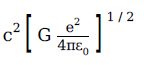
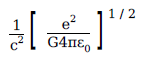
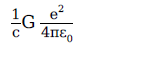
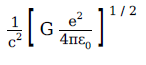
A physical quantity of the dimensions of length that can be formed out of c, G and \(\displaystyle \frac{e^2}{4\pi \, \epsilon_0}\) is
[c is velocity of light, G is the universal constant of gravitation and e is charge]
(1).
(2).
(3).
(4).
[c is velocity of light, G is the universal constant of gravitation and e is charge]
(1).
(2).
(3).
(4).
Number of Attempts: 2
Correct Attempts: 1
Time Taken: 00:04
Average Time: 00:02