
Home >> My Performance >> My Topic Performance >> My Question Performance
My Question Performance Summary in Topic Wise Tests !
Questions Available: 34
Questions Attempted: 15
Number of Attempts: 25
Correct Attempts: 12
Total Time Spent: 00:45
Avg Time Per Question: 00:02
My Question Performance Details in Topic Wise Tests
A specialised membranous structure in a prokaryotic cell which helps in cell wall formation, DNA replication and respiration is :
(1). Endoplasmic Reticulum
(2). Mesosome
(3). Chromatophores
(4). Cristae
(1). Endoplasmic Reticulum
(2). Mesosome
(3). Chromatophores
(4). Cristae
Number of Attempts: 03
Correct Attempts: 01
Time Taken: 00:15
Average Time: 00:05
Given below are two statements : one is labelled as Assertion (A) and the other is labelled as Reason (R).
Assertion (A) : The primary function of the Golgi apparatus is to package the materials made by the endoplasmic reticulum and deliver it to intracellular targets and outside the cell.
Reason (R) : Vesicles containing materials made by the endoplasmic reticulum fuse with the cis face of the Golgi apparatus, and they are modified and released from the trans face of the Golgi apparatus.
In the light of the above statements, choose the correct answer from the options given below :
(1). A is false but R is true
(2). Both A and R are true and R is the correct explanation of A
(3). Both A and R are true but R is not the correct explanation of A
(4). A is true but R is false
Assertion (A) : The primary function of the Golgi apparatus is to package the materials made by the endoplasmic reticulum and deliver it to intracellular targets and outside the cell.
Reason (R) : Vesicles containing materials made by the endoplasmic reticulum fuse with the cis face of the Golgi apparatus, and they are modified and released from the trans face of the Golgi apparatus.
In the light of the above statements, choose the correct answer from the options given below :
(1). A is false but R is true
(2). Both A and R are true and R is the correct explanation of A
(3). Both A and R are true but R is not the correct explanation of A
(4). A is true but R is false
Number of Attempts: 03
Correct Attempts: 01
Time Taken: 00:15
Average Time: 00:05
Given below are two statements:
Statement I: In prokaryotes, the positively charged DNA is held with some negatively charged proteins in a region called nucleoid.
Statemnent II : In eukaryotes, the negatively charged DNA is wrapped around the positively charged histone octamer to form nucleosome.
In the light of the above statements, choose the correct answer from the options given below
(1). Both Statement I and Statement II are false.
(2). Statement I is correct but Statement II is false.
(3). Statement I incorrect but Statement II is true.
(4). Both Statement I and Statement II are true.
Statement I: In prokaryotes, the positively charged DNA is held with some negatively charged proteins in a region called nucleoid.
Statemnent II : In eukaryotes, the negatively charged DNA is wrapped around the positively charged histone octamer to form nucleosome.
In the light of the above statements, choose the correct answer from the options given below
(1). Both Statement I and Statement II are false.
(2). Statement I is correct but Statement II is false.
(3). Statement I incorrect but Statement II is true.
(4). Both Statement I and Statement II are true.
Number of Attempts: 03
Correct Attempts: 01
Time Taken: 00:15
Average Time: 00:05
Match List -I with List - II.
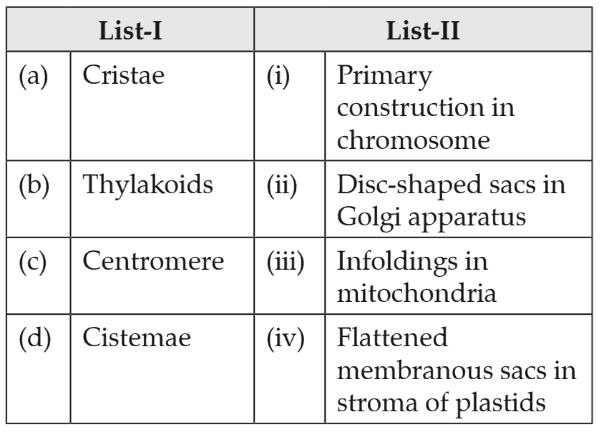
Choose the correct answer from the options given below.
(1). (a) - (iv), (b) - (iii), (c) - (ii), (d) - (i)
(2). (a) - (iii), (b) - (iv), (c) - (iii), (d) - (ii)
(3). (a) - (iii), (b) - (iv), (c) - (i), (d) - (ii)
(4). (a) - (ii), (b) - (iii), (c) - (iv), (d) - (i)
Choose the correct answer from the options given below.
(1). (a) - (iv), (b) - (iii), (c) - (ii), (d) - (i)
(2). (a) - (iii), (b) - (iv), (c) - (iii), (d) - (ii)
(3). (a) - (iii), (b) - (iv), (c) - (i), (d) - (ii)
(4). (a) - (ii), (b) - (iii), (c) - (iv), (d) - (i)
Number of Attempts: 03
Correct Attempts: 01
Time Taken: 00:15
Average Time: 00:05
Which of the following statements is not correct ?
(1). The hydrolytic enzymes of lysosomes are active under acidic pH.
(2). Lysosomes are membrane bound structures.
(3). Lysosomes are formed by the process of packaging in the endoplasmic reticulum.
(4). Lysosomes have numerous hydrolytic enzymes.
(1). The hydrolytic enzymes of lysosomes are active under acidic pH.
(2). Lysosomes are membrane bound structures.
(3). Lysosomes are formed by the process of packaging in the endoplasmic reticulum.
(4). Lysosomes have numerous hydrolytic enzymes.
Number of Attempts: 03
Correct Attempts: 01
Time Taken: 00:15
Average Time: 00:05
Which of the following statements regarding mitochondria is incorrect ?
(1). Enzymes of electron transport are embedded in outer membrane.
(2). Inner membrane is convoluted with infoldings.
(3). Mitochondrial matrix contains single circular DNA molecule and ribosomes.
(4). Outer membrane is permeable to monomers of carbohydrates fats and proteins.
(1). Enzymes of electron transport are embedded in outer membrane.
(2). Inner membrane is convoluted with infoldings.
(3). Mitochondrial matrix contains single circular DNA molecule and ribosomes.
(4). Outer membrane is permeable to monomers of carbohydrates fats and proteins.
Number of Attempts: 03
Correct Attempts: 01
Time Taken: 00:15
Average Time: 00:05
Which of the following is true for nucleolus?
(1). It is a site for active ribosomal RNA synthesis
(2). It takes part in spindle formation
(3). It is a membrane-bound structure
(4). Larger nucleoli are present in dividing cells
(1). It is a site for active ribosomal RNA synthesis
(2). It takes part in spindle formation
(3). It is a membrane-bound structure
(4). Larger nucleoli are present in dividing cells
Number of Attempts: 03
Correct Attempts: 01
Time Taken: 00:15
Average Time: 00:05
Many ribosomes may associate with a single mRNA to form multiple copies of a polypeptide simultaneously. Such strings of ribosomes are termed as
(1). nucleosome.
(2). plastidome.
(3). polyhedral bodies.
(4). polysome.
(1). nucleosome.
(2). plastidome.
(3). polyhedral bodies.
(4). polysome.
Number of Attempts: 03
Correct Attempts: 01
Time Taken: 00:15
Average Time: 00:05
Mitochondria and chloroplast are
I. semi-autonomous organelles
II. formed by the division of pre existing organelles and they contain DNA but lack protein synthesising machinery
Which one of the following options is correct?
(1). II is true but I is false
(2). I is true but II is false
(3). Both I and II are false
(4). Both I and II are correct
I. semi-autonomous organelles
II. formed by the division of pre existing organelles and they contain DNA but lack protein synthesising machinery
Which one of the following options is correct?
(1). II is true but I is false
(2). I is true but II is false
(3). Both I and II are false
(4). Both I and II are correct
Number of Attempts: 03
Correct Attempts: 01
Time Taken: 00:15
Average Time: 00:05
From the statements given below choose the correct option :
A. The eukaryotic ribosomes are 80S and prokaryotic ribosomes are 70S.
B. Each ribosome has two sub-units.
C. The two sub-units of 80S ribosome are 60S and 40S while that of 70S are 50S and 30S.
D. The two sub-units of 80S ribosome are 60S and 20S and that of 70S are 50S and 20S.
E. The two sub-units of 80S are 60S and 30S and that of 70S are 50S and 30S.
(1). B, D, E are true
(2). A, B, C are true
(3). A, B, D are true
(4). A, B, E are true
A. The eukaryotic ribosomes are 80S and prokaryotic ribosomes are 70S.
B. Each ribosome has two sub-units.
C. The two sub-units of 80S ribosome are 60S and 40S while that of 70S are 50S and 30S.
D. The two sub-units of 80S ribosome are 60S and 20S and that of 70S are 50S and 20S.
E. The two sub-units of 80S are 60S and 30S and that of 70S are 50S and 30S.
(1). B, D, E are true
(2). A, B, C are true
(3). A, B, D are true
(4). A, B, E are true
Number of Attempts: 03
Correct Attempts: 01
Time Taken: 00:15
Average Time: 00:05
Match List - I with List - II
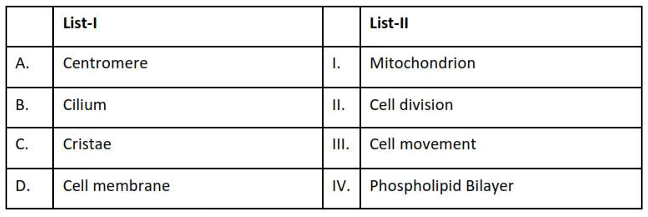
Choose the correct answer from the optionsgiven below :
(1). A-II, B-III, C-I, D-IV
(2). A-I, B-II, C-III, D-IV
(3). A-II, B-I, C-IV, D-III
(4). A-IV, B-II, CIII, D-I
Choose the correct answer from the optionsgiven below :
(1). A-II, B-III, C-I, D-IV
(2). A-I, B-II, C-III, D-IV
(3). A-II, B-I, C-IV, D-III
(4). A-IV, B-II, CIII, D-I
Number of Attempts: 03
Correct Attempts: 01
Time Taken: 00:15
Average Time: 00:05
Match List-I with List-II
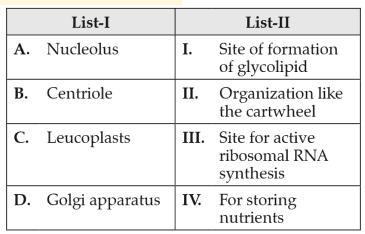
Choose the correct answer from the options given below:
(1). A-III, B-IV, C-II, D-I
(2). A-I, B-II. C-III, D-IV
(3). A-III, B-II, C-IV, D-I
(4). A-II, B-III, C-I, D-IV
Choose the correct answer from the options given below:
(1). A-III, B-IV, C-II, D-I
(2). A-I, B-II. C-III, D-IV
(3). A-III, B-II, C-IV, D-I
(4). A-II, B-III, C-I, D-IV
Number of Attempts: 03
Correct Attempts: 01
Time Taken: 00:15
Average Time: 00:05
The DNA present in chloroplast is:
(1). Linear, single stranded
(2). Circular, single stranded
(3). Linear, double standed
(4). Circular, double stranded
(1). Linear, single stranded
(2). Circular, single stranded
(3). Linear, double standed
(4). Circular, double stranded
Number of Attempts: 03
Correct Attempts: 01
Time Taken: 00:15
Average Time: 00:05
Match List I with List II: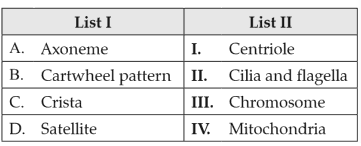
Choose the correct answer from the options given below:
(1). A-II, B-IV, C-I, D-III
(2). A-II, B-I, C-IV, D-III
(3). A-IV, B-III, C-II, D-I
(4). A-IV, B-II, C-III, D-I
Choose the correct answer from the options given below:
(1). A-II, B-IV, C-I, D-III
(2). A-II, B-I, C-IV, D-III
(3). A-IV, B-III, C-II, D-I
(4). A-IV, B-II, C-III, D-I
Number of Attempts: 03
Correct Attempts: 01
Time Taken: 00:15
Average Time: 00:05
Given below are two statements:
Statement I : Mitochindria and chloroplasts are both double membrane bound organelles.
Statement II: Inner memebrane of mitochondria is relatively less permeable, as compared to chroloroplast.
In the light of the above staements, choose the most appropriate answer from the options given below
(1). Statement I is correct but Statement II is incorrect.
(2). Statement I is incorrect but Statement II is correct
(3). Both Statement I and Statement II are correct.
(4). Both Statement I and Statement II are incorrect.
Statement I : Mitochindria and chloroplasts are both double membrane bound organelles.
Statement II: Inner memebrane of mitochondria is relatively less permeable, as compared to chroloroplast.
In the light of the above staements, choose the most appropriate answer from the options given below
(1). Statement I is correct but Statement II is incorrect.
(2). Statement I is incorrect but Statement II is correct
(3). Both Statement I and Statement II are correct.
(4). Both Statement I and Statement II are incorrect.
Number of Attempts: 03
Correct Attempts: 01
Time Taken: 00:15
Average Time: 00:05
How many diferent proteins does the ribosome
consist of?
(1). 60
(2). 40
(3). 20
(4). 80
(1). 60
(2). 40
(3). 20
(4). 80
Number of Attempts: 03
Correct Attempts: 01
Time Taken: 00:15
Average Time: 00:05
Which of the following are NOT considered as the
part of endomembrane system
A. Mitochondria
B. Endoplasmic Reticulum
C. Chloroplasts
D. Golgi complex
E. Peroxisomes
Choose the most appropriate answer from the options given below :
(1). A, C and E only
(2). A and D only
(3). A, D and E only
(4). B and D only
A. Mitochondria
B. Endoplasmic Reticulum
C. Chloroplasts
D. Golgi complex
E. Peroxisomes
Choose the most appropriate answer from the options given below :
(1). A, C and E only
(2). A and D only
(3). A, D and E only
(4). B and D only
Number of Attempts: 03
Correct Attempts: 01
Time Taken: 00:15
Average Time: 00:05
Which of the following statements with respect to Endoplasmic Reticulum is incorrect?
(1). RER has ribosomes attached to ER
(2). SER is devoid of ribosomes
(3). In prokaryotes only RER are present
(4). SER are the sites for lipid synthesis
(1). RER has ribosomes attached to ER
(2). SER is devoid of ribosomes
(3). In prokaryotes only RER are present
(4). SER are the sites for lipid synthesis
Number of Attempts: 03
Correct Attempts: 01
Time Taken: 00:15
Average Time: 00:05
Identify the types of cell junctions that help to stop
the leakage of the substances across a tissue and
facilitate communication with neighbouring cells
via rapid transfer of ions and molecules.
(1). Gap junctions and Adhering junctions, respectively.
(2). Tight junctions and Gap junctions, respectively.
(3). Adhering junctions and Tight junctions, respectively.
(4). Adhering junctions and Gap junctions, respectively.
(1). Gap junctions and Adhering junctions, respectively.
(2). Tight junctions and Gap junctions, respectively.
(3). Adhering junctions and Tight junctions, respectively.
(4). Adhering junctions and Gap junctions, respectively.
Number of Attempts: 03
Correct Attempts: 01
Time Taken: 00:15
Average Time: 00:05
Which of the following is an incorrect statement?
(1). Mature sieve tube elements possess a conspicuous nucleus and usual cytoplasmic organelles.
(2). Microbodies are present both in plant and animal cells.
(3). The perinuclear space forms a barrier between the materials present inside the nucleus and that of the cytoplasm.
(4). Nuclear pores act as passages for proteins and RNA molecules in both directions between nucleus and cytoplasm.
(1). Mature sieve tube elements possess a conspicuous nucleus and usual cytoplasmic organelles.
(2). Microbodies are present both in plant and animal cells.
(3). The perinuclear space forms a barrier between the materials present inside the nucleus and that of the cytoplasm.
(4). Nuclear pores act as passages for proteins and RNA molecules in both directions between nucleus and cytoplasm.
Number of Attempts: 03
Correct Attempts: 01
Time Taken: 00:15
Average Time: 00:05
When the centromere is situated in the middle of two equal arms of chromosomes, the chromosome is referred as:
(1). Metacentric
(2). Telocentric
(3). Sub-metacentric
(4). Acrocentric
(1). Metacentric
(2). Telocentric
(3). Sub-metacentric
(4). Acrocentric
Number of Attempts: 03
Correct Attempts: 01
Time Taken: 00:15
Average Time: 00:05
Which of the following statements about inclusion
bodies is incorrect?
(1). These are involved in ingestion of food partides.
(2). They lie free in the cytoplasm.
(3). These represent reserve material in cytoplasm.
(4). They are not bound by any membrane.
(1). These are involved in ingestion of food partides.
(2). They lie free in the cytoplasm.
(3). These represent reserve material in cytoplasm.
(4). They are not bound by any membrane.
Number of Attempts: 03
Correct Attempts: 01
Time Taken: 00:15
Average Time: 00:05
Which is the important site of formation of
glycoproteins and glycolipids in eukaryotic cells ?
(1). Peroxisomes
(2). Golgi bodies
(3). Polysomes
(4). Endoplasmic reticulum
(1). Peroxisomes
(2). Golgi bodies
(3). Polysomes
(4). Endoplasmic reticulum
Number of Attempts: 03
Correct Attempts: 01
Time Taken: 00:15
Average Time: 00:05
The concept of “Omnis cellula-e cellula” regarding cell division was first proposed by
(1). Theodore Schwann.
(2). Schleiden.
(3). Aristotle.
(4). Rudolf Virchow.
(1). Theodore Schwann.
(2). Schleiden.
(3). Aristotle.
(4). Rudolf Virchow.
Number of Attempts: 03
Correct Attempts: 01
Time Taken: 00:15
Average Time: 00:05
The shorter and longer arms of a submetacentric chromosome are referred to as
(1). p-arm and q-arm respectively.
(2). q-arm and p-arm respectively.
(3). m-arm and n-arm respectively.
(4). s-arm and l-arm respectively.
(1). p-arm and q-arm respectively.
(2). q-arm and p-arm respectively.
(3). m-arm and n-arm respectively.
(4). s-arm and l-arm respectively.
Number of Attempts: 03
Correct Attempts: 01
Time Taken: 00:15
Average Time: 00:05
Which of the following pair of organelles does not contain DNA ?
(1). Chloroplast and Vacuoles
(2). Lysosomes and Vacuoles
(3). Nuclear envelope and Mitochondria
(4). Mitochondria and Lysosomes
(1). Chloroplast and Vacuoles
(2). Lysosomes and Vacuoles
(3). Nuclear envelope and Mitochondria
(4). Mitochondria and Lysosomes
Number of Attempts: 03
Correct Attempts: 01
Time Taken: 00:15
Average Time: 00:05
The Golgi complex participates in
(1). activation of amino acid.
(2). respiration in bacteria.
(3). formation of secretory vesicles.
(4). fatty acid breakdown.
(1). activation of amino acid.
(2). respiration in bacteria.
(3). formation of secretory vesicles.
(4). fatty acid breakdown.
Number of Attempts: 03
Correct Attempts: 01
Time Taken: 00:15
Average Time: 00:05
Nissl bodies are mainly composed of
(1). free ribosomes and RER.
(2). nucleic acids and SER.
(3). DNA and RNA.
(4). proteins and lipids.
(1). free ribosomes and RER.
(2). nucleic acids and SER.
(3). DNA and RNA.
(4). proteins and lipids.
Number of Attempts: 03
Correct Attempts: 01
Time Taken: 00:15
Average Time: 00:05
Which of the following events does not occur in rough endoplasmic reticulum?
(1). Phospholipid synthesis
(2). Cleavage of signal peptide
(3). Protein glycosylation
(4). Protein folding
(1). Phospholipid synthesis
(2). Cleavage of signal peptide
(3). Protein glycosylation
(4). Protein folding
Number of Attempts: 03
Correct Attempts: 01
Time Taken: 00:15
Average Time: 00:05
Which of the following components provides sticky character to the bacterial cell ?
(1). Glycocalyx
(2). Cell wall
(3). Nuclear membrane
(4). Plasma membrane
(1). Glycocalyx
(2). Cell wall
(3). Nuclear membrane
(4). Plasma membrane
Number of Attempts: 03
Correct Attempts: 01
Time Taken: 00:15
Average Time: 00:05
Which of the following cell organelles is responsible for extracting energy from carbohydrates to form ATP ?
(1). Mitochondrion
(2). Lysosome
(3). Ribosome
(4). Chloroplast
(1). Mitochondrion
(2). Lysosome
(3). Ribosome
(4). Chloroplast
Number of Attempts: 03
Correct Attempts: 01
Time Taken: 00:15
Average Time: 00:05
Microtubules are the constituents of
(1). spindle fibres, centrioles and cilia
(2). centrioles, spindle fibres and chromatin
(3). centrosome, nucleosome and centrioles
(4). cilia, flagella and peroxisomes
(1). spindle fibres, centrioles and cilia
(2). centrioles, spindle fibres and chromatin
(3). centrosome, nucleosome and centrioles
(4). cilia, flagella and peroxisomes
Number of Attempts: 03
Correct Attempts: 01
Time Taken: 00:15
Average Time: 00:05
Which one of the following cell organelles is enclosed by a single membrane?
(1). Chloroplasts
(2). Lysosomes
(3). Nuclei
(4). Mitochondria
(1). Chloroplasts
(2). Lysosomes
(3). Nuclei
(4). Mitochondria
Number of Attempts: 03
Correct Attempts: 01
Time Taken: 00:15
Average Time: 00:05
Water soluble pigments found in plant cell vacuoles are
(1). chlorophylls
(2). carotenoids
(3). anthocyanins
(4). xanthophylls
(1). chlorophylls
(2). carotenoids
(3). anthocyanins
(4). xanthophylls
Number of Attempts: 03
Correct Attempts: 01
Time Taken: 00:15
Average Time: 00:05