
Home >> My Performance >> My Topic Performance >> My Question Performance
My Question Performance Summary in Topic Wise Tests !
Questions Available: 26
Questions Attempted: 15
Number of Attempts: 25
Correct Attempts: 12
Total Time Spent: 00:45
Avg Time Per Question: 00:02
My Question Performance Details in Topic Wise Tests
Which of the following is a correct statement?
(1). Cyanobacteria are a group of autotrophic organisms classified under Kingdom Monera.
(2). Bacteria are exclusively heterotrophic organisms
(3). Slime moulds are saprophytic organisms classified under Kingdom Monera.
(4). Mycoplasma have DNA, Ribosome and cell wall
(1). Cyanobacteria are a group of autotrophic organisms classified under Kingdom Monera.
(2). Bacteria are exclusively heterotrophic organisms
(3). Slime moulds are saprophytic organisms classified under Kingdom Monera.
(4). Mycoplasma have DNA, Ribosome and cell wall
Number of Attempts: 03
Correct Attempts: 01
Time Taken: 00:15
Average Time: 00:05
Which of the following statements is correct?
(1). Fusion of two cells is called Karyogamy.
(2). Fusion of protoplasms between two motile on non-motile gametes is called plasmogamy.
(3). Organisms that depend on living plants are called saprophytes.
(4). Some of the organisms can fix atmospheric nitrogen in specialized cells called sheath cells.
(1). Fusion of two cells is called Karyogamy.
(2). Fusion of protoplasms between two motile on non-motile gametes is called plasmogamy.
(3). Organisms that depend on living plants are called saprophytes.
(4). Some of the organisms can fix atmospheric nitrogen in specialized cells called sheath cells.
Number of Attempts: 03
Correct Attempts: 01
Time Taken: 00:15
Average Time: 00:05
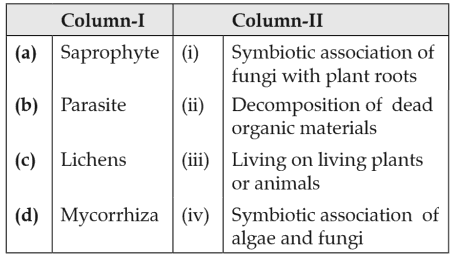
Match Column-I with Column-II
 B
B
(1). (a) - (iii), (b) - (ii), (c) - (i), (d) - (iv)
(2). (a) - (ii), (b) - (i), (c) - (iii), (d) - (iv)
(3). (a) - (ii), (b) - (iii), (c) - (iv), (d) - (i)
(4). (a) - (i), (b) - (ii), (c) - (iii), (d) - (iv)
B(1). (a) - (iii), (b) - (ii), (c) - (i), (d) - (iv)
(2). (a) - (ii), (b) - (i), (c) - (iii), (d) - (iv)
(3). (a) - (ii), (b) - (iii), (c) - (iv), (d) - (i)
(4). (a) - (i), (b) - (ii), (c) - (iii), (d) - (iv)
Number of Attempts: 03
Correct Attempts: 01
Time Taken: 00:15
Average Time: 00:05
After karyogamy followed by meiosis, spores are produced exogenously in
(1). Saccharomyces.
(2). Agaricus.
(3). Alternaria.
(4). Neurospora.
(1). Saccharomyces.
(2). Agaricus.
(3). Alternaria.
(4). Neurospora.
Number of Attempts: 03
Correct Attempts: 01
Time Taken: 00:15
Average Time: 00:05
Chrysophytes, euglenoids, dinoflagellates and slime moulds are included in the kingdom
(1). Protista
(2). Fungi
(3). Animalia
(4). Monera
(1). Protista
(2). Fungi
(3). Animalia
(4). Monera
Number of Attempts: 03
Correct Attempts: 01
Time Taken: 00:15
Average Time: 00:05
One of the major components of cell wall of most fungi is
(1). peptidoglycan
(2). cellulose
(3). hemicellulose
(4). chitin
(1). peptidoglycan
(2). cellulose
(3). hemicellulose
(4). chitin
Number of Attempts: 03
Correct Attempts: 01
Time Taken: 00:15
Average Time: 00:05
Each of the following characteristics represent a Kingdom proposed by Whittaker. Arrange the following in increasing order of complexity of body organization.
A. Multicellular heterotrophs with cell wall made of chitin.
B. Heterotrophs with tissue/organ/organ system level of body organization.
C. Prokaryotes with cell wall made of polysaccharides and amino acids.
D. Eukaryotic autotrophs with tissue/organ level of body organization.
E. Eukaryotes with cellular body organization.
Choose the correct answer from the options given below:
(1). C, E, A, B, D
(2). A, C, E, B, D
(3). C, E, A, D, B
(4). A, C, E, D, B
A. Multicellular heterotrophs with cell wall made of chitin.
B. Heterotrophs with tissue/organ/organ system level of body organization.
C. Prokaryotes with cell wall made of polysaccharides and amino acids.
D. Eukaryotic autotrophs with tissue/organ level of body organization.
E. Eukaryotes with cellular body organization.
Choose the correct answer from the options given below:
(1). C, E, A, B, D
(2). A, C, E, B, D
(3). C, E, A, D, B
(4). A, C, E, D, B
Number of Attempts: 03
Correct Attempts: 01
Time Taken: 00:15
Average Time: 00:05
Which one of the following is not a criterion for classification of fungi?
(1). Mode of spore formation
(2). Fruiting body
(3). Morphology of mycelium
(4). Mode of nutrition
(1). Mode of spore formation
(2). Fruiting body
(3). Morphology of mycelium
(4). Mode of nutrition
Number of Attempts: 03
Correct Attempts: 01
Time Taken: 00:15
Average Time: 00:05
Match List I with List II:
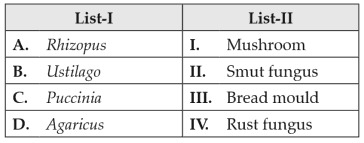
(1). A-III, B-II, C-I, D-IV
(2). A-IV, B-III, C-II, D-I
(3). A-III, B-II, C-IV, D-I
(4). A-I, B-III, C-II, D-IV
(1). A-III, B-II, C-I, D-IV
(2). A-IV, B-III, C-II, D-I
(3). A-III, B-II, C-IV, D-I
(4). A-I, B-III, C-II, D-IV
Number of Attempts: 03
Correct Attempts: 01
Time Taken: 00:15
Average Time: 00:05
Read the following statements and choose the set of correct statements:
In the members of Phaeophyceae.
A. Asexual reproduction occurs usually by biflagellate zoospores.
B. Sexual reproduction is by oogamous method only.
C. Stored food is in the form of carbohydrates which is either mannitol or laminarin.
D. The major pigments found are chlorophyll a, c and carotenoids and xanthophyll.
E. Vegetative cells have a cellulosic wall, usually covered on the outside by gelatinous coating of algin.
Choose the correct answer from the options given below:
(1). A, C, D, and E only
(2). A, B, C, and E only
(3). A, B, C, and D only
(4). B, C, D, and E only
In the members of Phaeophyceae.
A. Asexual reproduction occurs usually by biflagellate zoospores.
B. Sexual reproduction is by oogamous method only.
C. Stored food is in the form of carbohydrates which is either mannitol or laminarin.
D. The major pigments found are chlorophyll a, c and carotenoids and xanthophyll.
E. Vegetative cells have a cellulosic wall, usually covered on the outside by gelatinous coating of algin.
Choose the correct answer from the options given below:
(1). A, C, D, and E only
(2). A, B, C, and E only
(3). A, B, C, and D only
(4). B, C, D, and E only
Number of Attempts: 03
Correct Attempts: 01
Time Taken: 00:15
Average Time: 00:05
In the taxonomic categories which hierarchical
arrangement in ascending order is correct in the
case of animals?
(1). Kingdom, Phylum, Class, Order, Family, Genus, Species
(2). Kingdom, Class, Phylum, Family, Order, Genus, Species
(3). Kingdom, Order, Class, Phylum, Family, Genus, Species
(4). Kingdom, Order, Phylum, Class, Family, Genus, Species
(1). Kingdom, Phylum, Class, Order, Family, Genus, Species
(2). Kingdom, Class, Phylum, Family, Order, Genus, Species
(3). Kingdom, Order, Class, Phylum, Family, Genus, Species
(4). Kingdom, Order, Phylum, Class, Family, Genus, Species
Number of Attempts: 03
Correct Attempts: 01
Time Taken: 00:15
Average Time: 00:05
Given below are two statements:
Statement I : Mycoplasma can pass through less than 1 micron filter size.
Statement II : Mycoplasma are bacteria with a cell wall.
In the light of the above statements, choose the most appropriate answer from the options given below:
(1). Both Statement I and Statement II are correct
(2). Both Statement I and Statement II are incorrect
(3). Statement I is correct but Statement II is incorrect
(4). Statement I is incorrect but Statement II is correct
Statement I : Mycoplasma can pass through less than 1 micron filter size.
Statement II : Mycoplasma are bacteria with a cell wall.
In the light of the above statements, choose the most appropriate answer from the options given below:
(1). Both Statement I and Statement II are correct
(2). Both Statement I and Statement II are incorrect
(3). Statement I is correct but Statement II is incorrect
(4). Statement I is incorrect but Statement II is correct
Number of Attempts: 03
Correct Attempts: 01
Time Taken: 00:15
Average Time: 00:05
Which of the following algae produce Carrageen?
(1). Green algae
(2). Brown algae
(3). Red algae
(4). Blue-green algae
(1). Green algae
(2). Brown algae
(3). Red algae
(4). Blue-green algae
Number of Attempts: 03
Correct Attempts: 01
Time Taken: 00:15
Average Time: 00:05
Which of the following algae contains mannitol as reserve food material?
(1). Ectocarpus
(2). Gracilaria
(3). Volvox
(4). Ulothrix
(1). Ectocarpus
(2). Gracilaria
(3). Volvox
(4). Ulothrix
Number of Attempts: 03
Correct Attempts: 01
Time Taken: 00:15
Average Time: 00:05
Floridean starch has structure similar to:
(1). Amylopectin and glycogen
(2). Mannitol and algin
(3). Laminarin and cellulose
(4). Starch and cellulose
(1). Amylopectin and glycogen
(2). Mannitol and algin
(3). Laminarin and cellulose
(4). Starch and cellulose
Number of Attempts: 03
Correct Attempts: 01
Time Taken: 00:15
Average Time: 00:05
Which of the following statements is incorrect ?
(1). Claviceps is source of many alkaloids and LSD.
(2). Conidia are produced exogenously and ascospores endogenously.
(3). Yeasts have filamentous bodies with long thread- like hyphae.
(4). Morels and truffles are edible delicacies.
(1). Claviceps is source of many alkaloids and LSD.
(2). Conidia are produced exogenously and ascospores endogenously.
(3). Yeasts have filamentous bodies with long thread- like hyphae.
(4). Morels and truffles are edible delicacies.
Number of Attempts: 03
Correct Attempts: 01
Time Taken: 00:15
Average Time: 00:05
Which of the following statements is incorrect ?
(1). Viruses are obligate parasites.
(2). Infective constituent in viruses is the protein coat.
(3). Prions consist of abnormally folded proteins.
(4). Viroids lack a protein coat.
(1). Viruses are obligate parasites.
(2). Infective constituent in viruses is the protein coat.
(3). Prions consist of abnormally folded proteins.
(4). Viroids lack a protein coat.
Number of Attempts: 03
Correct Attempts: 01
Time Taken: 00:15
Average Time: 00:05
Which among the following is not a prokaryote?
(1). Oscillatoria
(2). Nostoc
(3). Mycobacterium
(4). Saccharomyces
(1). Oscillatoria
(2). Nostoc
(3). Mycobacterium
(4). Saccharomyces
Number of Attempts: 03
Correct Attempts: 01
Time Taken: 00:15
Average Time: 00:05
Select the wrong statement.
(1). Mitochondria are the powerhouse of the cell in all kingdoms except Monera.
(2). Pseudopodia are locomotory and feeding structures in Sporozoans.
(3). Mushrooms belong to Basidiomycetes.
(4). Cell wall is present in members of Fungi and Plantae.
(1). Mitochondria are the powerhouse of the cell in all kingdoms except Monera.
(2). Pseudopodia are locomotory and feeding structures in Sporozoans.
(3). Mushrooms belong to Basidiomycetes.
(4). Cell wall is present in members of Fungi and Plantae.
Number of Attempts: 03
Correct Attempts: 01
Time Taken: 00:15
Average Time: 00:05
Ciliates differ from all other protozoans in
(1). having two types of nuclei.
(2). using pseudopodia for capturing prey.
(3). having a contractile vacuole for removing excess water.
(4). using flagella for locomotion.
(1). having two types of nuclei.
(2). using pseudopodia for capturing prey.
(3). having a contractile vacuole for removing excess water.
(4). using flagella for locomotion.
Number of Attempts: 03
Correct Attempts: 01
Time Taken: 00:15
Average Time: 00:05
Which among the following are the smallest living cells, known without a definite cell wall, pathogenic to plants as well as animals and can survive without oxygen ?
(1). Nostoc
(2). Bacillus
(3). Pseudomonas
(4). Mycoplasma
(1). Nostoc
(2). Bacillus
(3). Pseudomonas
(4). Mycoplasma
Number of Attempts: 03
Correct Attempts: 01
Time Taken: 00:15
Average Time: 00:05
Which of the following represents order of ' Horse ' ?
(1). Ferus
(2). Equidae
(3). Perissodactyla
(4). Caballus
(1). Ferus
(2). Equidae
(3). Perissodactyla
(4). Caballus
Number of Attempts: 03
Correct Attempts: 01
Time Taken: 00:15
Average Time: 00:05
Which of the following are found in extreme saline conditions ?
(1). Mycobacteria
(2). Archaebacteria
(3). Eubacteria
(4). Cyanobacteria
(1). Mycobacteria
(2). Archaebacteria
(3). Eubacteria
(4). Cyanobacteria
Number of Attempts: 03
Correct Attempts: 01
Time Taken: 00:15
Average Time: 00:05
The primitive prokaryotes responsible for the production of biogas from the dung of ruminant animals, include the
(1). thermoacidophiles
(2). eubacteria
(3). methanogens
(4). halophiles
(1). thermoacidophiles
(2). eubacteria
(3). methanogens
(4). halophiles
Number of Attempts: 03
Correct Attempts: 01
Time Taken: 00:15
Average Time: 00:05
Which one of the following statements is wrong ?
(1). Golden algae are also called desmids
(2). Eubacteria are also called false bacteria
(3). Phycomycetes are also called algal fungi
(4). Cyanobacteria are also called blue-green algae
(1). Golden algae are also called desmids
(2). Eubacteria are also called false bacteria
(3). Phycomycetes are also called algal fungi
(4). Cyanobacteria are also called blue-green algae
Number of Attempts: 03
Correct Attempts: 01
Time Taken: 00:15
Average Time: 00:05
Which of the following statements is wrong for viroids ?
(1). They are smaller than viruses
(2). They cause infections
(3). Their RNA is of high molecular weight
(4). They lack a protein coat
(1). They are smaller than viruses
(2). They cause infections
(3). Their RNA is of high molecular weight
(4). They lack a protein coat
Number of Attempts: 03
Correct Attempts: 01
Time Taken: 00:15
Average Time: 00:05