Home >> Topics >> Biodiversity and Conservation
Unattempted Questions
Questions Available: 24
Year: 2024
Topic: Biodiversity and Conservation
1.
These are regarded as major causes of biodiversity loss:
A. Overexploitation
B. Co-extinction
C. Mutation
D. Habitat loss and fragmentation
E. Migration
(1).
A, B and E only
(2).
A, B and D only
(3).
A, C and D only
(4).
A, B, C, and D only

Year: 2025
Topic: Biodiversity and Conservation
2.
Which one of the following is an example of ex-situ conservation?
(1).
Protected areas
(2).
National Park
(3).
Wildlife Sanctuary
(4).
Zoos and botanical gardens

Year: 2025
Topic: Biodiversity and Conservation
3.
Match List I with List Il :

Choose the option with all correct matches.
(1).
A-III, B-II, C-IV, D-I
(2).
A-III, B-II, C-I, D-IV
(3).
A-III, B-I, C-II, D-IV
(4).
A-III, B-IV, C-II, D-I

Year: 2025
Topic: Biodiversity and Conservation
4.
Who is known as the father of Ecology in India?
(1).
Birbal Sahni
(2).
S. R. Kashyap
(3).
Ramdeo Misra
(4).
Ram Udar

Year: 2024
Topic: Biodiversity and Conservation
5.
The type of conservation in which the threatened species are taken out from their natural habitat and placed in special settings where they can be protected and given special care is called:
(1).
Semi-conservative method
(2).
Sustainable development
(3).
in-situ conservation
(4).
Biodiversity conservation

Year: 2024
Topic: Biodiversity and Conservation
6.
Tropical regions show greatest level of species richness because -
A. Tropical latitudes have remained relatively undisturbed for millions of years, hence more time was available for species diversification.
B. Tropical environments are more seasonal
C. More solar energy is available in tropics
D. Constant environments promote niche specialization.
E. Tropical environments are constant and predictable
Choose the correct answer form the options given below:
(1).
A, B and E only
(2).
A, B and D only
(3).
A, C, D and E only
(4).
A and B only

Year: 2024
Topic: Biodiversity and Conservation
7.
List of endangered species was released by-
(1).
FOAM
(2).
IUCN
(3).
GEAC
(4).
WWF

Year: 2024
Topic: Biodiversity and Conservation
8.
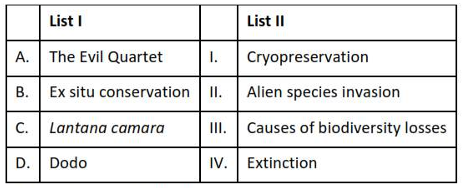
Match List I with List II:

Choose the correct answer from the options given below:
(1).
A-I, B-III, C-II, D-IV
(2).
A-III, B-IV, C-II, D-I
(3).
A-II, B-III, C-I, D-IV
(4).
A-III, B-I, C-IV, D-II

Year: 2023
Topic: Biodiversity and Conservation
9.
Among "The Evil Quartet', which one is considered the most important cause driving extinetion of species?
(1).
Over exploitation for economic gain
(2).
Alien species invasions
(3).
Co-extinctions
(4).
Habitat loss and fragmentation

Year: 2023
Topic: Biodiversity and Conservation
10.
The historic Convention on Biological Diversity, The Earth Summit' was held in Rio de Janeiro in the year:
(1).
1992
(2).
1986
(3).
2002
(4).
1985

Year: 2022
Topic: Biodiversity and Conservation
11.
In situ conservation refers to:
(1).
Protect and conserve the whole ecosystem
(2).
Conserve only high risk species
(3).
Conserve only endangered species
(4).
Conserve only extinct species

Year: 2022
Topic: Biodiversity and Conservation
12.
Which of the following is not a method of ex situ conservation?
(1).
In vitro fertilization
(2).
National Parks
(3).
Micropropagation
(4).
Cryopreservation

Year: 2022
Topic: Biodiversity and Conservation
13.
Habitat loss and fragmentation, over exploitation, alien species invasion and co-extinction are causes for:
(1).
Population explosion
(2).
Competition
(3).
Biodiversity loss
(4).
Natality

Year: 2020
Topic: Biodiversity and Conservation
14.
Which of the following regions of the globe exhibits highest species diversity ?
(1).
Madagascar
(2).
Himalayas
(3).
Amazon forests
(4).
Western Ghats of India

Year: 2020
Topic: Biodiversity and Conservation
15.
According to Robert May, the global species diversity is about:
(1).
20 million
(2).
50 million
(3).
7 million
(4).
1.5 million

Year: 2019
Topic: Biodiversity and Conservation
16.
Which one of the following is not a method of in situ conservation of biodiversity?
(1).
Wildlife Sanctuary
(2).
Botanical Garden
(3).
Sacred Grove
(4).
Biosphere Reserve

Year: 2019
Topic: Biodiversity and Conservation
17.
The Earth Summit held in Rio de Janeiro in 1992 was called
(1).
for conservation of biodiversity and sustainable utilisation of its benefits.
(2).
to assess threat posed to native species by invasive weed species.
(3).
for immediate steps to discontinue use of CFCs that were damaging the ozone layer. .
(4).
to reduce caused CO2 emissions and global warming

Year: 2019
Topic: Biodiversity and Conservation
18.
Which of the following is the most important cause for animals and plants being driven to extinction ?
(1).
Drought and floods
(2).
Economic exploitation
(3).
Alien species invasion
(4).
Habitat loss and fragmentation

Year: 2018
Topic: Biodiversity and Conservation
19.
All of the following are included in ‘ex-situ conservation’ except
(1).
seed banks.
(2).
botanical gardens.
(3).
sacred groves.
(4).
wildlife safari parks.

Year: 2017
Topic: Biodiversity and Conservation
20.
The region of Biosphere Reserve which is legally protected and where no human activity is allowed is known as
(1).
Restoration zone .
(2).
Core zone .
(3).
Buffer zone.
(4).
Transition zone .

Year: 2017
Topic: Biodiversity and Conservation
21.
Which one of the following is related to Ex-situ conservation of threatened animals and plants ?
(1).
Himalayan region
(2).
Wildlife Safari parks
(3).
Biodiversity hot spots
(4).
Amazon rainforest

Year: 2016
Topic: Biodiversity and Conservation
22.
Which is the National Aquatic Animal of India ?
(1).
River dolphin
(2).
Blue whale
(3).
Sea-horse
(4).
Gangetic shark

Year: 2016
Topic: Biodiversity and Conservation
23.
Which of the following is the most important cause of animals and plants being driven to extinction?
(1).
Alien species invasion
(2).
Habitat loss and fragmentation
(3).
Co-extinctions
(4).
Over-exploitation

Year: 2016
Topic: Biodiversity and Conservation
24.
A system of rotating crops with legume or grass pasture to improve soil structure and fertility is called
(1).
contour farming
(2).
strip farming
(3).
shifting agriculture
(4).
ley farming