Home >> Topics >> Organisms and Populations
Unattempted Questions
Questions Available: 23
Year: 2024
Topic: Organisms and Populations
1.
Given below are two statements :
Statement I: Gause’s competitive exclusion principle states that two closely related species competing for different resources cannot exist indefinitely.
Statement II: According to Gause’s principle, during competition, the inferior will be eliminated. This may be true if resources are limiting.
In the light of the above statements, choose the correct answer from the options given below:
(1).
Statement I is true but Statement II is false.
(2).
Statement I is false but Statement II is true.
(3).
Both Statement I and Statement II are true.
(4).
Both Statement I and Statement II are false.

Year: 2022
Topic: Organisms and Populations
2.
While explaining interspecific interaction of population, (+) sign is assigned for beneficial interaction, (-) sign is assigned for detrimental interaction and (0) for neutral interaction. Which of the following interactions can be assigned (+) for one species and (-) for another species involved in the interaction?
(1).
Predation
(2).
Amensalism
(3).
Commensalism
(4).
Competition

Year: 2018
Topic: Organisms and Populations
3.
Which one of the following plants shows a very close relationship with a species of moth, where none of the two can complete its life cycle without the other?
(1).
Viola
(2).
Banana
(3).
Yucca
(4).
Hydrilla

Year: 2018
Topic: Organisms and Populations
4.
Which one of the following population interactions is widely used in medical science for the production of antibiotics ?
(1).
Amensalism
(2).
Parasitism
(3).
Mutualism
(4).
Commensalism

Year: 2025
Topic: Organisms and Populations
5.
Epiphytes that are growing on a mango branch is an example of which of the following?
(1).
Amensalism
(2).
Commensalism
(3).
Mutualism
(4).
Predation

Year: 2025
Topic: Organisms and Populations
6.
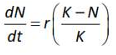
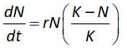
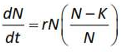
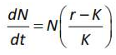
Which one of the following equations represents the Verhulst-Pearl Logistic Growth of population?
(1).
(2).
(3).
(4).

Year: 2024
Topic: Organisms and Populations
7.
The equation of Verhulst-Pearl logistic growth is -
\(\displaystyle \frac{\text{dN}}{\text{dt}}\,=\,\text{rN}\left[\frac{\text{K}-\text{N}}{\text{K}}\right]\)
From this equation, K indicates:
(1).
Carrying capacity
(2).
Population density
(3).
Intrinsic rate of natural increase
(4).
Biotic potential

Year: 2023
Topic: Organisms and Populations
8.
Match List I with List II

Choose the correct answer from the options given below :
(1).
A-II, B-III, C-I, D-IV
(2).
A-II, B-IV, C-I, D-III
(3).
A-II, B-IV, C-III, D-I
(4).
A-II, B-I, C-III, D-IV

Year: 2022
Topic: Organisms and Populations
9.
If 8 Drosophila in a laboratory population of 80died during a week, the death rate in the populationis ______ individuals per Drosophila per week.
(1).
0.1
(2).
10
(3).
1.0
(4).
Zero

Year: 2022
Topic: Organisms and Populations
10.
Which one of the following statements cannot be connected to Predation?
(1).
It helps in maintaining species diversity in a community
(2).
It might lead to extinction of a species
(3).
Both the interacting species are negatively impacted
(4).
It is necessitated by nature to maintain the ecological balance

Year: 2021
Topic: Organisms and Populations
11.
Inspite of interspecific competition in nature, which mechanism the competing species might have evolved for their survival?
(1).
Resource partitioning
(2).
Competitive release
(3).
Mutualism
(4).
Predation

Year: 2021
Topic: Organisms and Populations
12.
Amensalism can be represented as :
(1).
Species A (-); Species B (0)
(2).
Species A (+); Species B (+)
(3).
Species A (-); Species B (-)
(4).
Species A (+); Species B (0)

Year: 2021
Topic: Organisms and Populations
13.
In the exponential growth equation Nt = N0erte represents:
(1).
The base of number logarithms
(2).
The base of exponential logarithms
(3).
The base of natural logarithms
(4).
The base of geometric logarithms

Year: 2020
Topic: Organisms and Populations
14.
Which of the following is not an attribute of a population ?
(1).
Natality
(2).
Mortality
(3).
Species interaction
(4).
Sex ratio

Year: 2019
Topic: Organisms and Populations
15.
Pinus seed cannot germinate and establish without fungal association. This is because
(1).
it has obligate association with mycorrhizae.
(2).
it has very hard seed coat.
(3).
its seeds contain inhibitors that prevent germination.
(4).
its embryo is immature

Year: 2018
Topic: Organisms and Populations
16.
Niche is
(1).
(a) the functional role played by the organism where it lives.
(2).
(b) the range of temperature that the organism needs to live.
(3).
(c) the physical space where an organism lives.
(4).
(d) all the biological factors in the organism's environment.

Year: 2018
Topic: Organisms and Populations
17.
Natality refers to
(1).
number of individuals entering a habitat.
(2).
number of individuals leaving the habitat.
(3).
birth rate.
(4).
death rate.

Year: 2018
Topic: Organisms and Populations
18.
In a growing population of a country,
(1).
pre-reproductive individuals are less than the reproductive individuals.
(2).
reproductive and pre-reproductive individuals are equal in number.
(3).
reproductive individuals are less than the post- reproductive individuals.
(4).
pre-reproductive individuals are more than the reproductive individuals.

Year: 2017
Topic: Organisms and Populations
19.
Asymptote in a logistic growth curve is obtained when
(1).
K < N
(2).
The value of 'r' approaches zero
(3).
K = N
(4).
K > N

Year: 2017
Topic: Organisms and Populations
20.
Presence of plants arranged into well defined vertical layers depending on their height can be seen best in
(1).
Temperate Forest.
(2).
Tropical Savannah.
(3).
Tropical Rain Forest.
(4).
Grassland.

Year: 2016
Topic: Organisms and Populations
21.
It is much easier for a small animal to run uphill than for a large animal, because
(1).
small animals have a higher metabolic rate.
(2).
small animals have low O2 requirement.
(3).
the efficiency of muscles in the large animals is less than the small animals.
(4).
it is easier to carry a small body weight.

Year: 2016
Topic: Organisms and Populations
22.
When does the growth rate of a population following the logistic modal equals zero ? The logistic model is given as
\(\displaystyle \frac{\text{dN}}{\text{dt}}\) = \(\displaystyle \text{rN} \left(\frac{\text{1-N}}{\text{K}}\right)\)
(1).
when N nears the carrying capacity of the habitat
(2).
when N / K equals zero
(3).
when death rate is greater than birth rate
(4).
when N / K is exactly one

Year: 2016
Topic: Organisms and Populations
23.
Gause’s principle of competitive exclusion states that
(1).
competition for the same resources excludes species having different food preferences
(2).
no two species can occupy the same niche indefinitely for the same limiting resources
(3).
larger organisms exclude smaller ones through competition
(4).
more abundant species will exclude the less abundant species through competition