Home >> Topics >> Sexual Reproduction in Flowering Plants
Unattempted Questions
Questions Available: 43
Year: 2022
Topic: Sexual Reproduction in Flowering Plants
1.
Identify the incorrect statement related to Pollination:
(1).
Pollination by water is quite rare in flowering plants
(2).
Pollination by wind is more common amongst abiotic pollination
(3).
Flowers produce foul odours to attract flies and beetles to get pollinated
(4).
Moths and butterflies are the most dominant pollinating agents among insects

Year: 2022
Topic: Sexual Reproduction in Flowering Plants
2.
Given below are two statements:
Statement I : Cleistogamous flowers are invariably autogamousaol.
Statement II : Cleistogamy is disadvantageousas there is no chance for cross pollination.
In the light of the above statements, choose thecorrect answer from the options given below:
(1).
Both Statement I and Statement II are correct
(2).
Both Statement I and Statement II are incorrect
(3).
Statement I is correct but Statement II isincorrect
(4).
Statement I is incorrect but Statement II is correct

Year: 2021
Topic: Sexual Reproduction in Flowering Plants
3.
A typical angiosperm embryo sac at maturity is:
(1).
8-nucleate and 7-celled
(2).
7-nucleate and 8-celled
(3).
7-nucleate and 7-celled
(4).
8-nucleate and 8-celled

Year: 2019
Topic: Sexual Reproduction in Flowering Plants
4.
Which one of the following statements regarding post-fertilization development in flowering plants is incorrect ?
(1).
Zygote develops into embryo.
(2).
Central cell develops into endosperm.
(3).
Ovules develop into embryo sac.
(4).
Ovary develops into fruit.

Year: 2018
Topic: Sexual Reproduction in Flowering Plants
5.
Which of the following has proved helpful in preserving pollen as fossils?
(1).
Sporopollenin
(2).
Oil content
(3).
Cellulosic intine
(4).
Pollenkitt

Year: 2018
Topic: Sexual Reproduction in Flowering Plants
6.
Pollen grains can be stored for several years in liquid nitrogen having a temperature of
(1).
–160°C
(2).
–196°C
(3).
–80°C
(4).
–120°C

Year: 2017
Topic: Sexual Reproduction in Flowering Plants
7.
Double fertilization is exhibited by
(1).
angiosperms.
(2).
gymnosperms.
(3).
algae.
(4).
fungi.

Year: 2017
Topic: Sexual Reproduction in Flowering Plants
8.
Attractants and rewards are required for
(1).
cleistogamy.
(2).
anemophily.
(3).
entomophily.
(4).
hydrophily.

Year: 2017
Topic: Sexual Reproduction in Flowering Plants
9.
Which of the following options gives the correct sequence of events during mitosis ?
(1).
Condensation → arrangement at equator → centromere division → segregation → telophase
(2).
Condensation → nuclear membrane disassembly → crossing over → segregation → telophase
(3).
Condensation → nuclear membrane disassembly → arrangement at equator → centromere division → segregation → telophase
(4).
Condensation → crossing over → nuclear membrane disassembly → segregation → telophase

Year: 2016
Topic: Sexual Reproduction in Flowering Plants
10.
Which of the following statements is not correct ?
(1).
Insects that consume pollen or nectar without bringing about pollination are called pollen nectar robbers
(2).
Pollen germination and pollen tube growth are regulated by chemical components of pollen interacting with those of the pistil
(3).
Some reptiles have also been reported as pollinators in some plant species
(4).
Pollen grains of many species can germinate on the stigma of a flower, but only one pollen tube of the same species grows into the style

Year: 2025
Topic: Sexual Reproduction in Flowering Plants
11.
In the seeds of cereals, the outer covering of endosperm separates the embryo by a protein- rich layer called :
(1).
Aleurone layer
(2).
Coleoptile
(3).
Coleorhiza
(4).
Integument

Year: 2025
Topic: Sexual Reproduction in Flowering Plants
12.
How many meiotic and mitotic divisions need to occur for the development of a mature female gametophyte from the megaspore mother cell in an angiosperm plant?
(1).
No Meiosis and 2 Mitosis
(2).
2 Meiosis and 3 Mitosis
(3).
1 Meiosis and 2 Mitosis
(4).
1 Meiosis and 3 Mitosis

Year: 2025
Topic: Sexual Reproduction in Flowering Plants
13.
Given below are two statements : One is labelled as Assertion (A) and the other is labelled as Reason (R).
Assertion (A) : Cells of the tapetum possess dense cytoplasm and generally have more than one nucleus.
Reason (R) : Presence of more than one nucleus in the tapetum increases the efficiency of nourishing the developing microspore mother cells.
In light of the above statements, choose the most appropriate answer from the options given below:
(1).
A is false but R is true
(2).
Both A and R are true and R is the correct explanation of A
(3).
Both A and R are true but R is NOT the correct explanation of A
(4).
A is true but R is false

Year: 2025
Topic: Sexual Reproduction in Flowering Plants
14.
Given below are two statements :
Statement I : Fig fruit is a non-vegetarian fruit as it has enclosed fig wasps in it.
Statement II : Fig wasp and fig tree exhibit mutual relationship as fig wasp completes its life cycle in fig fruit and fig fruit gets pollinated by fig wasp.
In the light of the above statements, choose the most appropriate answer from the options given below :
(1).
Statement I is incorrect but statement Il is correct
(2).
Both statement I and statement II are correct
(3).
Both statement I and statement Il are incorrect
(4).
Statement I is correct but statement Il is incorrect

Year: 2025
Topic: Sexual Reproduction in Flowering Plants
15.
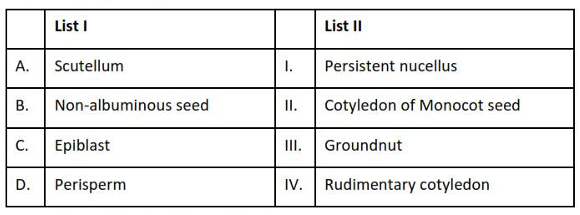
Match List I with List II :

Choose the option with all correct matches.
(1).
(1) A-II, B-IV, C-III, D-I
(2).
(2) A-II, B-III, C-IV, D-I
(3).
(3) A-IV, B-III, C-II, D-I
(4).
(4) A-IV, B-III, C-I, D-II

Year: 2025
Topic: Sexual Reproduction in Flowering Plants
16.
Given below are two statements : One is labelled as Assertion (A) and the other is labelled as Reason (R).
Assertion (A) : A typical unfertilised, angiosperm embryo sac at maturity is 8 nucleate and 7-celled.
Reason (R) : The egg apparatus has 2 polar nuclei.
In the light of the above statements, choose the correct answer from the options given below :
(1).
A is false but R is true
(2).
Both A and R are true and R is the correct explanation of A
(3).
Both A and R are true but R is NOT the correct explanation of A
(4).
A is true but R is false

Year: 2025
Topic: Sexual Reproduction in Flowering Plants
17.
Given below are two statements : One is labelled as Assertion (A) and the other is labelled as Reason (R).
Assertion (A) : Both wind and water pollinated flowers are not very colourful and do not produce nectar.
Reason (R) : The flowers produce enormous amount of pollen grains in wind and water pollinated flowers.
In the light of the above statements, choose the correct answer from the options given below :
(1).
A is false but R is true
(2).
Both A and R are true and R is the correct explanation of A
(3).
Both A and R are true but R is NOT the correct explanation of A
(4).
A is true but R is false

Year: 2024
Topic: Sexual Reproduction in Flowering Plants
18.
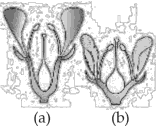
Identify the type of flowers based on the position of calyx, corolla, and androecium with respect to the ovary from the given figures (a) and (b).
(1).
(a) Perigynous; (b) Epigynous
(2).
(a) Perigynous; (b) Perigynous
(3).
(a) Epigynous; (b) Hypogynous
(4).
(a) Hypogynous; (b) Epigynous

Year: 2024
Topic: Sexual Reproduction in Flowering Plants
19.
Identify the set of correct statements:
A. The flowers of Vallisneria are colourful and produce nectar
B. The flowers of waterlily are not pollinated by water
C. In most of water-pollinated species, the pollen grains are protected from wetting
D. Pollen grains of some hydrophytes are long and ribbon like
E. In some hydrophytes, the pollen grains are carried passively inside water
Choose the correct answer fron the options given below:
(1).
A, C, D, and E only
(2).
B, C, D, and E only
(3).
C, D, and E only
(4).
A, B, C, and D only

Year: 2024
Topic: Sexual Reproduction in Flowering Plants
20.
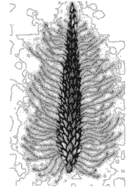
Identify the correct description about the given figure:
(1).
Cleistogamous flowers showing autogamy.
(2).
Compact inflorescence showing complete autogamy.
(3).
Wind pollinated plant inflorescence showing flowers with well exposed stamens.
(4).
Water pollinated flowers showing stamens with mucilaginous covering.

Year: 2023
Topic: Sexual Reproduction in Flowering Plants
21.
What is the function of tassels in the corn cob?
(1).
To trap pollen grains
(2).
To disperse pollen grains
(3).
To protect seeds
(4).
To attract insects

Year: 2023
Topic: Sexual Reproduction in Flowering Plants
22.
Large, colourful, fragrant flowers with nectar are seen in
(1).
bird pollinated plants
(2).
bat pollinated plants
(3).
wind pollinated plants
(4).
insect pollinated plants

Year: 2023
Topic: Sexual Reproduction in Flowering Plants
23.
Given below are two statemente: One is labelled as Assertion A and the other is labelled as Reason R.
Assertion: A flower is defined as modified shoot wherein the shoot apical meristem changes to floral meristem.
Reason R: Internode of the shoot gets condensed to produce different floral appendages laterally at successive nodes instead of leaves.
In the light of the above statements, choose the correct answer from the options given below:
(1).
Both A and R are true but R is NOT the correct explanation of A.
(2).
A is true but R is false.
(3).
A is false but R is true.
(4).
Both A and R are true and R is the correct explanation of A.

Year: 2021
Topic: Sexual Reproduction in Flowering Plants
24.
The term used for transfer of pollen grains from anthers of one plant to stigma of a different plant which, during pollination, brings genetically different types of pollen grains to stigma, is:
(1).
Xenogamy
(2).
Geitonogamy
(3).
Chasmogamy
(4).
Cleistogamy

Year: 2021
Topic: Sexual Reproduction in Flowering Plants
25.
The production of gametes by the parents, formation of zygotes, the F1 and F2 plants, can be understood from a diagram called:
(1).
Bullet square
(2).
Punch square
(3).
Punnett square
(4).
Net square

Year: 2021
Topic: Sexual Reproduction in Flowering Plants
26.
Which of the following plants is monoecious?
(1).
Carica papaya
(2).
Chara
(3).
Marchantia polymorpha
(4).
Cycas circinalis

Year: 2021
Topic: Sexual Reproduction in Flowering Plants
27.
In some members of which of the following pairs of families, pollen grains retain their viability for months after release?
(1).
Poaceae; Rosaceae
(2).
Poaceae; Leguminosae
(3).
Poaceae; Solanaceae
(4).
Rosaceae; Leguminosae

Year: 2020
Topic: Sexual Reproduction in Flowering Plants
28.
The plant parts which consist of two generations- one within the other:
(a) Pollen grains inside the anther
(b) Germinated pollen grain with two male gametes
(c) Seed inside the fruit
(d) Embryo sac inside the ovule
(1).
(a), (b) and (c)
(2).
(c) and (d)
(3).
(a) and (d)
(4).
(a) only

Year: 2020
Topic: Sexual Reproduction in Flowering Plants
29.
In water hyacinth and water lily, pollination takes place by:
(1).
water currents only
(2).
wind and water
(3).
insects and water
(4).
insects or wind

Year: 2020
Topic: Sexual Reproduction in Flowering Plants
30.
The body of the ovule is fused within the funicle at
(1).
Micropyle
(2).
Nucellus
(3).
Chalaza
(4).
Hilum

Year: 2019
Topic: Sexual Reproduction in Flowering Plants
31.
What is the fate of the male gametes discharged in the synergid ?
(1).
All fuse with the egg
(2).
One fuses with the egg, other(s) fuse(s)with synergid nucleus
(3).
One fuses with the egg and other fuses with central cell nuclei
(4).
One fuses with the egg, other(s) degenerate(s) in the synergid

Year: 2019
Topic: Sexual Reproduction in Flowering Plants
32.
In some plants, the female gamete develops into embryo without fertilisation. This phenomenon is known as
(1).
parthenocarpy.
(2).
syngamy.
(3).
parthenogenesis.
(4).
autogamy.

Year: 2019
Topic: Sexual Reproduction in Flowering Plants
33.
Persistent nucellus in the seed is known as
(1).
perisperm.
(2).
hilum.
(3).
tegmen.
(4).
chalaza.

Year: 2018
Topic: Sexual Reproduction in Flowering Plants
34.
Offsets are produced by
(1).
parthenogenesis.
(2).
parthenocarpy.
(3).
mitotic divisions.
(4).
meiotic divisions.

Year: 2018
Topic: Sexual Reproduction in Flowering Plants
35.
Which of the following flowers only once in its life-time?
(1).
Papaya
(2).
Mango
(3).
Jackfruit
(4).
Bamboo species

Year: 2018
Topic: Sexual Reproduction in Flowering Plants
36.
Double fertilisation is
(1).
syngamy and triple fusion.
(2).
fusion of two male gametes with one egg.
(3).
fusion of one male gamete with two polar nuclei.
(4).
fusion of two male gametes of a pollen tube with two different eggs.

Year: 2017
Topic: Sexual Reproduction in Flowering Plants
37.
The morphological nature of the edible part of coconut is
(1).
pericarp.
(2).
perisperm.
(3).
cotyledon.
(4).
endosperm.

Year: 2017
Topic: Sexual Reproduction in Flowering Plants
38.
Flowers which have single ovule in the ovary and are packed into inflorescence are usually pollinated by
(1).
bat
(2).
water
(3).
bee
(4).
wind

Year: 2017
Topic: Sexual Reproduction in Flowering Plants
39.
Functional megaspore in an angiosperm develops into
(1).
embryo.
(2).
ovule.
(3).
endosperm.
(4).
embryo sac.

Year: 2017
Topic: Sexual Reproduction in Flowering Plants
40.
A dioecious flowering plant prevents both
(1).
cleistogamy and xenogamy.
(2).
autogamy and xenogamy.
(3).
autogamy and geitonogamy.
(4).
geitonogamy and xenogamy.

Year: 2016
Topic: Sexual Reproduction in Flowering Plants
41.
Which one of the following statements is not true ?
(1).
Exine of pollen grains is made up of sporopollenin
(2).
Pollen grains of many species cause severe allergies
(3).
Stored pollen in liquid nitrogen can be used in the crop breeding programmes
(4).
Tapetum helps in the dehiscence of anther

Year: 2016
Topic: Sexual Reproduction in Flowering Plants
42.
The coconut water from tender coconut represents
(1).
fleshy mesocarp
(2).
free - nuclear proembryo
(3).
free - nuclear endosperm
(4).
endocarp

Year: 2016
Topic: Sexual Reproduction in Flowering Plants
43.
Seed formation without fertilisation in flowering plants involves the process of
(1).
budding
(2).
somatic hybridization
(3).
apomixis
(4).
sporulation