Home >> Topics >> Excretory Products and their Elimination
Unattempted Questions
Questions Available: 15
Year: 2024
Topic: Excretory Products and their Elimination
1.
Choose the correct statement given below regarding juxta medullary nephron.
(1).
Loop of Henle of juxta medullary nephron runs deep into medulla.
(2).
Juxta medullary nephrons outnumber the cortical nephrons.
(3).
Juxta medullary nephrons are located in the columns of Bertini.
(4).
Renal corpuscle of juxta medullary nephron lies in the outer portion of the renal medulla.

Year: 2025
Topic: Excretory Products and their Elimination
2.
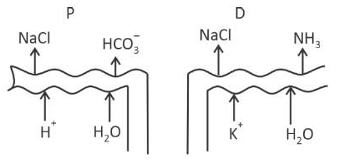
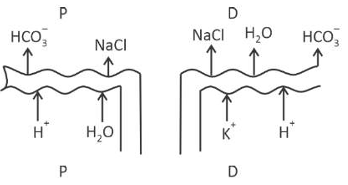
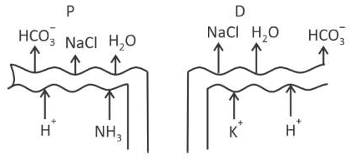
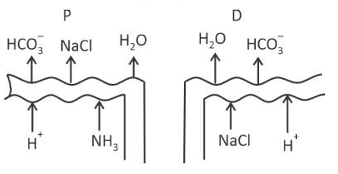
Which of the following diagrams is correct withregard to the proximal (P) and distal (D) tubule of the Nephron.
(1).
(2).
(3).
(4).

Year: 2024
Topic: Excretory Products and their Elimination
3.
Given below are two statements:
Statement I : In the nephron , the descending limb of loop of Henle is impermeable to water and permeable to electrolytes
Statement II : The proximal convoluted tubule is lined by simple columnar brush border epithelium and increases the surface area for reabsorption .
In the light of the above statements , choose the correct answer from the options given below :
(1).
Statement I is true but Statement II is false .
(2).
Statement I is false but Statement II is true .
(3).
Both Statement I and Statement II are true .
(4).
Both Statement I and Statement II are false .

Year: 2023
Topic: Excretory Products and their Elimination
4.
Given below are two statements : one is labelled as Assertion A and the other is labelled as Reason R
Assertion A: Nephrons are of two types: Cortical & Juxta medullary, based on their relative position in cortex and medulla.
Reason R: Juxta medullary nephrons have short loop of Henle. Whereas, cortical nephrons have longer loop of Henle.
In the light of the above statements, choose the correct answer from the options given below:
(1).
Both A and R are true but R is NOT the correct explanation of A.
(2).
A is true but R is false. .
(3).
A is false but R is true.
(4).
Both A and R are true and R is the correct explanation of A

Year: 2023
Topic: Excretory Products and their Elimination
5.
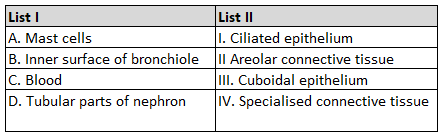
Match List I with List II.

Choose the correct answer from the options given below :
(1).
A-II, B-III, C-I, D-IV
(2).
A-II, B-I, C-IV, D-III
(3).
A-III, B-IV, C-II, D-I
(4).
A-I, B-II, C-IV, D-III

Year: 2022
Topic: Excretory Products and their Elimination
6.
Nitrogenous waste is excreted in the form of pellet or paste by:
(1).
Ornithorhynchus
(2).
Salamandra
(3).
Hippocampus
(4).
Pavo

Year: 2020
Topic: Excretory Products and their Elimination
7.
Cuboidal epithelium with brush border of microvilli is found in:
(1).
ducts of salivary glands
(2).
proximal convoluted tubule of nephron
(3).
eustachian tube
(4).
lining of intestine

Year: 2020
Topic: Excretory Products and their Elimination
8.
Which of the following would help in prevention of diuresis?
(1).
Reabsorption of Na and water from renal tubules due to aldosterone
(2).
Atrial natriuretic factor causes vasoconstriction
(3).
Decrease in secretion of renin by JG cells
(4).
More water reabsorption due to undersecretion of ADH

Year: 2019
Topic: Excretory Products and their Elimination
9.
Which of the following factors is responsible for the formation of concentrated urine ?
(1).
Maintaining hyperosmolarity towards inner medullary interstitium in the kidneys
(2).
Selection of erythropoetin by Juxtaglo-merular complex
(3).
Hydrostatic pressure during glomerular filtration
(4).
Low levels of antidiuretic hormone

Year: 2019
Topic: Excretory Products and their Elimination
10.
Use of an artificial kidney during haemodialysis may result in :
1. Nitrogenous waste build-up in the body
2. Non-elimination of excess potassium ions
3. Reduced absorption of calcium ions from gastro-intestinal tract
4. Reduced RBC production
Which of the following options is the most appropriate ?
(1).
(2) and (3) are correct
(2).
(3) and (4) are correct
(3).
(1) and (4) are correct
(4).
(1) and (2) are correct

Year: 2018
Topic: Excretory Products and their Elimination
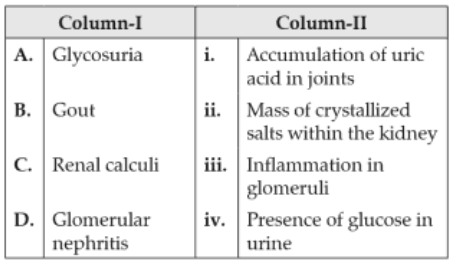
11.
Match the items given in Column I with those in Column II and select the correct option given below:
(1).
(a) - (iv), (b) - (i), (c) - (ii), (d) - (iii)
(2).
(a) - (ii), (b) - (iii), (c) - (i), (d) - (iv)
(3).
(a) - (i), (b) - (ii), (c) - (iii), (d) - (iv)
(4).
(a) - (iii), (b) - (ii), (c) - (iv), (d) - (i)

Year: 2018
Topic: Excretory Products and their Elimination
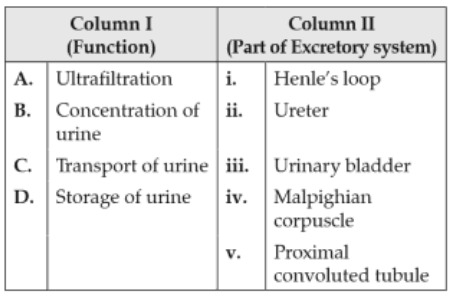
12.
Match the items given in Column I with those in Column II and select the correct option given below:
(1).
(a) - (v), (b) - (iv), (c) - (i), (d) - (iii)
(2).
(a) - (v), (b) - (iv), (c) - (i), (d) - (ii)
(3).
(a) - (iv), (b) - (i), (c) - (ii), (d) - (iii)
(4).
(a) - (iv), (b) - (v), (c) - (ii), (d) - (iii)

Year: 2017
Topic: Excretory Products and their Elimination
13.
A decrease in blood pressure/volume will not cause the release of
(1).
ADH.
(2).
renin.
(3).
atrial Natriuretic Factor.
(4).
aldosterone.

Year: 2017
Topic: Excretory Products and their Elimination
14.
Which of the following statements is correct ?
(1).
The descending limb of loop of Henle is permeable to electrolytes .
(2).
The ascending limb of loop of Henle is impermeable to water .
(3).
The descending limb of loop of Henle is impermeable to water .
(4).
The ascending limb of loop of Henle is permeable to water .

Year: 2016
Topic: Excretory Products and their Elimination
15.
In the mammals, which blood vessel would normally carry largest amount of urea ?
(1).
Dorsal Aorta
(2).
Hepatic Vein
(3).
Hepatic Portal Vein
(4).
Renal Vein