Home >> Topics >> Breathing and Exchange of Gases
Unattempted Questions
Questions Available: 20
Year: 2025
Topic: Breathing and Exchange of Gases
1.
Frogs respire in water by skin and buccal cavity and on land by skin, buccal cavity and lungs. Choose the correct answer from the following:
(1).
The statement is false for both the environment
(2).
The statement is true for water but false for land
(3).
The statement is true for both the environment
(4).
The statement is false for water but true for land

Year: 2024
Topic: Breathing and Exchange of Gases
2.
Which of the following factors are favourable for the formation of oxyhaemoglobin in alveoli?
(1).
Low pCO2, and High H+ concentration
(2).
Low pCO2, and High temperature
(3).
High pO2, and High pCO2
(4).
High pO2, and Lesser H+ concentration

Year: 2024
Topic: Breathing and Exchange of Gases
3.
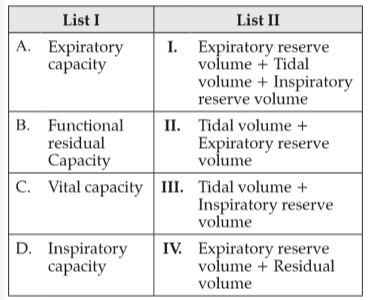
Match List I with List II:

Choose the correct answer from the options given below:
(1).
A-II, B-I, C-IV, D-III
(2).
A-I, B-III, C-II, D-IV
(3).
A-II, B-IV, C-I, D-III
(4).
A-III, B-II, C-IV, D-I

Year: 2023
Topic: Breathing and Exchange of Gases
4.
Vital capacity of lung is
(1).
IRV + ERV + TV + RV
(2).
IRV + ERV + TV- RV
(3).
IRV + ERV + TV
(4).
IRV + ERV

Year: 2022
Topic: Breathing and Exchange of Gases
5.
Which of the following is not the function of theconducting part of the respiratory system?
(1).
It clears inhaled air from foreign particles
(2).
Inhaled air is humidified
(3).
Temperature of inhaled air is brought to bodytemperature
(4).
Provides surface for diffusion of O2 and CO2

Year: 2022
Topic: Breathing and Exchange of Gases
6.
Under normal physical conditions in human beings every 100 ml oxygenated blood can deliver ______ ml of O2 to the tissues.
(1).
2 ml
(2).
5 ml
(3).
4 ml
(4).
10 ml

Year: 2021
Topic: Breathing and Exchange of Gases
7.
The partial pressures (in mmHg) of oxygen (O2) and carbon dioxide (CO2) at alveoli (the site of diffusion) are:
(1).
pO2 =104 and pCO2 = 40
(2).
pO2= 40 and pCO2=45
(3).
pO2 = 95 and pCO2 = 40
(4).
pO2 = 159 and pCO2= 0.3

Year: 2021
Topic: Breathing and Exchange of Gases
8.
Assertion (A): A person goes to high altitude and experiences 'altitude sickness' with symptoms like breathing difficulty and heart palpitations.
Reason (R): Due to low atmospheric pressure at high altitude, the body does not get sufficient Oxygen.
In the light of the above statements, choose the correct answer from the options given below.
(1).
Both (A) and (R) are true and (R) is the correct explanation of (A)
(2).
Both (A) and (R) are true but (R) is not the correct explanation of (A)
(3).
(A) is true but (R) is false
(4).
(A) is false but (R) is true

Year: 2021
Topic: Breathing and Exchange of Gases
9.
Select the favourable conditions required for the formation of oxyhaemoglobin at the alveoli.
(1).
High pO2 , low pCO2, less H+, lower temperature
(2).
Low pO2, high pCO2, more H+, higher temperature
(3).
High pO2, high pCO2, less H+, higher temperature
(4).
Low pO2, low pCO2, more H+, higher temperature

Year: 2020
Topic: Breathing and Exchange of Gases
10.
ldentify the wrong statement with reference to transport of oxygen.
(1).
Partial pressure of CO2 can interfere with O2 binding with haemoglobin
(2).
Higher H+ conc. in alveoli favours the formation of oxyhaemoglobin
(3).
Low pCO2 in alveoli favours the formation of Oxyhaemoglobin
(4).
Binding of oxygen with haemoglobin is mainly related to partial pressure of O2

Year: 2020
Topic: Breathing and Exchange of Gases
11.
Select the correct events that occur during inspiration.
(a) Contraction of diaphragm
(b) Contraction of external inter-costal muscles
(c) Pulmonary volume decreases
(d) Intra pulmonary pressure increases
(1).
(c) and (d)
(2).
(a), (b) and (d)
(3).
only (d)
(4).
(a) and (b)

Year: 2019
Topic: Breathing and Exchange of Gases
12.
Tidal Volume and Expiratory Reserve Volume of an athlete is 500 mL and 1000 mL respectively. What will be his Expiratory Capacity if the Residual Volume is 1200 mL ?
(1).
1700 mL
(2).
2200 mL
(3).
2700 mL
(4).
1500 mL

Year: 2019
Topic: Breathing and Exchange of Gases
13.
Due to increasing air-borne allergens and pollutants, many people in urban areas are suffering from respiratory disorder causing wheezing due to
(1).
inflammation of bronchi and bronchioles.
(2).
proliferation of fibrous tissues and damage of the alveolar walls.
(3).
reduction in the secretion of surfactants by pneumocytes.
(4).
benign growth on mucous lining of nasal cavity.

Year: 2018
Topic: Breathing and Exchange of Gases
14.
Which of the following is an occupational respiratory disorder?
(1).
Emphysema
(2).
Botulism
(3).
Silicosis
(4).
Anthracis

Year: 2018
Topic: Breathing and Exchange of Gases
15.
Which of the following options correctly represents the lung conditions in asthma and emphysema, respectively ?
(1).
Decreased respiratory surface; Inflammation of bronchioles
(2).
Increased respiratory surface; Inflammation of bronchioles
(3).
Increased number of bronchioles; Increased respiratory surface
(4).
Inflammation of bronchioles; Decreased respiratory surface

Year: 2018
Topic: Breathing and Exchange of Gases
16.
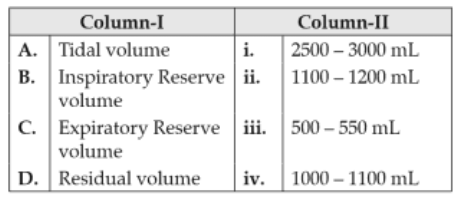
Match the items given in Column I with those in Column II and select the correct option given below :
(1).
(a) - (iv), (b) - (iii), (c) - (ii), (d) - (i)
(2).
(a) - (i), (b) - (iv), (c) - (ii), (d) - (iii)
(3).
(a) - (iii), (b) - (i), (c) - (iv), (d) - (ii)
(4).
(a) - (iii), (b) - (ii), (c) - (i), (d) - (iv)

Year: 2017
Topic: Breathing and Exchange of Gases
17.
Lungs are made up of air-filled sacs, the alveoli. They do not collapse even after forceful expiration, because of
(1).
Expiratory Reserve Volume.
(2).
Residual Volume.
(3).
Inspiratory Reserve Volume.
(4).
Tidal Volume.

Year: 2016
Topic: Breathing and Exchange of Gases
18.
Reduction in pH of blood will
(1).
reduce the blood supply to the brain
(2).
decrease the affinity of hemoglobin with oxygen
(3).
release bicarbonate ions by the liver
(4).
reduce the rate of heart beat.

Year: 2016
Topic: Breathing and Exchange of Gases
19.
Asthma may be attributed to
(1).
allergic reaction of most of the cells in the lungs
(2).
inflammation of the trachea
(3).
accumulation of fluid in the lungs
(4).
bacterial infection of the lungs

Year: 2016
Topic: Breathing and Exchange of Gases
20.
Name the chronic respiratory disorder caused mainly by cigarette smoking
(1).
asthma
(2).
respiratory acidosis
(3).
respiratory alkalosis
(4).
emphysema