Home >> Topics >> Structural Organisation in Animals
Unattempted Questions
Questions Available: 19
Year: 2022
Topic: Structural Organisation in Animals
1.
Which of the following is not a connective tissue?
(1).
Blood
(2).
Adipose tissue
(3).
Cartilage
(4).
Neuroglia

Year: 2025
Topic: Structural Organisation in Animals
2.
What is the name of the blood vessel that carries deoxygenated blood from the body to the heart in a frog ?
(1).
Vena cava
(2).
Aorta
(3).
Pulmonary artery
(4).
Pulmonary vein

Year: 2025
Topic: Structural Organisation in Animals
3.
In frog, the Renal portal system is a special venous connection that acts to link :
(1).
Kidney and lower part of body
(2).
Liver and intestine
(3).
Liver and kidney
(4).
Kidney and intestine

Year: 2025
Topic: Structural Organisation in Animals
4.
Which of the following statement is correct about location of the male frog copulatory pad ?
(1).
First digit of the fore limb
(2).
First and Second digit of fore limb
(3).
First digit of hind limb
(4).
Second digit of fore limb

Year: 2024
Topic: Structural Organisation in Animals
5.
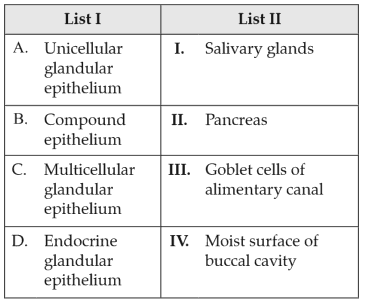
Match List I with List II:

Choose the correct answer from the options given below:
(1).
A-III, B-IV, C-I, D-II
(2).
A-II, B-I, C-IV, D-III
(3).
A-II, B-I, C-III, D-IV
(4).
A-IV, B-III, C-I, D-II

Year: 2024
Topic: Structural Organisation in Animals
6.
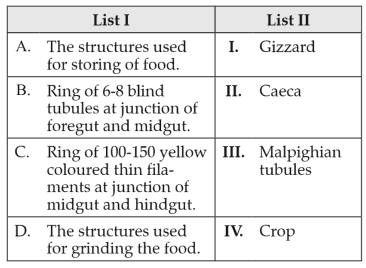
Match List I with List II:

Choose the correct answer from the options given below:
(1).
A-IV, B-III, C-II, D-I
(2).
A-III, B-II, C-IV, D-I
(3).
A-IV, B-II, C-III, D-I
(4).
A-I, B-II, C-III, D-IV

Year: 2022
Topic: Structural Organisation in Animals
7.
In which of the following animals, does the digestive tract have additional chambers like crop and gizzard?
(1).
Corvus, Columba, Chameleon
(2).
Bufo, Balaenoptera, Bangarus
(3).
Catla, Columbia, Crocodilus
(4).
Pavo, Psittacula, Corvus

Year: 2022
Topic: Structural Organisation in Animals
8.
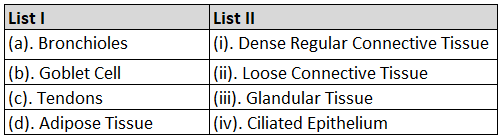
Match list I with list II.

Choose the correct answer fromn the options given below:
(1).
(a)- (iv): (b) - (iii); (c)-(); (d) - (ii)aiE
(2).
(a)- (i); (b) - (ii); (c) - (ii); (d) - (iv)
(3).
(a)- (i); (b) - (i); (c)- (iv); (d) - (iii)
(4).
(a)- (iii); (b) - (iv); (c) - (ii); (d) - (i)

Year: 2021
Topic: Structural Organisation in Animals
9.
Following are the statements about prostomium of earthworm.
(a) It serves as a covering for the mouth.
(b) It helps to open cracks in the soil into which it can crawl.
(c) It is one of the sensory structures.
(d) It is the first body segment.
Choose the correct answer from the options given below.
(1).
(a), (b) and (c) are correct
(2).
(a), (b) and (d) are correct
(3).
(a), (b), (c) and (d) are correct
(4).
(b) and (c) are correct

Year: 2021
Topic: Structural Organisation in Animals
10.
Which of the following statements wrongly represents the nature of smooth muscle?
(1).
These muscle have no striations
(2).
They are involuntary muscles
(3).
Communication among the cells is performed by intercalated discs
(4).
These muscles are present in the wall of blood vessels

Year: 2021
Topic: Structural Organisation in Animals
11.
Which one of the following organisms bears hollow and pneumatic long bones?
(1).
Neophron
(2).
Hemidactylus
(3).
Macropus
(4).
Ornithorhynchus

Year: 2020
Topic: Structural Organisation in Animals
12.
If the head of cockroach is removed, it may live for few days because:
(1).
the cockroach does not have nervous system.
(2).
the head holdsa small proportion of a nervous system while the rest is situated along the ventral part of its body.
(3).
the head holdsa /3rd of a nervous system while the rest is situated along the dorsal part of its body.
(4).
the supra-oesophageal ganglia of the cockroach are situated in ventral part of abdomen.

Year: 2020
Topic: Structural Organisation in Animals
13.
Goblet cells of alimentary canal are modified from
(1).
Columnar epithelial cels
(2).
Chondrocytes
(3).
Compound epithelial cells
(4).
Squamous epithelial cells

Year: 2019
Topic: Structural Organisation in Animals
14.
Sequence of organs in the alimentary canal of cockroach starting from mouth Out of Syllabus
(1).
Pharynx → Oesophagus → Gizzard → Crop → Ileum → Colon → Rectum
(2).
Pharynx → Oesophagus → Gizzard → Ileum → Crop → Colon → Rectum
(3).
Pharynx → Oesophagus → Ileum → Crop → Gizzard → Colon → Rectum
(4).
Pharynx → Oesophagus → Crop → Gizzard → Ileum → Colon → Rectum

Year: 2019
Topic: Structural Organisation in Animals
15.
The ciliated epithelial cells are required to move particles or mucus in a specific direction. In humans, these cells are mainly present in
(1).
fallopian tubes and pancreatic duct.
(2).
eustachian and salivary duct.
(3).
bronchioles and fallopian tubes. .
(4).
bile duct and bronchioles

Year: 2018
Topic: Structural Organisation in Animals
16.
Which of the following features is used to identify a male cockroach from a female cockroach?
(1).
Presence of anal cerci
(2).
Forewings with darker tegmina
(3).
Presence of caudal styles
(4).
Presence of a boat shaped sternum on the 9th abdominal segment

Year: 2017
Topic: Structural Organisation in Animals
17.
Which cells of 'Crypts of Lieberkuhn' secrete antibacterial lysozyme ?
(1).
Kupffer cells
(2).
Argentaffin cells
(3).
Paneth cells
(4).
Zymogen cells

Year: 2016
Topic: Structural Organisation in Animals
18.
Which of the following features is not present in Periplaneta americana ?
(1).
Indeterminate and radial cleavage during embryonic development
(2).
Exoskeleton composed of N-acetylglucosamine
(3).
Metamerically segmented body
(4).
Schizocoelom as body cavity

Year: 2016
Topic: Structural Organisation in Animals
19.
Which type of tissue correctly matches with its location ?
(1).
Areolar tissue - Tendons
(2).
Transitional - Tip of nose epithelium
(3).
Cuboidal epithelium - Lining of stomach
(4).
Smooth muscle - Wall of intestine