Home >> Topics >> Anatomy of Flowering Plants
Unattempted Questions
Questions Available: 21
Year: 2024
Topic: Anatomy of Flowering Plants
1.
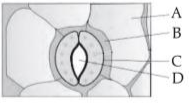
In the given figure, which component has thin outer walls and highly thickened inner walls?
(1).
A
(2).
B
(3).
C
(4).
D

Year: 2018
Topic: Anatomy of Flowering Plants
2.
Plants having little or no secondary growth are
(1).
cycads.
(2).
conifers.
(3).
deciduous angiosperms.
(4).
grasses.

Year: 2025
Topic: Anatomy of Flowering Plants
3.
Find the statement that is NOT correct with regard to the structure of monocot stem.
(1).
Phloem parenchyma is absent.
(2).
Hypodermis is parenchymatous.
(3).
Vascular bundles are scattered.
(4).
Vascular bundles are conjoint and closed.

Year: 2024
Topic: Anatomy of Flowering Plants
4.
Bulliform cells are responsible for-
(1).
Increased photosynthesis in monocots
(2).
Providing large spaces for storage of sugars
(3).
Inward curling of leaves in monocots
(4).
Protecting the plant from salt stress

Year: 2024
Topic: Anatomy of Flowering Plants
5.
Formation of interfascicular cambium from fully developed parenchyma cells is an example for
(1).
Dedifferentiation
(2).
Maturation
(3).
Differentiation
(4).
Redifferentiation

Year: 2023
Topic: Anatomy of Flowering Plants
6.
Given below are two statements: One is labelled as Assertion A and the other is labelled as Reason R:
Assertion A : Late wood has fewer xylary elements with narrow vessels.
Reason R: Cambium is less active in winters.
In the light of the above statements, choose the correct answer from the options given below:
(1).
Both A and R are true but R is NOT the correct explanation of A.
(2).
A is true but R is false.
(3).
A is false but R is true.
(4).
Both A and R are true and R is the correct explanation of A.

Year: 2023
Topic: Anatomy of Flowering Plants
7.
Cellulose does not form blue colour with lodine because:
(1).
It is a helical molecule.
(2).
It does not contain complex helices and hence can not hold iodine molecules.
(3).
It breakes down when iodine reacts with it.
(4).
It is a disaccharide.

Year: 2021
Topic: Anatomy of Flowering Plants
8.
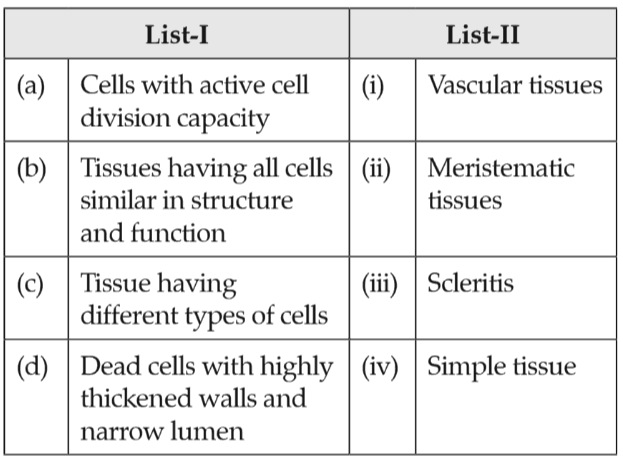
Match List -I with List -II

Select the correct answer from the options given below.
(1).
(a) - (ii), (b) - (iv), (c) - (i), (d) - (iii)
(2).
(a) - (iv), (b) - (iii), (c) - (ii), (d) - (i)
(3).
(a) - (i), (b) - (ii), (c) - (iii), (d)- (iv)
(4).
(a) - (iii), (b) - (ii), (c) -(iv), (d) - (i)

Year: 2021
Topic: Anatomy of Flowering Plants
9.
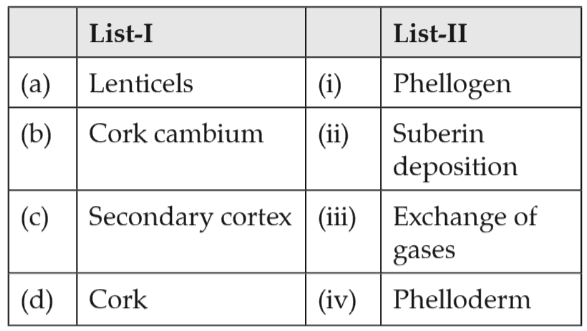
Match List - I with List - II

Choose the correct answer from the options given below.
(1).
(a) - (iv), (b) - (i), (c) - (iii), (d) - (ii)
(2).
(a) - (iii), (b) - (i), (c) - (iv), (d) - (ii)
(3).
(a) - (ii), (b) - (iii), (c) - (iv), (d) - (i)
(4).
(a) - (iv), (b) - (ii), (c) - (i), (d) - (iii)

Year: 2021
Topic: Anatomy of Flowering Plants
10.
Select the correct pair.
(1).
Large colorless empty cells in the epidermis of grass leaves - Subsidiary Cells
(2).
In dicot leaves, vascular bundles are surrounded by large thick-walled cells - Conjunctive Tissue
(3).
Cells of medullary rays that form part of cambial ring - Interfascicular cambium
(4).
Loose parenchyma cells rupturing the epidermis and forming a lens shaped opening in the bark - Spongy Parenchyma

Year: 2020
Topic: Anatomy of Flowering Plants
11.
ldentify the incorrect statement.
(1).
Sapwood is involved in conduction of water and minerals from root to leaf.
(2).
Sapwood is the innermost secondary xylem and is lighter in colour.
(3).
Due to deposition of tannins, resins, oils etc., heart wood is dark in colour.
(4).
Heart wood does not conduct water but gives mechanical support.

Year: 2020
Topic: Anatomy of Flowering Plants
12.
The transverse section of a plant shows following anatomical features:
(a) Large number of scattered vascular bundles surrounded by bundle sheath.
(b) Large conspicuous parenchymatous ground tissue.
(c) Vascular bundles conjoint and closed.
(d) Phloem parenchyma absent.
ldentify the category of plant and its part:
(1).
Monocotyledonous root
(2).
Dicotyledonous stem
(3).
Dicotyledonous root
(4).
Monocotyledonous stem

Year: 2019
Topic: Anatomy of Flowering Plants
13.
Phloem in gymnosperms lacks
(1).
sieve tubes only.
(2).
companion cells only.
(3).
both sieve tubes and companion cells.
(4).
albuminous cells and sieve cells.

Year: 2019
Topic: Anatomy of Flowering Plants
14.
Which of the statements given below is not true about formation of annual rings in trees ?
(1).
Differential activity of cambium causes light and dark bands of tissue-early and late wood respectively.
(2).
Activity of cambium depends upon variation in climate.
(3).
Annual rings are not prominent in trees of temperate region.
(4).
Annual ring is a combination of spring wood and autumn wood produced in a year.

Year: 2018
Topic: Anatomy of Flowering Plants
15.
Stomata in grass leaf are
(1).
barrel shaped.
(2).
rectangular.
(3).
kidney shaped.
(4).
dumb-bell shaped.

Year: 2018
Topic: Anatomy of Flowering Plants
16.
Secondary xylem and phloem in dicot stem are produced by
(1).
axillary meristems.
(2).
phellogen.
(3).
vascular cambium.
(4).
apical meristems.

Year: 2018
Topic: Anatomy of Flowering Plants
17.
Casparian strips occur in
(1).
endodermis.
(2).
cortex.
(3).
pericycle.
(4).
epidermis.

Year: 2017
Topic: Anatomy of Flowering Plants
18.
Which of the following is made up of dead cells ?
(1).
Phloem
(2).
Xylem parenchyma
(3).
Collenchyma
(4).
Phellem

Year: 2017
Topic: Anatomy of Flowering Plants
19.
Identify the wrong statement in context of heartwood
(1).
It comprises dead elements with highly lignified walls.
(2).
Organic compounds are deposited in it.
(3).
It is highly durable.
(4).
It conducts water and minerals efficiently.

Year: 2017
Topic: Anatomy of Flowering Plants
20.
Root hairs develop from the region of
(1).
Meristematic activity
(2).
Maturation
(3).
Elongation
(4).
Root cap

Year: 2016
Topic: Anatomy of Flowering Plants
21.
Specialised epidermal cells surrounding the guard cells are called
(1).
subsidiary cells
(2).
bulliform cells
(3).
lenticels
(4).
complementary cells