
Home >> Topics >> Electric charges and fields
Unattempted Questions
Questions Available: 8
Year: 2017
Topic: Electric charges and fields
1.
Suppose the charge of a proton and an electron differ slightly. One of them is \(−e\) and the other is \(\left(e + \Delta e\right)\). If the net of electrostatic force and gravitational force between two hydrogen atoms placed at a distance d (much greater than atomic size) apart is zero, then \(\Delta e\) is of the order [Given mass of hydrogen, \(m_h =1.67 × 10^{−27} kg\)]
Solution
Year: 2025
Topic: Electric charges and fields
2.
Two identical charged conducting spheres A and B have their centres separated by a certain distance. Charge on each sphere is q and the force of repulsion between them is F. A third identical uncharged conducting sphere is brought in contact with sphere A first and then with B and finally removed from both. New force of repulsion between spehere A and B (Radii of A and B are negligible compared to the distance of separation so that for calculating force between them they can be considered as point charges) is best given as:
Solution
Year: 2025
Topic: Electric charges and fields
3.
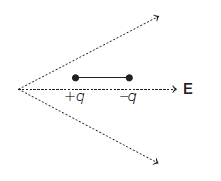
An electric dipole with dipole moment \(5 \times 10^{-4}\) Cm is aligned with the direction of a uniform electric field of magnitude \(4 \times 10^5\) N/C. The dipole is then rotated through an angle of \(60^\circ\) with respect to the electric field. The change in the potential energy of the dipole is:
Solution
Solution
Solution
Solution
Solution
Year: 2016
Topic: Electric charges and fields
8.
Two identical charged spheres suspended from a common point by two mass less strings of lengths l, are initially at a distance d (d < < l) apart because of their mutual repulsion. The charges begin to leak from both the spheres at a constant rate. As a result, the spheres approach each other witha velocity \(v\). Then, \(v\) varies as a function of the distance \(x\) between the sphere, as