
Home >> Topics >> Work, Energy, and Power
Unattempted Questions
Questions Available: 18
Solution
Year: 2022
Topic: Work, Energy, and Power
2.
An electric lift with a maximum load of 2000 kg (lift + passengers) is moving up with a constant speed of 1.5 ms−1. The frictional force opposing the motion is 3000 N . The minimum power delivered by the motor to the lift in watts is : (g = 10 ms−2)
Solution
Solution
Solution
Year: 2025
Topic: Work, Energy, and Power
5.
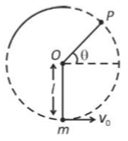
A bob of heavy mass m is suspended by a light string of length l. The bob is given a horizontal velocity \(v_0\) as shown in the figure. If the string gets slack at some point P making an angle \(\theta\) from the horizontal, the ratio of the speed v of the bob at point P to its initial speed \(v_0\) is:
Solution
Year: 2025
Topic: Work, Energy, and Power
6.
The kinetic energies of two similar cars A and B are 100J and 225 J respectively. On applying breaks, car A stops after 1000 m and car B stops after 1500 m. If \(\text{F}_\text{A}\) and \(\text{F}_\text{B}\) are the forces applied by the breaks on cars A and B, respectively, then the ratio \(\text{F}_\text{A}\,/ \,\text{F}_\text{B}\) is
Solution
Solution
Solution
Solution
Solution
Solution
Solution
Solution
Solution
Year: 2018
Topic: Work, Energy, and Power
15.
A moving block having mass m, collides with another stationary block having mass 4m. The lighter block comes to rest after collision. When the initial velocity of the lighter block is v, then the value of coefficient of restitution (e) will be
Solution
Year: 2017
Topic: Work, Energy, and Power
16.
Consider a drop of rain water having mass 1 g falling from a height of 1km. It hits the ground with a speed of 50ms−1. Take 'g' constant with a value 10ms−2.The work done by the (i) gravitational force and the (ii) resistive force of air is
Solution
Year: 2016
Topic: Work, Energy, and Power
17.
A particle of mass 10 g moves along a circle of radius 6.4 cm with a constant tangential acceleration. What is the magnitude of this acceleration if the kinetic energy of the particle becomes equal to 8 × 10⁻⁴J by the end of the second revolution after the beginning of the motion ?
Solution
Year: 2016
Topic: Work, Energy, and Power
18.
A body of mass 1 kg begins to move under the action of time dependent force \(\vec{F}\) = \(\left(2t\hat{i} + 3t^2\hat{j}\right)\) N , where \(\hat{i}\) and \(\hat{j}\) are unit vectors along x and y axis.What power will developed by the force at the time (t) ?