Home >> Topics >> Laws of motion
Unattempted Questions
Questions Available: 15
Year: 2023
Topic: Laws of motion
1.
A football player is moving southward and suddenly turns eastward with the same speed to avoid an opponent. The force that acts on the player while turning is
(1).
Along northward
(2).
Along north-east
(3).
Along south-west
(4).
Along eastward

Year: 2018
Topic: Laws of motion
2.
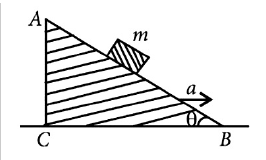
A block of mass m is placed on a smooth inclined wedge ABC of inclination θ as shown in the figure.

The wedge is given an acceleration a towards the right. The relation between a and θ for the block to remain stationary on the wedge is
(1).
\(\displaystyle a = \frac{g}{cosec \, θ}\)
(2).
\(\displaystyle a = \frac{g}{sin \, θ}\)
(3).
\(\displaystyle a = g\, cos \, θ\)
(4).
\(\displaystyle a = g\, tan \, θ\)

Year: 2017
Topic: Laws of motion
3.
One end of string of length \(l\) is connected to a particle of mass \('m'\) and the other end is connected to a small peg on a smooth horizontal table.If the particle moves in circle with speed 'V' , the net force on the particle (directed towards center) will be (T represents the tension in the string)
(1).
\(\displaystyle T\, +\, \frac{mv^2}{l}\)
(2).
\(\displaystyle T\, -\, \frac{mv^2}{l}\)
(3).
zero
(4).
\(T\)

Year: 2025
Topic: Laws of motion
4.
There are two inclined surfaces of equal length (L) and same angle of inclination \(45^\circ\) with the horizontal. One of them is rough and the other is perfectly smooth. A given body takes 2 times as much time to slide down on rough surface than on the smooth surface. The coefficient of kinetic friction (\(\mu_k\)) between the object and the rough surface is close to
(1).
0.75
(2).
0.25
(3).
0.40
(4).
0.5

Year: 2025
Topic: Laws of motion
5.
A ball of mass 0.5 kg is dropped from a height of 40 m. The ball hits the ground and rises to a height of 10 m. The impulse imparted to the ball during its collision with the ground is (Take \(g\, =\, 9.8 m/s^2\))
(1).
84 NS
(2).
21 NS
(3).
7 NS
(4).
0

Year: 2024
Topic: Laws of motion
6.
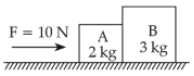
A horizontal force 10 N is applied to a block A as shown in figure. The mass of blocks A and B are 2 kg and 3 kg respectively. The blocks slide over a frictionless surface. The force exerted by block A on block B is :
(1).
Zero
(2).
4 N
(3).
6 N
(4).
10 N

Year: 2023
Topic: Laws of motion
7.
Calculate the maximum acceleration of a moving car so that a body lying on the floor of the car remains stationary. The coefficient of static friction between the body and the floor is 0.15 (g = 10 \(m s^{−2})\).
(1).
\( 150 \, m s^{−2}\)
(2).
\(1.5 \, m s^{−2}\)
(3).
\(50 \, m s^{−2}\)
(4).
\(1.2 \, m s^{−2}\)

Year: 2021
Topic: Laws of motion
8.
A ball of mass 0.15 kg is dropped from a height 10 m, strikes the ground and rebounds to the same height.The magnitude of impulse imparted to the ball is (g = 10 m/s2) nearly
(1).
0 kg m/s
(2).
4.2 kg m/s
(3).
2.1 kg m/s
(4).
1.4 kg m/s

Year: 2021
Topic: Laws of motion
9.
A particle is released from height S from the surface of the Earth. At a certain height its kinetic energy is three times its potential energy. The height from the surface of earth and the speed of the particle at thatinstant are respectively
(1).
\(\displaystyle \frac{S}{4}\), \(\displaystyle \frac{3gS}{2}\)
(2).
\(\displaystyle \frac{S}{4}\),\(\displaystyle\frac{\sqrt{3gs}}{2}\)
(3).
\(\displaystyle \frac{S}{2}\),\(\displaystyle \frac{\sqrt{3gs}}{2}\)
(4).
\( \displaystyle \frac{S}{4}\),\(\displaystyle \sqrt{\frac{3gs}{2}}\)

Year: 2020
Topic: Laws of motion
10.
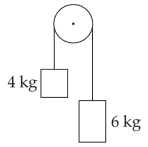
Two bodies of mass 4 kg and 6 kg are tied to the ends of a massless string. The string passes over a pulley which is frictionless (see figure). The acceleration of the system in terms of acceleration due to gravity (g) is
(1).
\(\displaystyle \frac{g}{2}\)
(2).
\(\displaystyle \frac{g}{5}\)
(3).
\(\displaystyle \frac{g}{10}\)
(4).
\(g\)

Year: 2019
Topic: Laws of motion
11.
A block of mass 10 kg is in contact against the inner wall of a hollow cylindrical drum of radius 1m. The coefficient of friction between the block and the inner wall of the cylinder is 0.1. The minimum angular velocity needed for the cylinder to keep the block stationary when the cylinder is vertical and rotating about its axis, will be \(g\, =\, 10\, m ∕ s^2\)
(1).
\(10\pi\) rad ∕ s
(2).
\(\sqrt{10}\) rad ∕ s
(3).
\(102\pi \) rad ∕ s
(4).
\(10\) rad ∕ s

Year: 2019
Topic: Laws of motion
12.
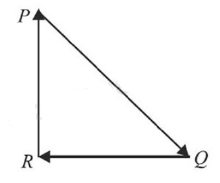
A particle moving with velocity \( \vec{v}\) is acted by three forces shown by the vector triangle PQR. The velocity of the particle will
(1).
change according to the smallest force \(\vec{QR}\)
(2).
increase
(3).
decrease
(4).
remain constant

Year: 2018
Topic: Laws of motion
13.
Which one of the following statements is incorrect?
(1).
Rolling friction is smaller than sliding friction.
(2).
Limiting value of static friction is directly proportional to normal reaction.
(3).
Frictional force opposes the relativemotion.
(4).
Coefficient of sliding friction has dimensions of length.

Year: 2017
Topic: Laws of motion
14.
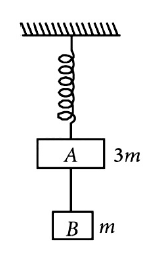
Two blocks A and B of masses 3m and m respectively are connected by a mass-less and in extensible string. The whole system is suspended by a mass-less spring as shown in figure. The magnitudes of acceleration of A and B immediately after the string is cut are, respectively
(1).
\(\displaystyle \frac{g}{3}\), \(g\)
(2).
\(g\), \(g\)
(3).
\(\displaystyle \frac{g}{3}\), \(\displaystyle \frac{g}{3}\)
(4).
\(g\), \(\displaystyle \frac{g}{3}\)

Year: 2016
Topic: Laws of motion
15.
A car is negotiating a curved road of radius R. The road is banked at anangle θ. The coefficient of friction between the tyres of the car and the road is μs. The maximum safe velocity on this road is
(1).
\(\displaystyle \sqrt{\frac{g\mu_s + tanθ}{R1 − \mu_stanθ}}\)
(2).
\(\displaystyle \sqrt{\frac{g\mu_s + tanθ}{R^21 − \mu_stanθ}}\)
(3).
\(\displaystyle \sqrt{gR^2\frac{\mu_s + tanθ}{1 − \mu_stanθ}}\)
(4).
\(\displaystyle \sqrt{gR\frac{\mu_s + tanθ}{1 − \mu_stanθ}}\)